 MineArchive
Kinglassie Colliery
| Location | Kinglassie, Fife — 56.1714, -3.2289 (approximate) |
|---|---|
| Commodity | Coal |
| Type | Coal |
| Worked | 1908–1966 |
| Operators | Fife Coal Company (1906–1947), National Coal Board (1947–1966) |
Overview
Kinglassie Colliery, sunk by the Fife Coal Company from 1906 and in production from 1908, fought a losing battle against water and faulted ground for sixty years, and lost four men to two separate roof falls a generation apart — in 1912 and 1927 — before closing in 1966.
History
The Fife Coal Company began sinking Kinglassie Pit around 1906, a process that took roughly four years and was hampered throughout by severe water inflows exceeding 3,000 gallons a minute at their worst, requiring a dedicated pumping system for the rest of the colliery's life. Production began in 1908 with just 17 men underground; a supplementary drift mine, Kinglassie Surface Mine, was added around 1932–38 with a 600-yard tunnel working the upper seams alongside the main pit. The workforce grew accordingly — over 650 by 1938, and peaking around 700–740 in the early 1960s — extracting coal from the Main Coal, Lochgelly Splint, Dunfermline Splint, Five Foot, Glassee, Mynheer and Lochgelly Parrot seams. The National Coal Board took over on nationalisation in 1947; the colliery produced 249,200 tons that year. Faulted strata increasingly cut off working sections through the early 1960s, and redundancies followed in 1963; the surface mine closed that August, reducing the workforce to around 320, and the main pit itself closed in November 1966.
Geology
Coal of the Fife field: the Main Coal, Lochgelly Splint and other seams, with a surface drift working the upper seams through a 600-yard tunnel.
Workings
The main pit was sunk from around 1906, taking roughly four years against water inflows exceeding 3,000 gallons a minute; a surface drift with a 600-yard tunnel was added around 1932-38 to work the upper seams.
Closure
The surface mine closed in August 1966, reducing the workforce to around 320, and the main pit closed that November.
What remains
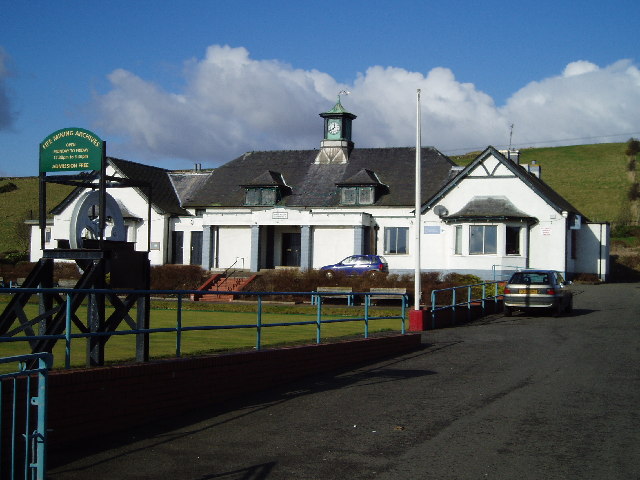
Little of the pit's physical infrastructure survives, but the inter-war miners' housing built to accommodate the workforce remains in use, along with the village's Miners' Welfare Institute (1931), still standing as a landmark of Kinglassie's mining history.
Nearby mines
- Denend Colliery — 2.2 miles (3.6 km) SW
- Bowhill Colliery — 2.3 miles (3.7 km) SW
- Westfield Opencast — 2.6 miles (4.2 km) W
- Rothes Colliery — 2.7 miles (4.4 km) E
- Minto Pit — 3.0 miles (4.8 km) SW
Straight-line distance, within 9 miles (15 km). Show on the map.
Disasters & major incidents
-
Kinglassie Colliery Roof Fall 1912
19 August 1912 · Collapse / Roof Fall · 2 fatalities
A large stone fell from the roof at Kinglassie Colliery on the night of 19 August 1912, killing William Whitton, 17, and Patrick Macauley, a married man with an infant son, and injuring two other miners. -
Kinglassie Colliery Roof Fall 1926
17 December 1926 · Collapse / Roof Fall · 2 fatalities
Thomas Gordon Whittaker and John Bennet Culbert, both miners' drawers, were killed when the roof burst in a new working's main roadway at Kinglassie Colliery; a public inquiry heard the roadway had been insufficiently supported.
Recorded claims
Individual factual claims, each attached to the source(s) that support it below. Where sources disagree, both are kept.
- Sinking Kinglassie Pit, begun around 1906, was hampered throughout by severe water inflows exceeding 3,000 gallons a minute at their worst, requiring a dedicated pumping system for the rest of the colliery's working life. 1
- The National Coal Board took over Kinglassie Colliery on nationalisation in 1947, the year it produced 249,200 tons of coal; the workforce peaked at around 700-740 in the early 1960s before faulted strata forced redundancies in 1963 and closure of the main pit in November 1966. 2
- The colliery worked the Main Coal, Lochgelly Splint, Dunfermline Splint, Five Foot, Glassee, Mynheer and Lochgelly Parrot seams; a supplementary drift mine, Kinglassie Surface Mine, was added around 1932-38 with a 600-yard tunnel working the upper seams alongside the main pit. 1
- Faulted strata increasingly cut off working sections through the early 1960s; the surface mine closed in August 1963, reducing the workforce to around 320, and the main pit itself closed in November 1966. 1
Sources
- (secondary) Kinglassie Pit — Pit K-5 — fifepits.co.uk
- (primary) Durham Mining Museum: Kinglassie Colliery (UK) — Durham Mining Museum
Record created: 27 August 2026 · Last researched: 29 August 2026