 MineArchive
Dook
| Dialect | Scottish |
|---|---|
| Category | Mine Workings & Access |
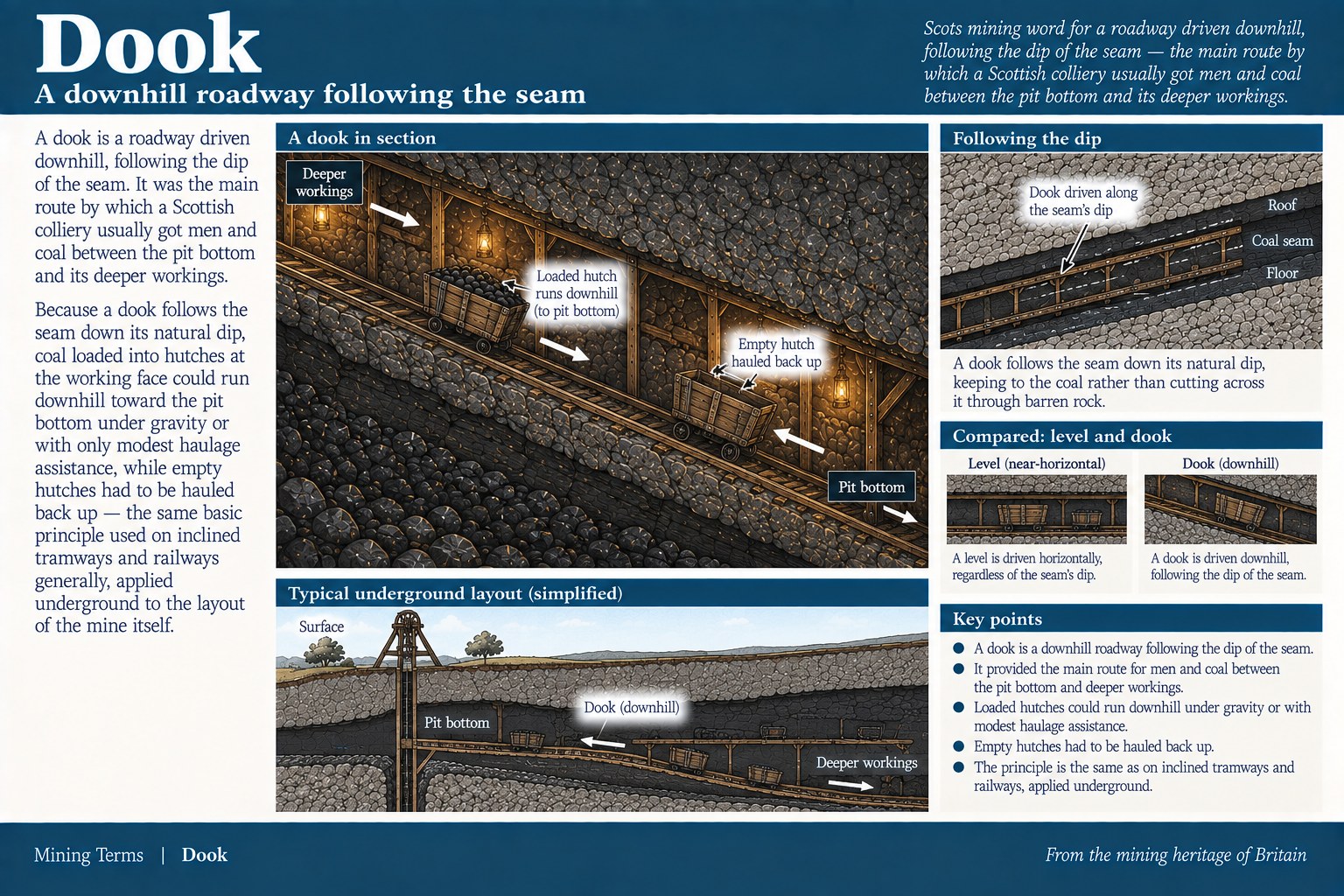
Scots mining word for a roadway driven downhill, following the dip of the seam — the main route by which a Scottish colliery usually got men and coal between the pit bottom and its deeper workings.
Historical usage
Dook is a working Scots word rather than a formal engineering term, used throughout Scottish coalfields to describe a roadway driven to follow the seam downward, in contrast to a level roadway or one driven to the rise. A colliery's main dook was often its single most important underground route, carrying the bulk of its haulage traffic; at Cadder Colliery near Glasgow, for instance, the 'Main Dook Brae' dipped for about 1,500 yards from the pit bottom. A colliery divided for working purposes might describe one half of its layout as its 'Dook Section', naming the whole district after the direction its roadways ran rather than any specific single road.
How it worked
Because a dook follows the seam down its natural dip, coal loaded into hutches at the working face could run downhill toward the pit bottom under gravity or with only modest haulage assistance, while empty hutches had to be hauled back up — the same basic principle used on inclined tramways and railways generally, applied underground to the layout of the mine itself.
Why it was used
A dook was simply the natural, most direct way to follow a dipping seam from the shaft bottom to workings that lay both deeper and further away — the alternative, following the seam at a constant level, would have meant either abandoning the deeper coal entirely or driving a second shaft to reach it.
Risks & limitations
Workings below the general level of the pit bottom — 'dook workings' — posed a particular drainage problem, since water draining naturally downhill collects exactly where the coal is being worked rather than at the shaft where it can be pumped out; dook districts therefore generally needed their own dedicated pumping arrangements.
Regional variation
Specifically Scottish usage; the equivalent English and Welsh term for a roadway following the dip is usually simply an incline or a dip heading, without the same single dedicated word.
Related terminology
Mines associated with this term
5 examples chosen from 14 linked records — the term page is not an index.
- Auchenharvie Colliery — North Ayrshire (well documented example)
The dook to the dip workings ran 750 yards south of the shaft, against rise workings 600 yards north reached by self-acting inclines the men called cousies. - Argyll Colliery, Machrihanish — Argyll and Bute (well documented example)
The Scottish term in everyday use at the colliery: the 1958 spontaneous-combustion fire broke out in the Slope Dook area, and because the dook lay higher than the working places, four seals had to be built before the area could be flooded to put it out. - Auchinreoch Colliery — East Dunbartonshire (well documented example)
Named in this record’s workings: “…was by rope-drawn rakes of hutches on inclines the returns call dooks, with manholes cut in the sides of the roadways for men to stand in…” - Auldhouseburn Colliery — East Ayrshire (well documented example)
Named in this record’s workings: “…gallons a minute. Haulage underground was by hutches in races on a dook. A siding of the mineral railway operated by William Baird and…” - Dechmont Colliery — South Lanarkshire (well documented example)
Named in this record’s workings: “…3); the Dechmont shaft was 180 fathoms deep in 1901. Hutches ran on dooks, self-acting inclines and 'cuddie braes', where a balance bogie drew…”
Disasters associated with this term
5 examples chosen from 6 linked records, most direct relationship first.
- Auchenharvie Colliery inrush, 1895 (contextual relationship)
Named 4 times in this record, first in the summary: “…No. 4 Pit and swept down the inclines to the shaft and on into the dook. Nine people drowned, four of them brothers and two of them…” - Blairmuckhill Colliery explosion, 1915 (contextual relationship)
The party entered by the dook. - Bowhill Colliery disaster, 1931 (contextual relationship)
Named twice in this record, first in the cause: “The men were repositioning a ventilation fan in the 'Hutt Dook' section of the Dunfermline Splint, five-foot seam, when firedamp…” - Glencraig Colliery explosion, 1902 (contextual relationship)
Named 6 times in this record, first in the narrative: “Peter Adamson and Andrew Marshall began work in a dook of the five-feet seam of No. 1 pit, about 250 fathoms below the…” - Herbertshire Colliery explosion, 1893 (contextual relationship)
The explosion happened in the Dook Section of the No. 3 pit, the down-dip workings that gave the district its name in Scottish pits.
Sources
- (primary) Glossary of Scotch Mining Terms — James Barrowman (1886), via Scottish Mining Website
- (secondary) Cadder Colliery Fire, Glasgow, 1913 — Northern Mine Research Society
- (secondary) Glossary of mining terms (D) — North Staffordshire Mining Group
Record created: 25 August 2026 · Last researched: 25 August 2026