 MineArchive
Cuddie Brae
| Also known as | Cuddy Brae (Scottish), Goose Brae (Scottish), Cuddie (Scottish) |
|---|---|
| Dialect | Scottish |
| Category | Mine Workings & Access |
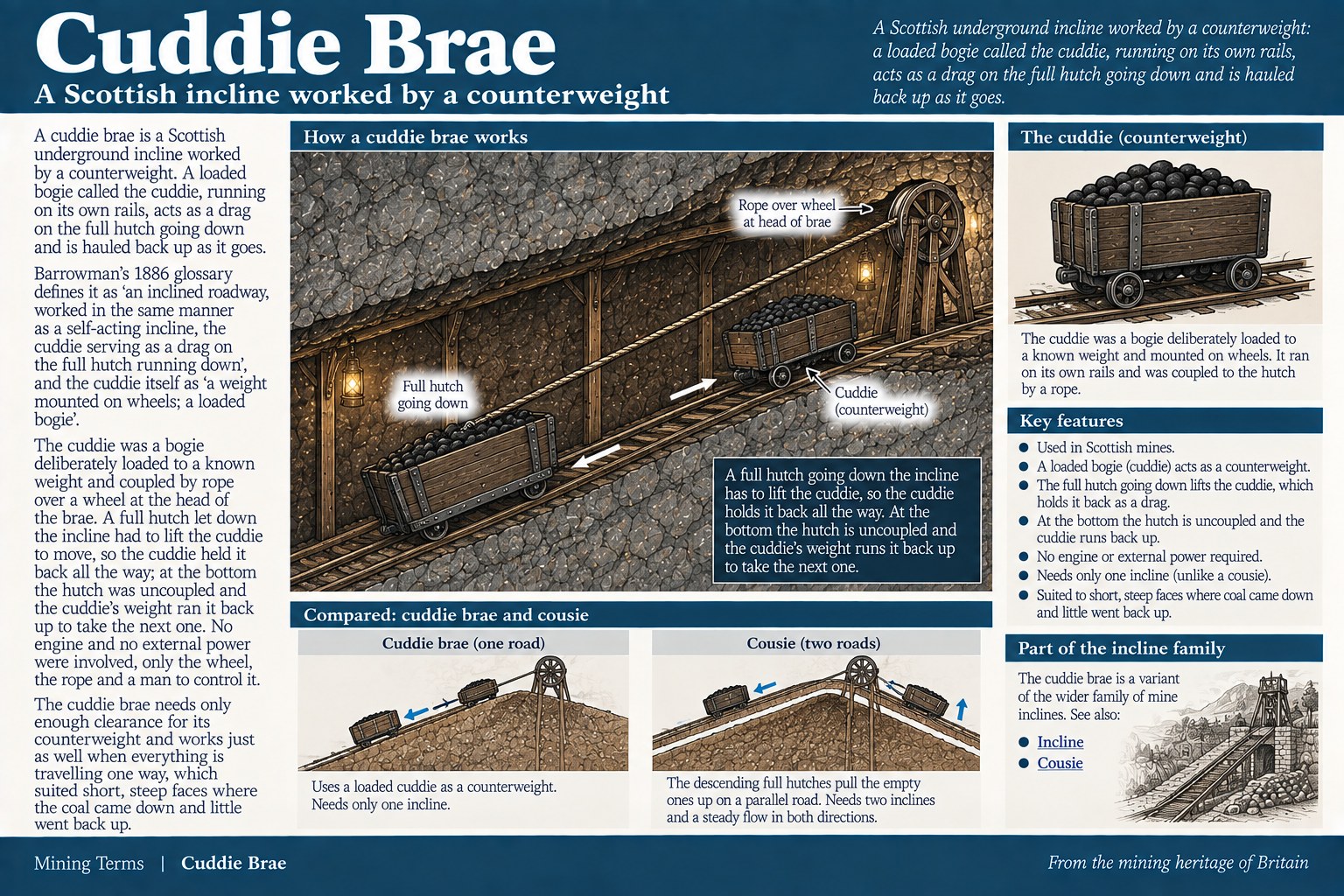
A Scottish underground incline worked by a counterweight: a loaded bogie called the cuddie, running on its own rails, acts as a drag on the full hutch going down and is hauled back up as it goes. Barrowman's 1886 glossary defines it as 'an inclined roadway, worked in the same manner as a self-acting incline, the cuddie serving as a drag on the full hutch running down', and the cuddie itself as 'a weight mounted on wheels; a loaded bogie'.
Historical usage
Brae is simply the Scots word for a slope, and Barrowman notes that in mining it was 'more commonly used in the compound form'. Scotland accordingly had a whole family of braes and named them by how they were worked: the cuddie brae by its counterweight, the cut-chain brae by the chain that could be cut in at different levels, the crane brae for a short incline in steep workings, and the cousie, pulley brae or wheel brae for a plain self-acting incline where the descending full hutches pulled the empties up. Goose brae was another word for a cuddie brae.
They were ordinary furniture in a Scottish pit rather than showpiece engineering, which is why they appear in this archive mostly in accident reports. Peter Connelly, aged twenty-eight, was killed at Riddochhill Colliery in August 1901 following a hutch of props up a short cuddie brae when the rope broke and the hutch forced him back against a tree; the rope was good steel wire of ample strength and why it parted was never established. Thomas Curran, a roadsman of fifty-four, was killed on the same colliery's cousie brae in April 1910, stepping into the rails as an empty hutch ran away from the top.
How it worked
The cuddie was a bogie deliberately loaded to a known weight and coupled by rope over a wheel at the head of the brae. A full hutch let down the incline had to lift the cuddie to move, so the cuddie held it back all the way; at the bottom the hutch was uncoupled and the cuddie's weight ran it back up to take the next one. No engine and no external power were involved, only the wheel, the rope and a man to control it.
That is a different arrangement from a plain self-acting incline, where the load itself does the balancing: on a cousie the descending full hutches pull the empty ones up on a parallel road, needing two roads and a steady traffic in both directions. The cuddie brae needs only enough clearance for its counterweight and works just as well when everything is travelling one way, which suited short, steep faces where the coal came down and little went back up. Both belong to the wider family covered by this archive's Incline record; the cuddie brae is the Scottish variant with the counterweight.
Why it was used
Because gravity was free and steam was not. A brae cost a wheel, a rope and a loaded bogie, and it moved coal down a steep road all shift without fuel, boiler or enginemen. Where a face haulage had to be put in cheaply and quickly and would be abandoned as the workings moved on, a cuddie brae was the obvious answer, and Scottish collieries went on using them into the twentieth century alongside powered haulage.
Risks & limitations
A brae was a rope, a gradient and men walking beside moving hutches, and it killed people regularly. The rope could part, as it did at Riddochhill in 1901, and there was nothing between a man and the load coming back at him. A hutch could run away from the top, as one did in 1910. Riding a brae was worse than walking it: John Garvock, twenty-seven, died at Riddochhill in 1924 after accompanying a loaded hutch up a haulage dook of about one in three and being caught between the top of the hutch and a girder over the road. Clearances were the recurring problem, and the mechanism itself was limited — a cuddie brae could only be as long as its counterweight run and could not work a road that was anything but steep.
Regional variation
Scottish, and specifically so: the counterweight sense of cuddie belongs to Scottish pits, where the everyday meaning of the word is a donkey. The general British term for the wider class is a self-acting or gravity incline. Barrowman's synonyms for a plain self-acting incline — cousie, pronounced cowssie, with its cousie wheel; pulley brae; wheel brae — and his cut-chain brae and crane brae are all recorded there, and this archive's own records carry the ordinary form: Canonbie Colliery's 1922 accident to Samuel Lindsay describes a self-acting brae of one in four and a half with cut-rope haulage serving four benches.
Related terminology
Mines associated with this term
Included only where MineArchive's own research gives a reasonable evidential basis — not every mine where this might plausibly apply.
- Riddochhill Colliery — West Lothian (notable incident)
A short cuddie brae here killed Peter Connelly in August 1901 when the haulage rope broke and the loaded hutch forced him backwards against a tree; the rope was sound steel wire and the cause of the fracture was never established. - Darngavil Colliery — North Lanarkshire (well documented example)
Named in this record’s history: “…a stone fell on a miner hauling a hutch up the incline called the Cuddy Brae in the Ladygrange seam of No. 4 pit. On 18 August 1920 surface…” - Dechmont Colliery — South Lanarkshire (well documented example)
Named in this record’s workings: “…deep in 1901. Hutches ran on dooks, self-acting inclines and 'cuddie braes', where a balance bogie drew them up. Coal-cutting machines were…” - Foulshiels Colliery — West Lothian (well documented example)
Named in this record’s history: “…Mining Museum: a drawer of fifteen caught by a loaded train on a cuddie brae in 1910, and a miner under a slab of roof between two lypes in 1924.…” - Whistleberry Colliery — South Lanarkshire (well documented example)
Named twice in this record, first in the history: “…the props holding up the head coal. In 1903 a miner at the top of a cuddie brae, putting a loaded hutch back on the rails without hooking it to the…”
Sources
- (primary) Glossary of Scotch Mining Terms — James Barrowman (1886), via Scottish Mining Website
- (secondary) Cousie brae — Scottish Shale glossary — Scottish Shale
Record created: 10 September 2026 · Last researched: 10 September 2026