 MineArchive
Roadman
| Also known as | Road Repairer, Roadsman, Road Fettler (Yorkshire) |
|---|---|
| Category | Labour & Roles |
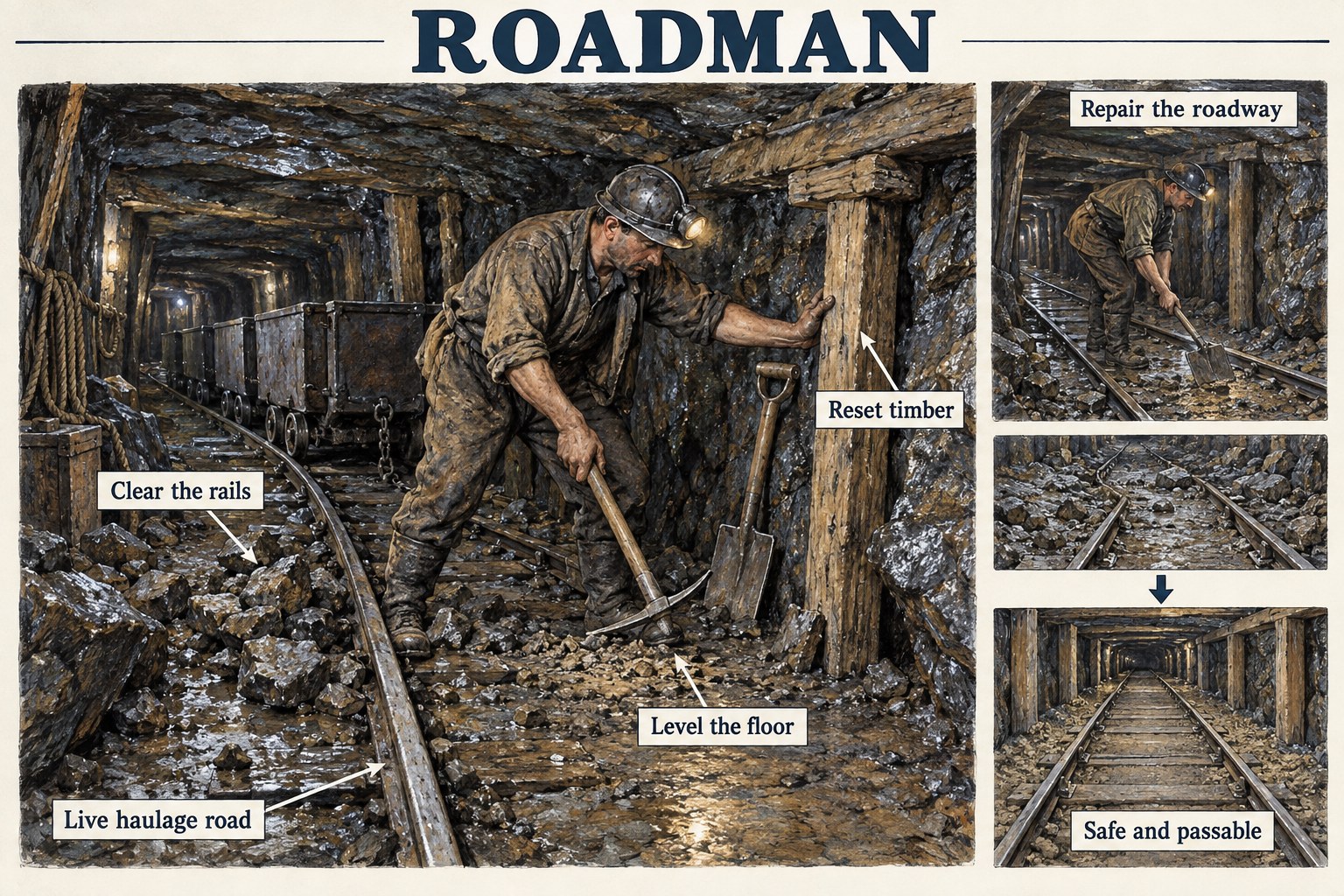
A worker whose job was to keep a mine's underground roadways -- the passages along which coal, ore, men and materials travelled -- in safe repair: levelling the floor, resetting timber, and clearing obstructions.
Historical usage
Roadman is one of a family of names for the same work rather than a single fixed grade. Healey Hero's pit terminology and the Scottish Mining Website both give roadsman as a mine official responsible for the making and maintenance of haulage roads, which puts the job a step above a labourer in some pits; elsewhere it is plainly a working job on the tools. The North East glossaries list the neighbouring trades that divide the same ground between them — the wasteman, who looked to the abandoned workings and their air, the brusher, who took down roof or lifted floor to heighten a roadway, and the repairer or timberer, who reset supports. The Coal Mines Acts of the later 19th century, by requiring travelling roads to be kept safe and passable, made the work a statutory duty rather than a matter for the manager's discretion, and it is in the returns and inspectors' reports of that period that the job title appears most often.
How it worked
A roadman levelled roadways with a pick and shovel, repaired broken timber and set any necessary light timber a single man could handle, raised the floor where it had dropped below the rails, and generally kept the road between the shaft and the working faces flat, trim and passable. Specialist variants existed for particular sections of road: an engine roadman kept rails and points clear specifically where haulage engines ran, while an incline keeper or plane cleaner did the same work on an inclined roadway.
Why it was used
A mine's roadways had to carry continuous traffic -- trams, cages, haulage ropes, men on foot -- and were under constant pressure from the surrounding ground; without dedicated repair work they would narrow, flood or collapse, cutting off the working faces they served.
Risks & limitations
Roadmen worked alone or in pairs, in ground that was already known to be moving — a road needs repair because the floor is lifting, the roof is settling or the timber has broken, so the repairer's working place is by definition the least stable part of the mine. They worked in and beside live haulage, among ropes under tension and runs of loaded tubs, often in the dark between the lit working places, and frequently on the back shift when there were fewest men about to hear an accident. Fatality lists show them killed by falls of roof while setting the timber meant to hold it up, and by the haulage they were clearing.
Regional variation
Roadsman is the commoner spelling in Scotland and in the rescue-service glossaries; roadman, road-layer and repairer appear in English coalfields, and the North East divides the work further between the brusher, the wasteman and the timberer. In metal mines, where levels were narrower and traffic lighter, the same maintenance usually fell to the miners working the level rather than to a dedicated grade.
Related terminology
Mines associated with this term
5 examples chosen from 10 linked records — the term page is not an index.
- Creggan Silver-Lead Mines — County Armagh (well documented example)
Named in this record’s history: “…mineworker Terence McParland, credits the actual discovery to a roadman named Murphy, who mentioned the presence of lead at Creggan to…” - Cronberry Moor Colliery — East Ayrshire (well documented example)
Named in this record’s history: “…in the parish of Auchinleck, by the 1870s: the inspectors recorded a roadsman killed by a roof fall in 1875, a drawer of fifteen in 1882, and in…” - Earnock Colliery — South Lanarkshire (well documented example)
Named twice in this record, first in the history: “…direction by, among others, Earnock's own oversman M'Bride and its roadsman Daniel M'Phail. M'Phail went down with the first party and found a…” - Elgin and Wellwood Colliery — Fife (well documented example)
Named in this record’s history: “…third died days later; the underground manager Francis Danks and the roadsman William Erskine Ramage were tried for culpable homicide and…” - Gardrum Colliery — Falkirk (well documented example)
Named in this record’s history: “…was killed by a falling stone at a facing in No. 4 pit and the roadman Gilbert Stewart died after coal fell on him in No. 2 pit, leaving a…”
Disasters associated with this term
5 examples chosen from 11 linked records, most direct relationship first.
- Caprington Colliery Inrush (contextual relationship)
Named in this record’s rescue and recovery: “James McSherry, a 23-year-old miner who had once worked as a roadsman, climbed the back air-course known as the chute towards the Ell…” - Elgin Colliery Balmule Pit accident, 1859 (contextual relationship)
Named twice in this record, first in the summary: “…once and a third days later. The underground manager and the pit's roadsman were tried for culpable homicide and acquitted.” - Gartshore Colliery explosion, 1923 (contextual relationship)
Named in this record’s narrative: “…Alexander Paterson (47, fireman, married), John Patrick (31, roadman, married) and George Young (18, apprentice bricklayer, single), who…” - Govan Colliery powder explosion, 1862 (contextual relationship)
Named 3 times in this record, first in the summary: “…No. 2 pit, Glasgow, exploded on 6 February 1862, apparently when a roadsman took a naked light in to help himself, killing two men.” - Kay's Slope roof fall, 1892 (contextual relationship)
Named in this record’s narrative: “…About a quarter of a mile from the mouth he stopped to talk to the roadman William Rogers, 53, while the son walked on. Moments later the roof…”
Sources
- (primary) 044.—Persons Making and Repairing Roads (A Dictionary of Occupational Terms, 1921 Census) — A Dictionary of Occupational Terms (1921 Census classification)
- (secondary) A Glossary of Mining Terms — Coal Mining History Resource Centre
- (secondary) Mining Terms — Scottish Mining Website
- (secondary) Old Coal Pit Explosion - Coalbrookdale - 1856 — Northern Mine Research Society
- (secondary) Pit Terminology — Healey Hero
Record created: 31 August 2026 · Last researched: 11 September 2026