 MineArchive
Bowhill Colliery disaster, 1931
A firedamp explosion and the afterdamp that followed it killed ten men working in the Dunfermline Splint seam at Bowhill Colliery, Cardenden, on 31 October 1931 — one of the worst disasters in the history of the Fife coalfield.
| Date | 31 October 1931 |
|---|---|
| Mine | Bowhill Colliery |
| Region | Fife |
| Primary type | Explosion |
| Associated types | Rescue |
| Fatalities | 10 (All ten victims died from a combination of burns and carbon monoxide poisoning (afterdamp) following an explosion of firedamp; the youngest was 19, the oldest 50, and two of the dead, Andrew and Thomas Smith, were brothers.) |
| Context | During active mining |
Cause
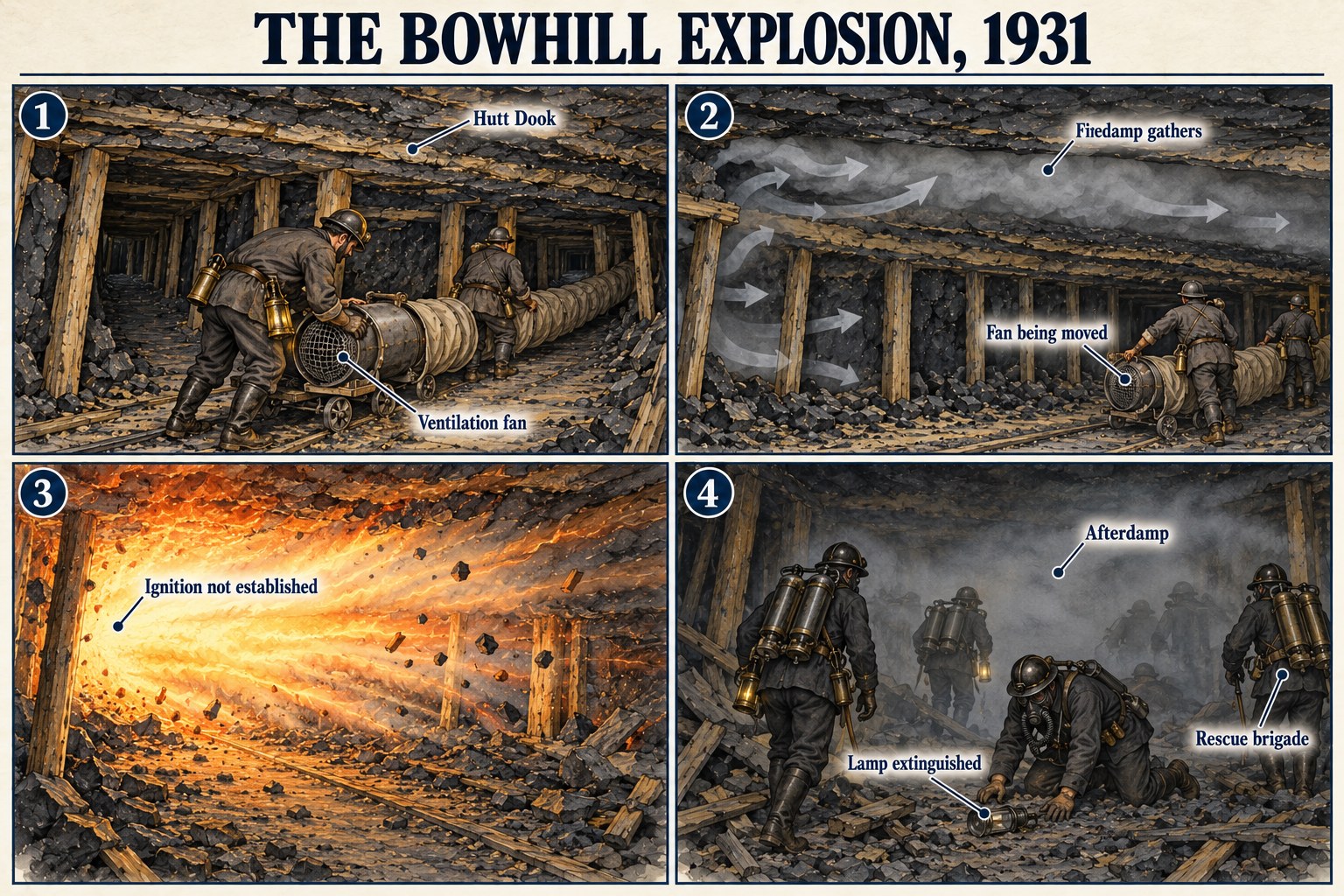
The men were repositioning a ventilation fan in the 'Hutt Dook' section of the Dunfermline Splint, five-foot seam, when firedamp ignited. The inquiry jury found the deaths were due to an ignition and explosion of firedamp but was unable to establish what had actually ignited it.
Contributing factors
No specific contributing factor beyond the ignition itself was established; the inquiry jury explicitly reported it could not assign a cause to the firedamp's ignition.
What happened
On the morning of 31 October 1931, men employed repositioning a ventilation fan in the Hutt Dook section of Bowhill's No. 2 Pit were killed when firedamp ignited, some between 11am and noon. It was not until 1.10pm that word reached the surface. Overman James Clark, working roughly 1,000 yards away in another section, heard a rumble and felt a rush of air; on investigating, he found the first of the dead. The ten men killed were John Donaldson (49, oversman), James Anderson (46, fireman), Alexander Dempster (50, fireman), brothers Andrew (28) and Thomas Smith (33), James Smith (34), James Paterson (19), Charles Fernie (20), William Dodds (24, an electrical apprentice) and William Ireland (35, oversman).
Rescue & recovery
James Clark crawled without a lamp along the coal face toward a glimmer of light and found a man still breathing, but could not move him alone and went back for help; returning with a safety lamp, he crawled back along the face until the lamp itself filled with firedamp and was extinguished, forcing him to abandon the attempt. Rescue and ambulance brigades from neighbouring collieries volunteered their services, but noxious gas hampered every attempt; although the bodies were located almost immediately, working parties did not reach the site until 7am the following morning, Sunday 1 November.
Investigation & inquiry
An inquiry was held at Dunfermline, concluding on 26 January 1932 before Deputy Sheriff Umpherston and a jury that included three women. The jury found the deaths were caused by an ignition and explosion of firedamp but could not establish what had ignited it, and singled out James Clark's rescue attempt for particular praise.
Changes to practice & legislation
The inquiry jury recommended that the section where the explosion occurred be fitted with an auxiliary fan kept in constant operation, that all electrical apparatus in the section be built and maintained flameproof, and that miners' electric lamps be encased in laminated triplex glass.
Related terminology
Mining terms this disaster is structurally linked to, with the nature of the relationship.
- Afterdamp (contextual relationship)
Named in this record’s summary: “A firedamp explosion and the afterdamp that followed it killed ten men working in the Dunfermline Splint…” - Dook (contextual relationship)
Named twice in this record, first in the cause: “The men were repositioning a ventilation fan in the 'Hutt Dook' section of the Dunfermline Splint, five-foot seam, when firedamp…” - Firedamp (contextual relationship)
Named 7 times in this record, first in the summary: “A firedamp explosion and the afterdamp that followed it killed ten men working…” - Fireman (contextual relationship)
Named twice in this record, first in the narrative: “…men killed were John Donaldson (49, oversman), James Anderson (46, fireman), Alexander Dempster (50, fireman), brothers Andrew (28) and Thomas…” - Overman (contextual relationship)
Named in this record’s narrative: “…and noon. It was not until 1.10pm that word reached the surface. Overman James Clark, working roughly 1,000 yards away in another section,…”
Sources
- (secondary) Bowhill Colliery Explosion - Cardenden - 1931 — Northern Mine Research Society
- (secondary) Bowhill Disaster - 31st October 1931 — Scottish Mining Website
Record created: 28 August 2026 · Last researched: 28 August 2026