 MineArchive
Auchenharvie Colliery inrush, 1895
At about three in the afternoon on 2 August 1895, water burst out of old workings into the rise of Auchenharvie's No. 4 Pit and swept down the inclines to the shaft and on into the dook. Nine people drowned, four of them brothers and two of them children. Five more were entombed behind a blockage and dug out alive two days later.
| Date | 2 August 1895 |
|---|---|
| Mine | Auchenharvie Colliery |
| Region | North Ayrshire |
| Primary type | Flooding / Inundation |
| Associated types | Entrapment, Rescue |
| Fatalities | 9 (Duncan Gallacher (30, married), John Glauchan (30, married), William Glauchan (28, married), James Glauchan (22, married), Henry Glauchan (19) — four brothers and their brother-in-law — with Robert Conn or McConn (17), James Mullen (19) and his brother Peter Mullen (12 years 8 months), and John Magee or McGhee (13).) |
| Injuries | Five men were entombed by the blockage on the incline and were released alive at about one o'clock on 4 August. |
| Context | During active mining (An afternoon irruption of water from abandoned workings beyond the colliery boundary.) |
Cause
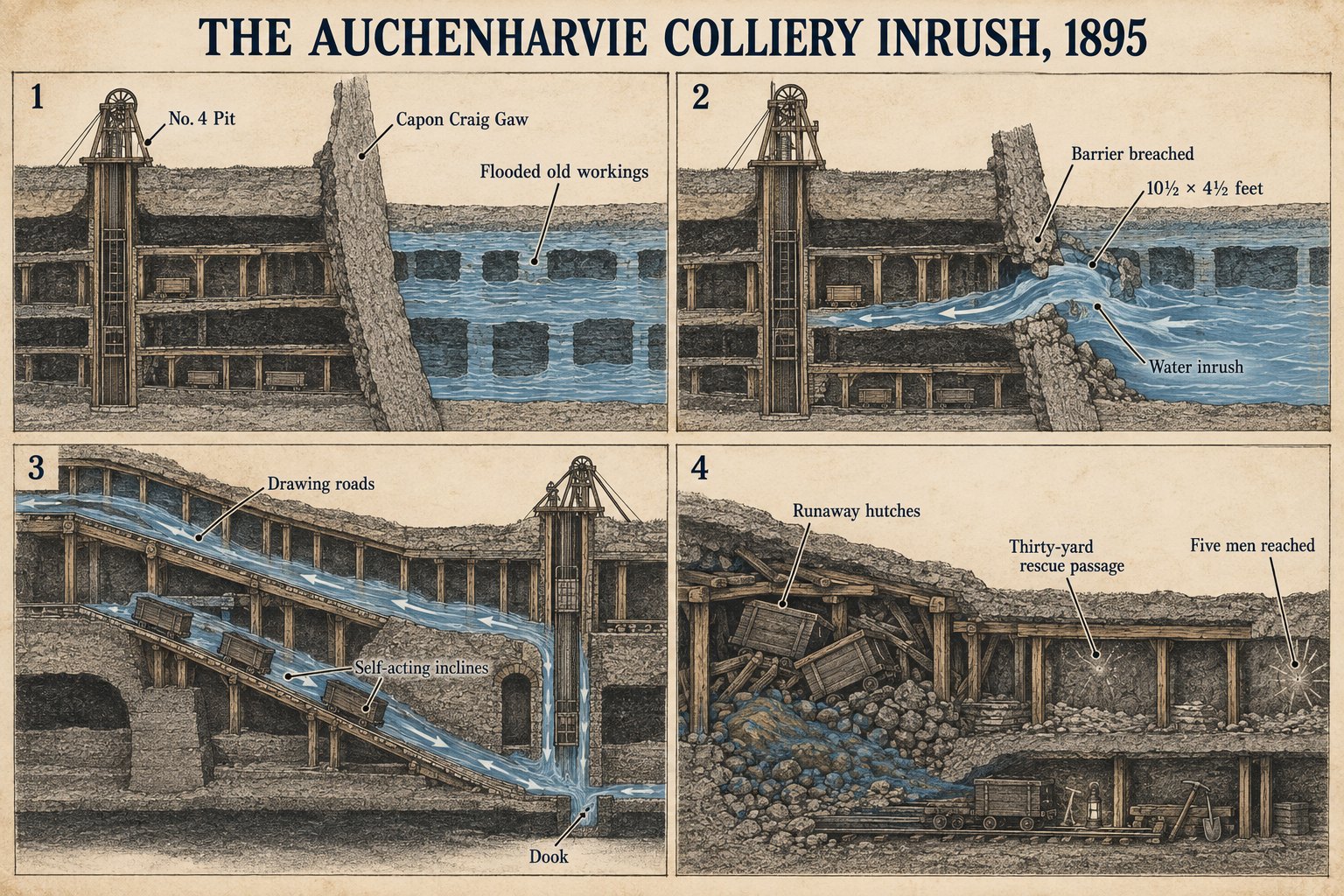
An irruption of water from abandoned stoop and room workings on the far side of the Capon Craig Gaw, a whin dyke forming the colliery's eastern boundary with the disused Stevenston Colliery. The opening found afterwards was ten and a half feet wide by four and a half high.
Contributing factors
The gaw was believed never to have been cut from either side, and the leases on both sides expressly prohibited the tenants from penetrating it — the barrier was the whole safeguard. Eight hundred yards beyond it stood the Deep Shank, an old pit 30 fathoms deep, from whose mouth water had regularly run before the accident; when the irruption came its level dropped until the water stood eleven and a half fathoms below the surface, and fresh subsidences appeared at the surface nearby.
What happened
At about three in the afternoon of 2 August 1895 water burst out in the working place of a miner named William Jackson, who with his two sons worked the extreme rise of the pit. It came down the drawing roads and the two self-acting inclines to the shaft with great velocity, and then went on down the dook into the dip workings. Almost everyone in the rise got out, either down the cousies to No. 4 Pit bottom or along the escape road to No. 1. John McGhee, a boy of thirteen working at the head of the first incline, appears to have run past the pit bottom and down the dook instead, and his body was never found. Eight of the men in the dip workings did not get out either. Of the nine who died, four were brothers — John, William, James and Henry Glauchan — and a fifth, Duncan Gallacher, was their brother-in-law; two more, James and Peter Mullen, were brothers, Peter being twelve years and eight months old.
Rescue & recovery
For hours the rush of water made it impossible to reach anyone. By midnight explorers got as far as a blockage on the second incline which was damming back a great deal of water, and which was too dangerous to clear by hand; two charges of dynamite on long fuses were fired at it without visible effect. By noon on 3 August the water behind the dam had drained away, and relays of men began cutting through the obstruction — a 'race' of runaway hutches that had blocked the road and collected stone and silt around itself. By eleven on the morning of 4 August they had driven more than thirty yards through it, and heard knocking. At about one o'clock a hole big enough to crawl through was opened and five imprisoned men came out alive. The dook was then searched for anyone who might be above water, and all hope for the rest was given up.
Investigation & inquiry
The district Inspector of Mines reported that irruptions of water were rare in the district. On 5 August he and Mr Mottram reached the point where the water had broken in and found the opening into the old stoop and room workings, though a roof fall stopped them going far. The colliery belonged to the Glengarnock Iron and Steel Company, with R. Main as agent and John Marshall as manager.
Memorials & commemoration
The disaster is commemorated locally in Stevenston and Saltcoats.
Recorded claims
Individual factual claims, each attached to the source(s) that support it below. Where sources disagree, both are kept.
- Water broke in from abandoned stoop and room workings beyond the Capon Craig Gaw through an opening ten and a half feet wide by four and a half high; both leases had prohibited cutting the dyke. 1
- Nine died: Duncan Gallacher (30), the four Glauchan brothers John (30), William (28), James (22) and Henry (19), Robert Conn (17), James Mullen (19), his brother Peter Mullen (12 years 8 months) and John Magee (13). 1
- Five entombed men were released alive at about 1 p.m. on 4 August, after relays cut more than thirty yards through a blockage formed by a race of runaway hutches; two dynamite charges fired at it the previous night had had no visible effect. 1
- The Deep Shank, an old pit 30 fathoms deep some 800 yards beyond the gaw, had regularly run water from its mouth; after the irruption its level fell until the water stood eleven and a half fathoms below the surface. 1
Related terminology
Mining terms this disaster is structurally linked to, with the nature of the relationship.
- Dook (contextual relationship)
Named 4 times in this record, first in the summary: “…No. 4 Pit and swept down the inclines to the shaft and on into the dook. Nine people drowned, four of them brothers and two of them…” - Incline (contextual relationship)
The inclines were the route the water took — it burst into the rise and swept down them to the pit bottom — and a thirteen-year-old working at the head of the first incline was among those never found. - Inrush (direct cause)
Water held in abandoned workings released into a live face — the textbook case, and the reason the boundary dyke was legally protected. - Mines Rescue Station (rescue/recovery concept)
Rescue here was improvised by the colliery's own men over two days, before organised rescue brigades existed in the district. - Room and Pillar (contextual relationship)
Named twice in this record, first in the cause: “An irruption of water from abandoned stoop and room workings on the far side of the Capon Craig Gaw, a whin dyke forming…”
Sources
- (primary) Auchenharvie 1895 — Scottish Mining Website — Scottish Mining Website
- (primary) Newcomen Engine House, Auchenharvie — North Ayrshire Heritage
Record created: 24 August 2026 · Last researched: 24 August 2026