 MineArchive
Barricading
| Category | Ground Conditions & Hazards |
|---|
An emergency survival tactic in which miners trapped underground by fire, explosion or gas seal themselves into a section of the workings with a barrier of stone, timber or whatever material is to hand, to keep out toxic afterdamp or smoke while awaiting rescue.
Historical usage
Barricading is most fully documented in early 20th-century American coal mining disasters, notably the Fraterville disaster in Tennessee (1902), where trapped miners built a barrier across a side passage but were ultimately overcome as afterdamp seeped in over several hours, and the Speculator Mine disaster in Montana (1917), where some miners barricaded themselves behind bulkheads in a dead-end drift and survived for as long as 55 hours before rescue reached them.
How it worked
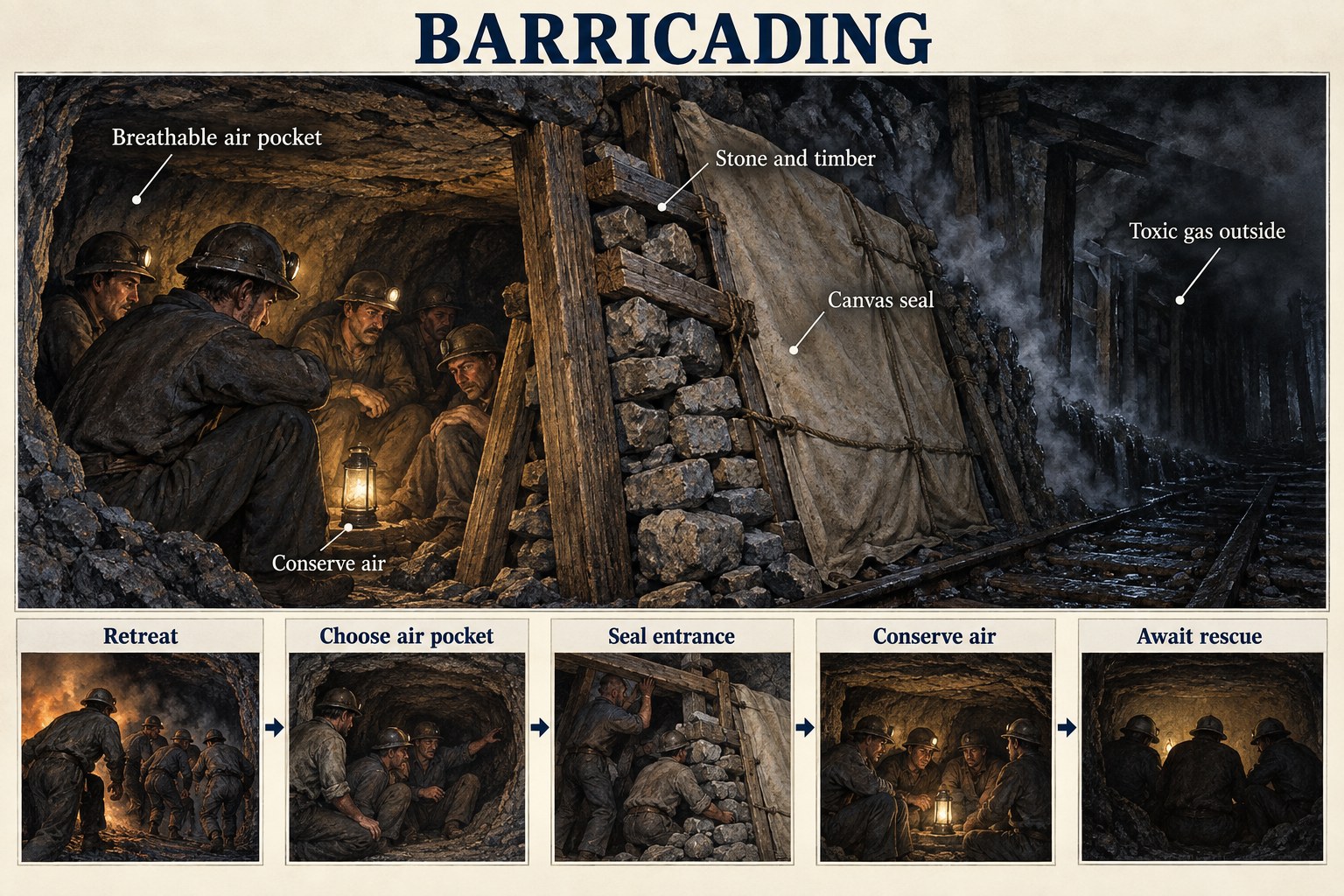
Trapped miners retreat to, or barricade off, a section of the workings believed to hold a viable supply of breathable air — sometimes chosen because it also had access to water — sealing its entrance with stone, timber, canvas or any available material to slow or stop the ingress of toxic gas from the rest of the mine, then wait, conserving air and light, for rescue to reach them.
Why it was used
When the main escape routes are blocked or filled with gas and rescue may take many hours, sealing off a survivable pocket of air is often a trapped miner's only realistic chance — a way of buying time that remaining exposed in open workings would not provide.
Risks & limitations
The tactic's success depends entirely on the sealed section genuinely holding enough breathable air for as long as rescue takes, and on the barricade being completed before gas concentrations become fatal; if either assumption fails, the same enclosed space that prolongs survival can equally prolong suffering, as happened to some of the miners at Fraterville.
Regional variation
The clearest documented cases of barricading come from American coal mining rather than British sources; the underlying logic — retreat, seal, conserve air, wait — is universal to underground gas incidents wherever they occur.
Related terminology
Roof Fall, Spontaneous Combustion
Sources
- (secondary) Speculator Mine disaster — Wikipedia
- (secondary) The Fraterville Mine disaster of 1902 — The History Blog
Record created: 23 August 2026 · Last researched: 23 August 2026