 MineArchive
Bentley Colliery explosion, 1931
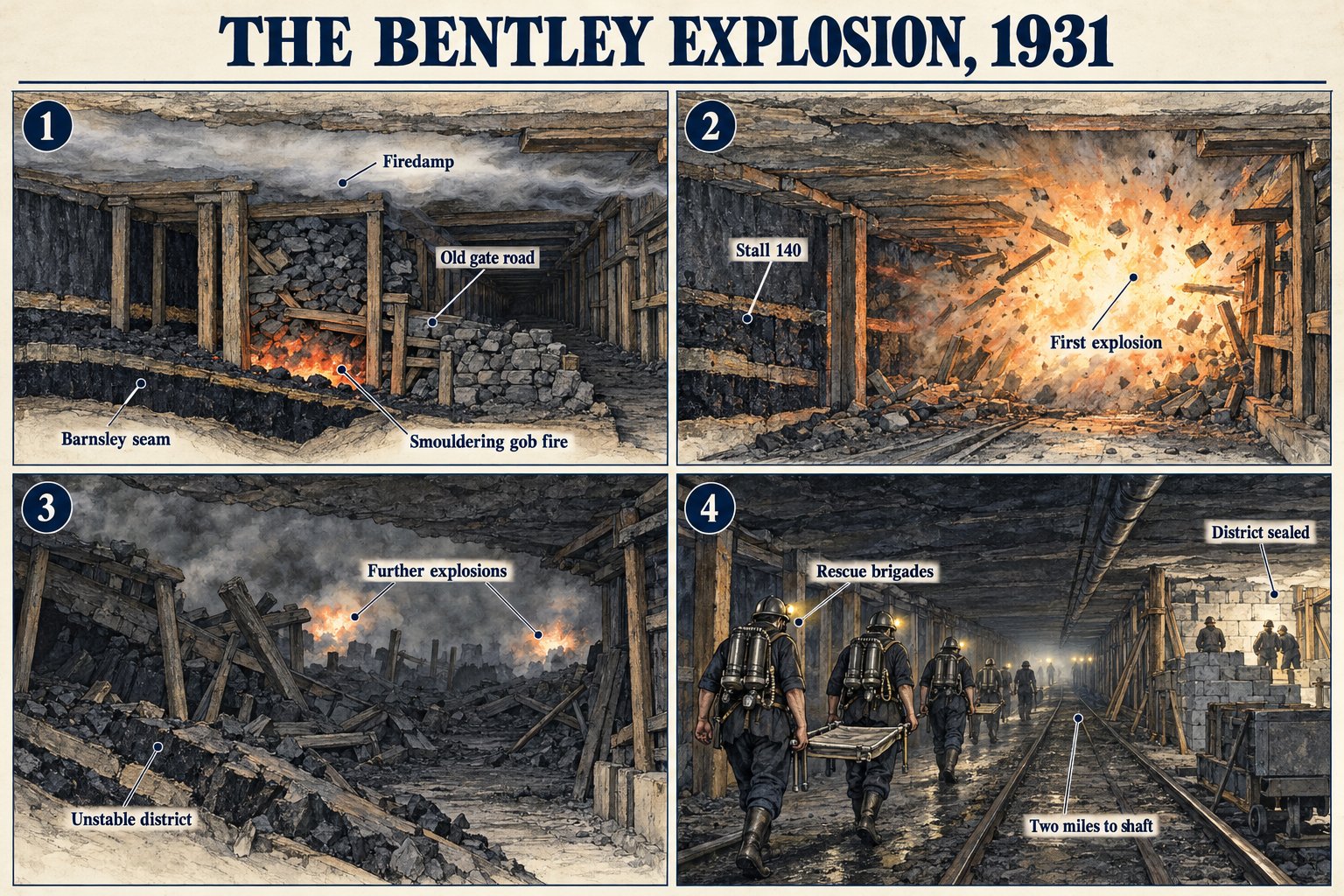
A firedamp explosion in the North-East District of Bentley Colliery's Barnsley seam killed 45 men and boys on the evening of 20 November 1931, most likely ignited by a gob fire smouldering in the mine's old workings; the rescue that followed brought eight Edward Medals.
| Date | 20 November 1931 |
|---|---|
| Mine | Bentley Colliery |
| Region | South Yorkshire |
| Type | Explosion |
| Fatalities | 45 (40 bodies were recovered; five men — J.W. Rowe, W. Brocklehurst, S. Mason, J.H. Smith and T. Dove — were never found. Three further men, Daniel Maloney, Horace Windle and Arthur Kirkland, died of their injuries in the days after the explosion rather than at the scene itself.) |
| Injuries | Five men were seriously injured in addition to the dead. |
| Context | During active mining |
Cause
Chief Inspector of Mines Sir Henry Walker concluded, after ruling out shotfiring, electrical ignition and matches, that the explosion was most likely caused by a gob fire smouldering either in the waste ground between stalls 141 and 140 or in an old gate road, near stall 140.
Contributing factors
Around 85 men were working in the North-East District at the time — 2 deputies, 49 colliers, 11 byeworkers, 2 bricklayers and 21 haulage workers — in a seam already known for persistent methane release.
What happened
The explosion struck at 5.45pm on Friday 20 November 1931, in the Barnsley seam's North-East District, with fatalities spread across stalls 140 to 148. Rescue efforts were complicated by at least two further, smaller explosions during the recovery operation, one occurring during the initial investigation and another around 1am the following morning.
Rescue & recovery
Rescuers went into the affected area to bring out the injured, in places carrying casualties two miles underground to reach the main shaft, working with the constant risk of further explosions from the still-smouldering gob fire. Recovery work continued over several shifts, coordinated with neighbouring collieries' rescue brigades, before the district was finally sealed off. Eight men were awarded the Edward Medal for their part in the rescue: Silver Medals to Ernest Allport (a deputy and St John's Ambulance man who spent over three hours in breathing apparatus helping stretcher cases, replenishing his equipment mid-rescue), Edgar Hamilton Frazer (Divisional Inspector of Mines), Samuel Jarrett Temperley (Assistant Surveyor) and John Ward (a pony driver); Bronze Medals to Richard Edward Darker (pony driver), Oliver Soulsby (haulage hand), Frank Sykes (Corporal) and Philip William Yates (haulage driver).
Investigation & inquiry
A formal inquiry conducted by Chief Inspector of Mines Sir Henry Walker opened on 29 December 1931 at the Co-operative Hall in Doncaster, sat for eight days, and reported on 18 April 1932; it identified a gob fire as the most likely cause, recommended alternative materials to coal be used in support packs, and noted discrepancies in the colliery's own report books.
Legal & regulatory aftermath
The disaster and its cause were raised in the House of Commons on 23 November 1931, three days after the explosion.
Changes to practice & legislation
Sir Henry Walker's recommendation to use non-combustible alternatives to coal in support packs directly targeted the gob-fire mechanism identified as the disaster's likely cause.
Recorded claims
Individual factual claims, each attached to the source(s) that support it below. Where sources disagree, both are kept.
- Chief Inspector Sir Henry Walker concluded, having ruled out shotfiring, electrical ignition and matches, that the explosion most likely resulted from a gob fire smouldering in old waste ground near stall 140. 1
- 45 men and boys died; five bodies (J.W. Rowe, W. Brocklehurst, S. Mason, J.H. Smith and T. Dove) were never recovered, and three further men died of their injuries in the days following the explosion. 1
- Eight rescuers were awarded the Edward Medal, four in Silver (Ernest Allport, Edgar Hamilton Frazer, Samuel Jarrett Temperley, John Ward) and four in Bronze (Richard Edward Darker, Oliver Soulsby, Frank Sykes, Philip William Yates), for extricating and carrying injured miners to safety amid the continuing risk of further explosions. 1
Related terminology
Mining terms this disaster is structurally linked to, with the nature of the relationship.
- Breathing Apparatus (contextual relationship)
Named in this record’s rescue and recovery: “…(a deputy and St John's Ambulance man who spent over three hours in breathing apparatus helping stretcher cases, replenishing his equipment mid-rescue),…” - Gate Road (contextual relationship)
Named in this record’s cause: “…either in the waste ground between stalls 141 and 140 or in an old gate road, near stall 140.” - HM Chief Inspector of Mines (contextual relationship)
Named 3 times in this record, first in the cause: “Chief Inspector of Mines Sir Henry Walker concluded, after ruling out shotfiring, electrical…” - Spontaneous Combustion (contextual relationship)
Named 4 times in this record, first in the summary: “…boys on the evening of 20 November 1931, most likely ignited by a gob fire smouldering in the mine's old workings; the rescue that followed…” - Stall (contextual relationship)
Named 3 times in this record, first in the cause: “…caused by a gob fire smouldering either in the waste ground between stalls 141 and 140 or in an old gate road, near stall 140.”
Sources
- (secondary) Bentley Colliery Explosion - Doncaster - 1931 — Northern Mine Research Society
- (primary) Bentley Colliery Disaster (Hansard, 23 November 1931) — UK Parliament, House of Commons (Historic Hansard)
- (secondary) Bentley Colliery — Wikipedia
Record created: 27 August 2026 · Last researched: 27 August 2026