 MineArchive
Hyde Colliery
| Location | Hyde Lane, Hyde, Greater Manchester — 53.4523, -2.0863 (approximate) |
|---|---|
| Commodity | Coal |
| Type | Coal |
| Worked | by 1842 |
| Maximum depth | 272 yards to the downcast shaft bottom in 1889, though because the measures dip about one in one and eight-tenths the depth to any particular seam varied greatly across the workings; the manager's own report of the same year gives the winding shaft as 274 yards and the upcast as 220. |
| Operators | J. W. and J. N. Sidebotham, Hyde Lane Colliery Company |
Overview
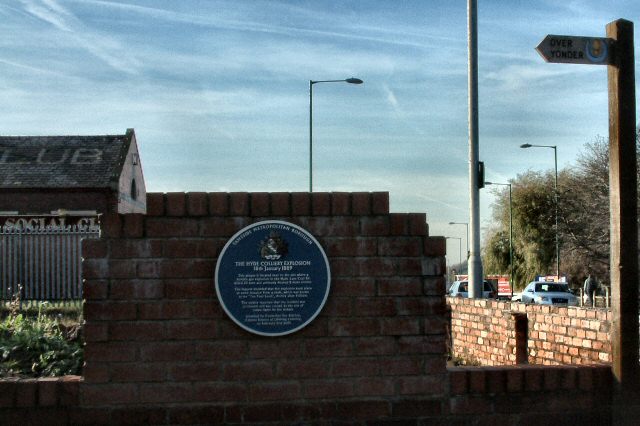
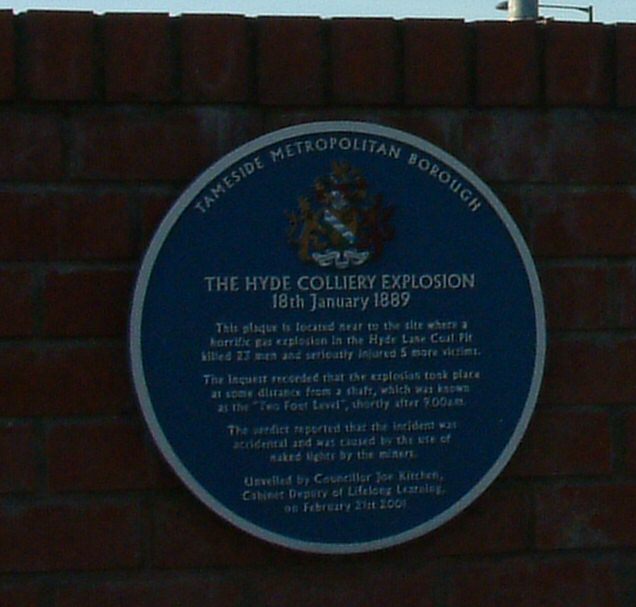
A Cheshire coalfield pit in the middle of Hyde, seven miles east of Manchester, worked on steeply inclined measures through three seams and owned in its best-known years by the mill-owning Sidebotham brothers. On 18 January 1889 an explosion of firedamp in its Two-feet mine killed twenty-three men and boys, the worst mining accident in Cheshire, and the relief match played for their families was the first game under floodlights for either of the clubs that became Manchester City and Manchester United. A blue plaque marks the site.
History
Also called Hyde Lane Colliery, the pit stood on Hyde Lane between the canal bridge and Alfred Street and was described by its own manager in 1889 as one of the oldest in the district, having been working for many years; an explosion in its Black Mine is recorded as early as 1842. Its shafts were first sunk to the Black Mine, the most valuable seam in the district for gas and house coal, and later deepened through the Two-feet mine to the Peacock. The Black Mine was then left unworked for some fifty years, Messrs Brown and Clayton having been the last to work it, and the old workings filled with water. It was the Hyde Lane Colliery Company, under the Manchester mining engineer John Higson, that drove tunnels from the Two-feet mine to win the unworked Black Mine, leaving a barrier of coal to hold back the water in the old workings; earlier the colliery had been worked by Messrs Bradbury and by the Hyde and Haughton Colliery Company. By the time of the disaster the owners were J. W. Sidebotham, member of parliament for the Hyde division, and his brother J. Nasmyth Sidebotham, of the family whose cotton mills dominated the town. The colliery was worked by two shafts twenty yards apart, the downcast 272 yards deep and twelve and a half feet across, used for winding coal, pumping and raising and lowering the men, and the upcast 222 yards deep and eight feet across, ventilated by a furnace near its bottom. The measures dip steeply to the north-west, about one in one and eight-tenths, so the depth to any given seam varied greatly across the workings. Three seams were worked, the Two-feet mine, the Peacock fourteen yards below it and the Third mine about fifty yards below that; by 1889 attention had turned to the Black Mine, worked longwall, its coal brought to the engine brow by endless rope haulage and drawn up a brow 970 yards long to the pit bottom. Lighting was by naked candles, allowed by agreement between the management and the men because the pit was thought to be so well ventilated that gas hardly showed. On the morning of 18 January 1889 that assumption failed and twenty-three were killed (see Disasters, below). The colliery was trading as Hyde Lane Colliery Ltd of Manchester Road by 1902. No source gives the date it finally stopped work.
Geology
The pit worked the Cheshire end of the Lancashire coalfield on strata inclined about twenty-eight degrees, roughly one in one and eight-tenths, dipping north-west, so that the same seam lay at very different depths across the take. Three seams were worked in descending order, the Two-feet mine, the Peacock fourteen yards below and the Third mine some fifty yards below that; beneath and beyond them lay the Black Mine, four feet eight inches thick and dipping one in two and a half, the district's best gas and house coal, which had been abandoned for half a century and was won again in the 1880s by driving from the Two-feet mine and leaving a barrier against the flooded old workings.
Geological setting: Sedimentary Beds and Seams (well documented example), Strike and Dip (well documented example)
Workings
Two shafts twenty yards apart, the downcast for winding, pumping and men and the upcast for ventilation, the air drawn by a furnace in a stone drift near the bottom of the upcast, the returns from the Two-feet and Peacock mines entering the upcast twenty-six yards above the furnace by a dumb drift. A metal brow, a stone drift 209 yards long, left the pit-bottom tunnel at right angles to cut the Two-feet seam and served as both intake airway and haulage road. The Black Mine was worked longwall with endless rope haulage to the foot of an engine brow 970 yards long. The men worked by naked candle, by an agreement made because the pit was thought too well ventilated to hold gas.
Closure
No source gives a closing date. The colliery was still trading as Hyde Lane Colliery Ltd of Manchester Road, Hyde, in 1902, and the site is long cleared, but neither the inspector's report, the manager's own account nor the local history pages consulted follow the pit past the turn of the century. A refresh should look at the Lists of Mines and the Cheshire coalfield literature.
What remains
The colliery is gone and the ground built over. A blue plaque on an old wall at the site records the explosion, photographed in 2007 and still in place in 2015; the Peak Forest Canal towpath runs close by.
None; a blue plaque on a surviving wall marks the site.
Redevelopment
Built over; the site lies beside the Peak Forest Canal in central Hyde.
Related mines
- Broomstair Colliery — Both worked by the Sidebotham brothers' Hyde and Haughton company; men from flooded Broomstair moved to Hyde in 1889.
Nearby mines
- Astley Deep Pit — 1.2 miles (2.0 km) N
- Lingard Lane Colliery — 2.2 miles (3.6 km) SW
- Heys Colliery — 2.7 miles (4.4 km) N
- Chisworth Colliery — 3.5 miles (5.6 km) SE, Derbyshire
- Woodpark Colliery — 4.2 miles (6.8 km) N
Straight-line distance, within 9 miles (15 km). Show on the map.
Disasters & major incidents
-
Hyde Colliery Explosion, 1889
18 January 1889 · Explosion · 23 fatalities
An explosion of firedamp in the Two-feet mine at Hyde Colliery on the morning of 18 January 1889 killed twenty-three men and boys, almost all of them by afterdamp. The men worked by naked candle under an agreement made because the pit was believed too well ventilated to hold gas; the inquest returned a verdict of accidental death.
Culture
- The Hyde Colliery Relief Match, 1889 (Sports)
The match was played in aid of the families of the twenty-three men and boys killed in the explosion at this colliery on 18 January 1889.
What's uncertain
Points where sources disagree or the record could not be settled; both accounts are kept. All open questions in the archive.
- The colliery manager's own report of about the same date gives the downcast and winding shaft as 274 yards deep and the upcast as 220 yards. (disputed) 2
Recorded claims
Individual factual claims, each attached to the source(s) that support it below. Where sources disagree, both are kept.
- The colliery was worked by two shafts: a downcast 272 yards deep and 12 feet 6 inches in diameter for coal, pumping and men, and an upcast 20 yards to its north, 222 yards deep and 8 feet across, ventilated by a furnace near its bottom. 1
- The colliery manager's own report of about the same date gives the downcast and winding shaft as 274 yards deep and the upcast as 220 yards. (disputed) 2
- Three seams were worked in descending order, the Two-feet mine, the Peacock 14 yards below it and the Third mine about 50 yards below the Peacock; the strata dip about 28 degrees, roughly 1 in 1.88, to the north-west. 1
- The shafts were first sunk to the Black Mine, which was then left unworked for about fifty years; the Hyde Lane Colliery Company, under the mining engineer John Higson of Manchester, drove tunnels from the Two-feet mine to win it again, leaving a barrier of coal to hold back the water standing in the old workings. 2
- The Black Mine, 4 feet 8 inches thick and dipping about 1 in 2.5, was worked longwall, the coal brought to the engine brow by endless rope haulage and drawn up a brow 970 yards long to the pit bottom. 2
- At the time of the 1889 explosion the owners were J. W. Sidebotham, member of parliament for the Hyde division, and his brother J. Nasmyth Sidebotham. 1,3
- Lighting underground was by naked candles, by agreement between the management and the men, because the pit was thought so well ventilated that there was hardly any sign of gas. 3
- A blue plaque on an old wall at the site of the colliery records the 1889 explosion. 4,5
Photographs & further reading
William Ollerenshaw's own description of the colliery, its shafts, seams and the winning of the abandoned Black Mine.
View sourceW. N. Atkinson's full report to the Home Secretary, with the layout of the workings, the course of the explosion and the inquest's findings.
View sourceSources
- (primary) Report to the Secretary of State on the explosion at Hyde Colliery, 18 January 1889, by W. N. Atkinson, HM Inspector of Mines — HM Inspectors of Mines, via Durham Mining Museum
- (primary) Hyde Lane Colliery: colliery report by William Ollerenshaw, colliery manager, c.1889 — pittdixon.co.uk
- (secondary) Hyde Lane Colliery explosion, 1889 (pittdixon.co.uk) — pittdixon.co.uk
- (observational) Site of Hyde Colliery, with the blue plaque (Geograph photograph, 15 November 2007) — Geograph / Gerald England
- (observational) Hyde Colliery explosion blue plaque (Geograph photograph, 15 November 2007) — Geograph / Gerald England
Record created: 9 September 2026 · Last researched: 9 September 2026