 MineArchive
Easington Colliery explosion, 1951
An underground explosion in the Fifth ('Duckbill') district of Easington Colliery killed 81 miners outright, with two rescue workers later dying from the effects of afterdamp — one of the worst British colliery disasters of the 20th century.
| Date | 29 May 1951 |
|---|---|
| Mine | Easington Colliery |
| Region | County Durham |
| Primary type | Explosion |
| Associated types | Rescue |
| Fatalities | 83 (81 men killed outright by the explosion; a further 2 rescue workers died afterwards from the effects of afterdamp, bringing the total to 83. Of the 81 miners caught underground, only one, 18-year-old Matthew Williams, was found alive, and he died of his injuries hours later.) |
| Context | During active mining |
Cause
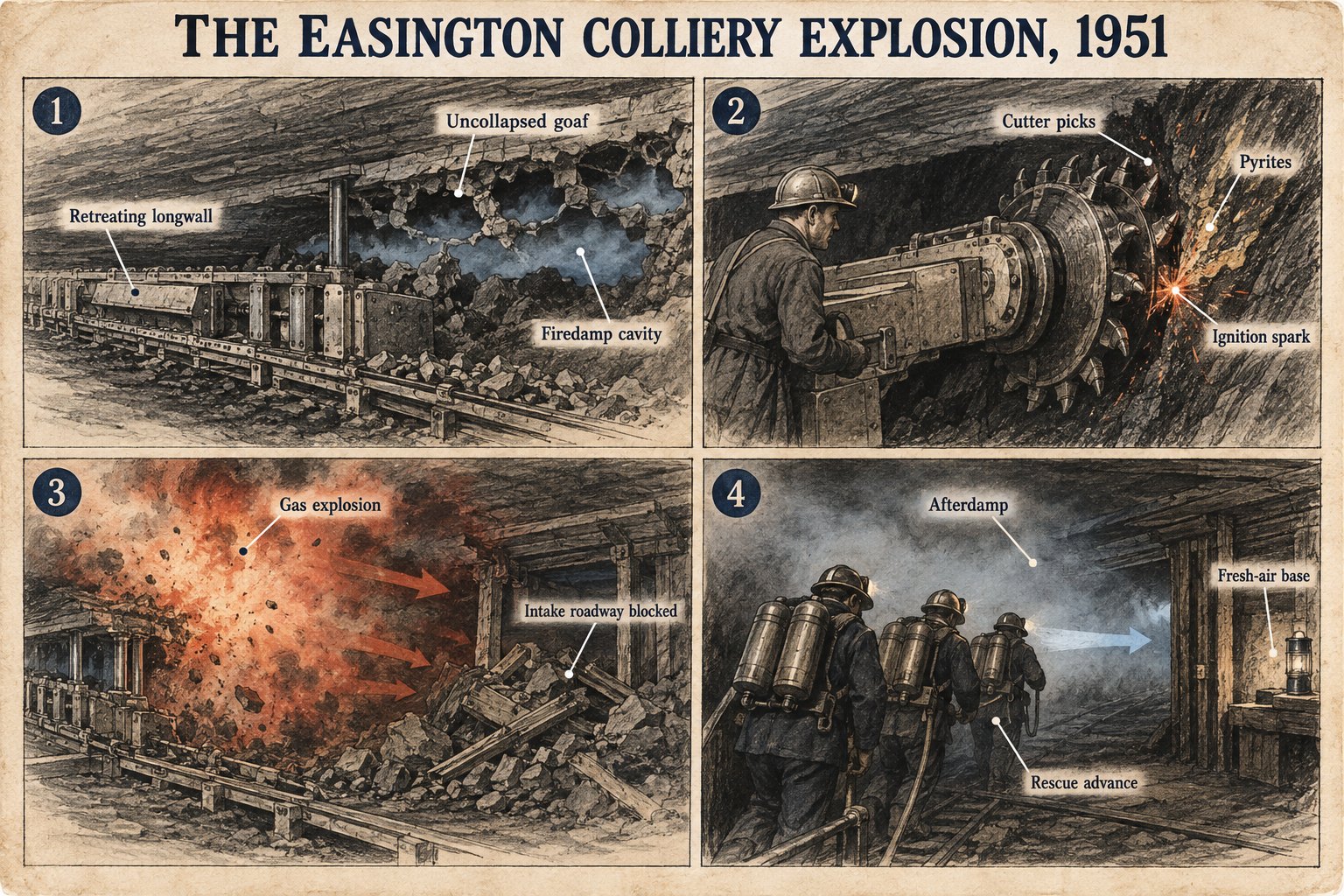
The official inquiry found that sparks caused by cutter picks striking pyrites ignited firedamp that had accumulated in large cavities within the waste area behind a retreating longwall coalface, in the Third South section, after the roof failed to collapse and seal the void as intended.
Contributing factors
Deficient dust control, inadequate ventilation from multiple auxiliary fans, and insufficient supervision of firedamp risk in the district were identified as contributing factors by the official inquiry.
What happened
The explosion occurred at around 4:35am on 29 May 1951, roughly a mile and a quarter from the shaft bottom, and was accompanied by a roof fall that blocked the intake roadway close to the shaft. The blast and its afterdamp spread through some 16,000 yards of roadway, killing the great majority of the men working the stone-shift and fore-shift in the affected district.
Rescue & recovery
Rescue operations continued for 257 hours. Eleven officers, 48 permanent Mines Rescue Service corpsmen and 291 trained colliery rescue workers took part, wearing breathing apparatus 1,168 times between them and using over 13,000 pounds of liquid air to establish fresh-air bases and advance progressively back into the mine. Two of the rescue workers died from the effects of afterdamp during the operation.
Investigation & inquiry
A formal inquiry, conducted by H.C.W. Roberts, HM Chief Inspector of Mines, sat at Easington Colliery Welfare Hall from 30 October to 15 November 1951, hearing evidence from 75 witnesses over 13 days. It identified ten specific findings, including deficient dust suppression, inadequate ventilation and insufficient supervision of firedamp risk.
Changes to practice & legislation
The inquiry issued twelve major recommendations covering roof-caving practice, a review of ventilation systems using multiple auxiliary fans, research into firedamp drainage, surveys of cutting horizons, improved dust suppression, and medical examination requirements for rescue workers.
Memorials & commemoration
A memorial garden was opened on the former colliery site in 2001, fifty years after the disaster, planted with 83 trees — one for each life lost; Queen Elizabeth II visited the site in her Golden Jubilee year, 2002. A separate Grade II-listed memorial, including memorial screens and a bas-relief of a miner, was erected in 1953-54.
Recorded claims
Individual factual claims, each attached to the source(s) that support it below. Where sources disagree, both are kept.
- 81 miners were killed outright by the explosion and a further 2 rescue workers died afterwards from the effects of afterdamp, bringing the total to 83.
- Rescue operations continued for 257 hours, involving 11 officers, 48 permanent corpsmen and 291 trained colliery rescue workers, who wore breathing apparatus 1,168 times.
Related terminology
Mining terms this disaster is structurally linked to, with the nature of the relationship.
- Afterdamp (direct cause)
Two rescue workers died from the effects of afterdamp during the 257-hour rescue operation. - Breathing Apparatus (contextual relationship)
The scale of the rescue is measured in apparatus: over 257 hours, 350 rescue workers wore breathing apparatus 1,168 times between them, using 13,000 pounds of liquid air to push fresh-air bases forward. - Fresh Air Base (rescue/recovery concept)
The disaster's own recorded rescue account explicitly describes fresh-air bases being established and progressively advanced during the 257-hour operation. - Longwall (direct cause)
The official inquiry found firedamp had accumulated in cavities behind a retreating longwall coalface where the roof failed to collapse and seal as intended. - Screens (contextual relationship)
Named in this record’s memorials: “…year, 2002. A separate Grade II-listed memorial, including memorial screens and a bas-relief of a miner, was erected in 1953-54.”
Sources
- (primary) Easington Colliery Disaster 1951. 81 killed. — Durham Mining Museum
- (secondary) Easington Colliery Explosion - West Hartlepool - 1951 — Northern Mine Research Society
Record created: 23 August 2026 · Last researched: 23 August 2026