 MineArchive
Banks Slate Quarry, Chapel Stile
| Also known as | Banks Mine, Langdale, Banks Slate Mine, Elterwater, Banks Quarry |
|---|---|
| Location | Banks, above Chapel Stile, Great Langdale, Cumbria — 54.4370, -3.0454 (approximate) |
| Commodity | Slate |
| Type | Slate |
| Worked | By 1882–After 1922 |
| Operators | J. and E. Bowness (1882–1922) |
Overview
A small green-slate working at Banks above Chapel Stile in Great Langdale, returned as a mine because its slate was got underground, worked by John Bowness and his family from the 1880s to the 1920s with never more than eight men. Its owner-miner John Bowness died in 1905 after a stone fell on him while he drilled alone at the foot of a thirty-foot chamber.
History
Great Langdale and Elterwater were centres of the Lakeland green-slate industry, with major quarries at Thrang, above Chapel Stile, and Elterwater by the mid-nineteenth century and some thirty workings at the peak. Banks was one of the smallest: the Durham Mining Museum returns it as a slate mine under John Bowness from 1882, with eight employed in 1883, and it appears in the Lists of Quarries as Banks, Elterwater, with three to five hands through the 1890s and 1900s, two of them below ground, raising green slate. In January 1885 the miner Thomas Gregg was knocked from a ladder by a loose stone and killed. On 27 June 1905 John Bowness, 53, working the mine as J. and E. Bowness with his brother, examined a thirty-foot high chamber from the top of a pile of shot-down blocks, saw that part of the top rock had stirred and went back alone after tea to drill it for a shot; his brother found him semi-conscious under fallen stone at half past seven with a broken arm and a fractured skull, and he died of pneumonia on 4 July. The inspector did not like men working alone in a mine of this sort. Eight were employed in 1910, none in 1915, and three in 1922, after which the record ends; Banks is now counted among the Langdale quarries fallen into disuse.
Geology
Westmorland green slate of the Borrowdale Volcanic Group, worked in underground chambers up to thirty feet high on the Lingmoor slopes above Chapel Stile.
Workings
Underground slate chambers, one thirty feet high in 1905, reached by ladders; blocks shot down and filled from behind pillars. Employment: 8 in 1883, 4 in 1894, 3 in 1896 and 1897, 5 in 1900, 4 in 1902 and 1905, 8 in 1910, none in 1915, 3 in 1922.
Closure
Not worked in 1915, three employed in 1922 and no later return; the closing date is not in the sources read.
What remains
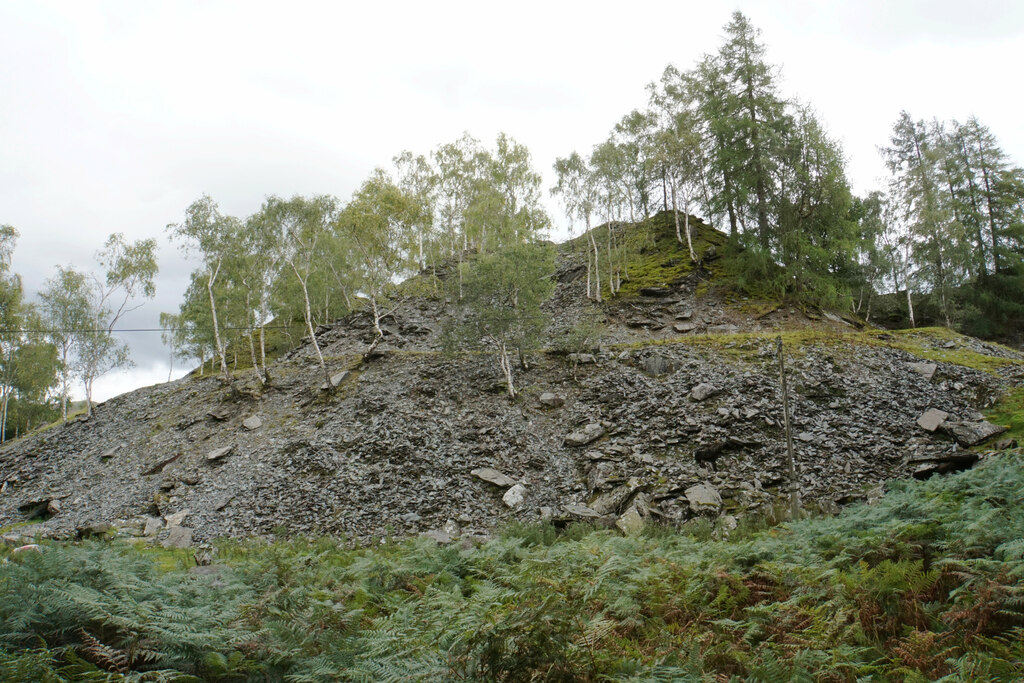
Disused; the slate spoil heaps above Chapel Stile are mature enough for trees to grow from them. A street of houses in the village is named Banks Quarry View.
Spoil heaps; the chambers are not described in the sources read.
Related mines
- Elterwater Quarry — Neighbouring Langdale green-slate workings; Elterwater is the survivor still at work.
- Lords Quarry — Neighbouring small slate mines of the Elterwater and Chapel Stile district.
Nearby mines
- Lords Quarry — 0.3 km S
- Elterwater Quarry — 0.6 km SE
- Loughrigg Fell Slate Quarry — 0.9 km SE
- Hodge Close Quarry — 3.5 km S
- Parrock Quarry — 3.6 km S
Straight-line distance, within 15 km. Show on the map.
Recorded claims
Individual factual claims, each attached to the source(s) that support it below. Where sources disagree, both are kept.
- Returned from 1882 to 1922; not worked in 1915. 1
- John Bowness, trading as J. and E. Bowness by 1905. 1,2
- Eight in 1883 and 1910, otherwise three to five. 1
- John Bowness, 53, was struck by stone falling from a thirty-foot chamber while drilling alone on 27 June 1905 and died on 4 July. 2
Photographs & further reading
Output and employment returns from 1882 to 1922 and the two recorded deaths.
View sourceThe inspector's account of John Bowness's death and his remarks on men working alone.
View sourceSources
- (primary) Banks (Slate) — Durham Mining Museum — Durham Mining Museum
- (primary) Banks slate mine accident, 27 June 1905 — Durham Mining Museum (inspector's report extract) — Durham Mining Museum
- (secondary) Great Langdale — Wikipedia — Wikipedia
- (secondary) Langdales township — Cumbria County History Trust — Cumbria County History Trust
Record created: 11 September 2026 · Last researched: 12 September 2026