 MineArchive
Hodge Close Quarry
| Also known as | Hodge Close Mine, Hodge Close Slate Quarry |
|---|---|
| Location | Tilberthwaite, between Coniston and Little Langdale, Cumbria — 54.4066, -3.0530 (exact) |
| Commodity | Slate |
| Type | Slate |
| Worked | By the 1780s, possibly earlier–1964 |
| Maximum depth | About 100 m from ground level |
| Operators | Buttermere Green Slate Quarries Ltd. (1940–1964, owner) James Stephenson & Co. (owner) Tilberthwaite Green Slate Co. Ltd (owner) |
Overview
A sheer-sided hole a hundred metres deep in the Tilberthwaite fells, worked for green slate from about the 1780s until 1964 and flooded since. Climbers abseil the face and divers go into the drowned levels below it, where several have died.
History
Hodge Close is one of many slate workings in the Tilberthwaite valley between Langdale and Coniston. Quarrying probably began around the 1780s and, with spells of inactivity, continued until 1964. The official returns show how uneven that working was: 56 employed in 1896 and 71 in 1897, then 8 in 1900 and 4 in 1902; 80 in 1905, 7 in 1915, and the 1925 return recording that the quarry had not been worked since 1924. It came back again — 32 in 1929, 26 in 1930, 19 in 1935, 14 in 1945.
The owners changed with the fortunes. James Stephenson and Company held it in the 1900s, the Tilberthwaite Green Slate Company in the 1910s, and by the 1940s it belonged to Buttermere Green Slate Quarries, the same firm that worked Honister and Dubs on the other side of the fells.
It began as an open pit with levels and chambers coming off it at various points. As the working developed those levels and chambers were largely quarried away, leaving only the ones now reachable underwater.
Geology
The light green slate of the Borrowdale Volcanic Group, the Lakeland green slate that was worked all down this valley.
Workings
An open pit about a hundred metres deep from ground level, with levels and chambers driven off it. Most of those were quarried away as the pit deepened; what survives of them is underwater. The face above the water is about a hundred and fifty feet, and the flooded workings below it about the same again.
Closure
Working ended in 1964 after nearly two centuries of intermittent quarrying.
What remains
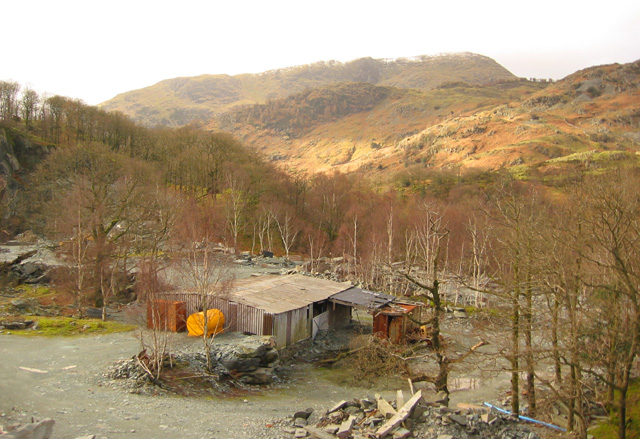
The pit is flooded and unfenced. It is a well-used place for walkers, climbers and abseilers, and a known site for scuba diving in the drowned levels — a number of divers have died there, mostly after becoming lost in the underwater tunnels. Ruined quarry buildings stand among the spoil heaps above.
The quarry itself, its spoil heaps and a group of ruined buildings on the fell above.
Related mines
- Honister Slate Mine — Both ended up with Buttermere Green Slate Quarries Ltd, which held Hodge Close by the 1940s and worked the Honister group throughout.
- Lords Quarry — Both passed to Buttermere Green Slate Quarries Ltd, which by the 1930s and 1940s held slate quarries across Langdale, Tilberthwaite and the Honister group.
- Parrock Quarry — The company's own 1930 return gives Parrock's locality as Hodge Close: the two workings are on the same ground in the Tilberthwaite valley.
Nearby mines
- Parrock Quarry — 0.1 miles (0.2 km) SW
- Tilberthwaite — 1.3 miles (2.0 km) SW
- Greenburn Mine — 1.6 miles (2.6 km) W
- Loughrigg Fell Slate Quarry — 1.9 miles (3.0 km) NE
- Elterwater Quarry — 2.0 miles (3.2 km) N
Straight-line distance, within 9 miles (15 km). Show on the map.
Recorded claims
Individual factual claims, each attached to the source(s) that support it below. Where sources disagree, both are kept.
- Mining probably started around the 1780s and, with a few periods of inactivity, continued until 1964. The quarry is a massive excavation of light green slate, sheer-sided and unfenced, worked to about a hundred metres from ground level. 1
- It began as an open pit with levels and chambers coming off it at various junctures. As the quarrying changed and developed the levels and chambers were obliterated, leaving just the ones accessible by diving. 1
- The official returns give James Stephenson and Company in the 1900s, the Tilberthwaite Green Slate Company in the 1910s and Buttermere Green Slate Quarries Ltd by the 1940s. Employment swings from 71 in 1897 to 4 in 1902, back to 80 in 1905, and the 1925 return records the quarry as not worked since 1924. 2
- The face is a favourite with abseilers and the flooded workings are popular with divers. A number of divers have died at Hodge Close, mainly as a result of becoming lost in the underwater tunnels. 1
Photographs & further reading
The quarry's working life, its dimensions and what has become of it — abseiling, diving and the deaths in the flooded levels.
View sourceThe official returns from 1896 to 1945, with the owners and the years the quarry stood idle.
View sourceA visit to the quarry and its buildings, with photographs of the pit and the workings above the waterline.
View sourceSources
- (secondary) Hodge Close Quarry — The English Lakes
- (primary) Hodge Close (Slate) — Durham Mining Museum
Record created: 11 September 2026 · Last researched: 11 September 2026