 MineArchive
Diglake Colliery Inrush, 1895
At about 11.30 on the morning of Monday 14 January 1895, after a winter of deep snow and thaw, water from the flooded workings of the old Diglake pit, abandoned since about 1850, burst into the new Ten Feet workings of Diglake or Audley Colliery at Bignall End and poured down the dip through the mine, drowning 77 men and boys of the 240 or so underground. About 160 escaped through the Boyle's Hall shaft, many led out by the under-manager William Dodd and the collier John Boulton, who went back into the rising water again and again and were decorated for it. A dam of tubs and timber at the foot of the dip and the threat of further floods and gas forced the rescue to be abandoned within the week with only two bodies recovered. The inquiry could not show how the water got in, called it an unforeseen accident, and left the men where they lay; three skeletons were found in 1932-33 and the workings were sealed.
| Date | 14 January 1895 |
|---|---|
| Mines involved | Diglake Colliery, Rookery Colliery (related workings) |
| Region | Staffordshire |
| Primary type | Flooding / Inundation |
| Associated types | Entrapment, Rescue |
| Fatalities | 77 (77 according to the official report and the relief fund; the Bignall End memorial lists 78 names, one of them twice. Only three bodies were recovered, two in January 1895 and three skeletons in 1932-33; 72 remain in the workings.) |
| Injuries | None specifically recorded; survivors were carried through deep, icy water and several were exhausted. |
| Context | During active mining |
Cause
An inrush of water from the abandoned and flooded workings of the old Diglake colliery into the East Ten Feet workings, where the fireman William Sproston had just fired a shot. The barrier of coal believed from the inherited plans to be 80 yards thick was in fact far thinner, the old plans and the new having been drawn to different scales and an unrecorded 'unknown place' having been worked between the two.
Contributing factors
Boreholes ahead of the Ten Feet face, required by General Rule 13 within forty yards of a suspected accumulation of water, had been discontinued on the managing partner's orders in reliance on the surface plan; a heavy winter of snow and thaw had swollen the water in the old workings; the pit's layout, with the shafts' sumps at the foot of the flow, put the pumps out of action at once.
What happened
The day shift of 166 went down No. 1 shaft at 6.30 and the rest through Boyle's Hall. William Sproston, the fireman, told his son Bill, fifteen, that a little more water was coming out of the top end and went back in to see if the men had started again. A boy came out to say water was coming in and a ventilation door was open; when the lad returned from closing it the boy had gone, and he never saw him or the 44 others in that part of the mine again. He heard a roar like thunder, got into a manhole, slipped, and was carried face up 200 yards to the bottom of the dip, where Richard Howle, waiting to load the cage, caught him; together they reached the outlet to Boyle's Hall. The water divided at the foot of the Ten Feet crut, part flowing east into the Seven Feet and part west into the Eight Feet past the shafts, a stream two feet deep that in seconds was three or four and within half an hour filled the roads at the shaft bottom to the roof. The first sign at the surface was the drenched men who came up the Boyle's Hall cage. William Dodd, the under-manager, dropped through a trapdoor into water to his armpits, was swept twenty yards and saved himself on a post, climbed the ladders of an air shaft against the flow and lost consciousness at the top, then took a lamp and went back to lead out the men who answered his shout of 'Where are you, lads?'. John Boulton swam into the flooded workings, carried five boys out on his shoulders one after another, and with Dodd found sixteen exhausted men on a back air road, six more beyond, and finally four men and a boy clinging to the roof timbers who were the last brought out alive. By five o'clock 150 had been saved; by nightfall over 160. Twelve men died in the West Eight Feet at the lowest level, 25 in the new East Ten Feet, where Bill Sproston was the only survivor of 26, and all 40 in the East Seven Feet, some perhaps cut off and suffocated as the air went bad.
Rescue & recovery
Rescuers worked all night while pumps of 300 gallons a minute barely held the water, which was still running in freely from both shafts. The bodies of Henry Holland, 30, of Chesterton and Harry Rhodes, 16, of Boon Hill were found wedged beneath an overturned wagon in the dam of debris near No. 1 shaft bottom. Beyond that dam, submerged under several feet of water, lay the 75 missing men, and by Thursday gas was being met; on Saturday 19 January, with the risk that a great volume of water behind the fall could break through on the rescuers, the search was abandoned. Wives who had waited at the pit head for days in sleet and rain, one with dry clothes for her husband and another who had to be restrained from throwing herself down the shaft, went home. The Miners' Federation's observers later argued that a drift driven from twenty yards up the shaft could have reached the seat of the disaster. In 1932 a heading from the new Rookery pit reached the area; a skeleton found on 3 September was brought up in March 1933, two more were found and the road was sealed, leaving 72 in the mine. Dodd received the Albert Medal from Queen Victoria at Windsor and Boulton a medal for his part; Dodd's headstone at St James's, Audley, was restored in 2007.
Investigation & inquiry
The inquest heard William Sproston's son and Richard Howle among others and, at the inquiry of 7 to 14 February 1895 reported by the Hon. Mark Napier and W. N. Atkinson, H.M. Inspector of Mines, Frank Rigby, the managing partner, accepted responsibility for the East Ten Feet and admitted no boreholes had been kept because the plans showed 80 yards of coal between the face and the water; he had meant to stop at a 60-yard barrier. The company's old surface plan, on which that estimate rested, was described by the Miners' Federation's representatives Cowey and Haslam as utterly unreliable, no measurement having been made to check it, and they judged the Ten Feet working haphazard and the disaster avoidable had boring continued. Atkinson thought the inherited plans misleading and ambiguous at the critical point and showed an 'unknown place' worked between the old and new Ten Feet. The jury found that the men died by water from the old Diglake workings getting into the Audley workings, that the evidence did not show how it got in, and that it was an unforeseen accident at a carefully managed colliery; Wikipedia records the inquiry, six months on, apportioning no blame but noting the absence of accurate records and calling for better planning.
Legal & regulatory aftermath
No prosecution followed. The Miners' Federation's observers called for the Mines Act to be amended to compel boreholes wherever workings approached water, since plans of abandoned mines could not be relied on. The North Staffordshire Permanent Relief Society, formed after the Talke explosion of 1866, paid widows 4s a week for five years and 2s for five more and children 2s to age thirteen, and the Staffordshire Sentinel's fund raised £17,000 for 37 widows and 88 children by the year's end, helped by an England v Scotland football match at the Victoria Ground and a performance of HMS Pinafore.
Changes to practice & legislation
Wikipedia links the disaster to the Mines (Precautions Against Inrushes) Regulations 1979, which require precautions where workings approach old workings, water or other inrush hazards.
Memorials & commemoration
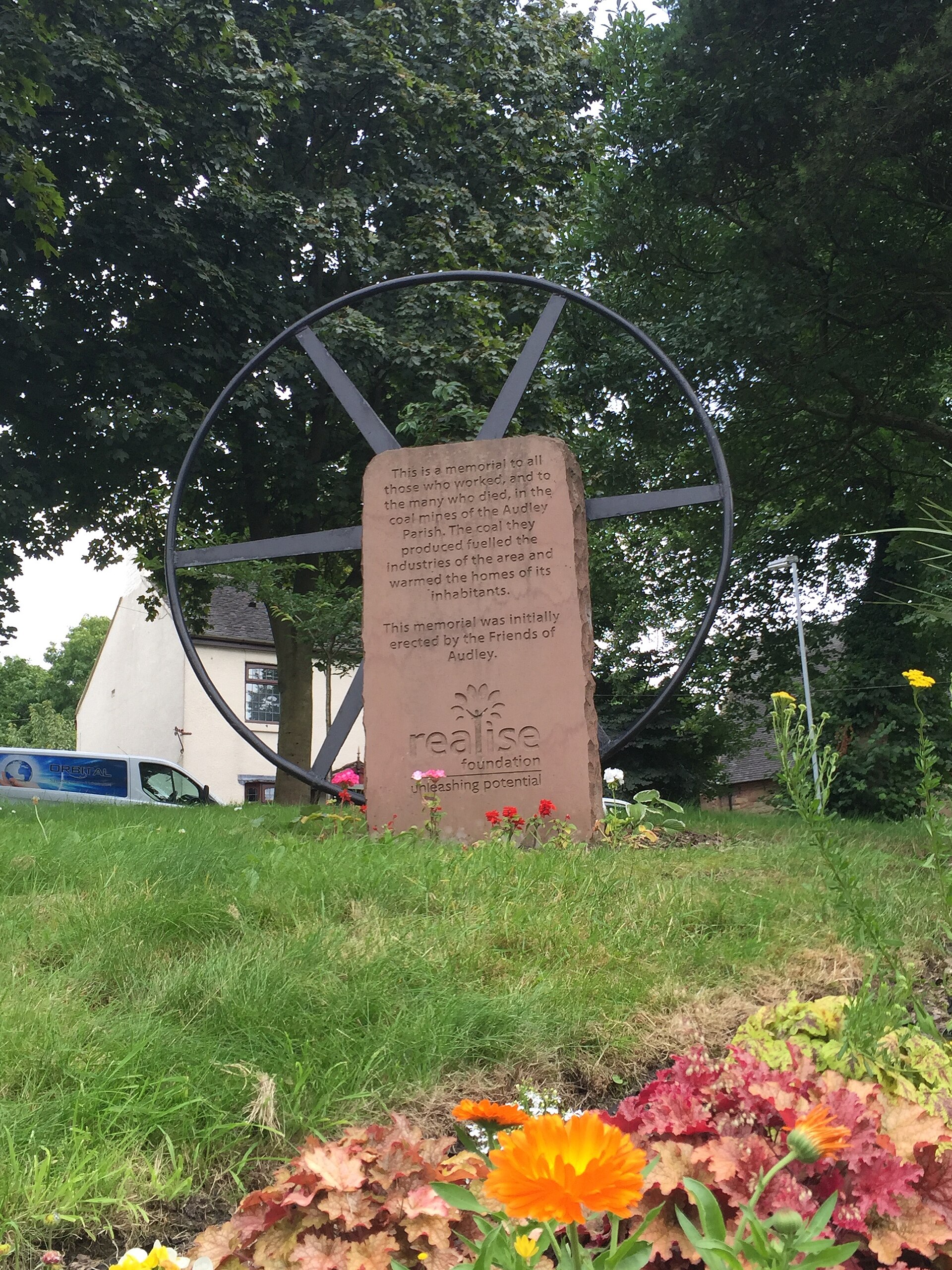
A memorial at Bignall End lists 78 names; a mining memorial stands in Audley; a sculpture of two kneeling miners was unveiled in Audley Methodist churchyard on 14 January 2020; William Dodd's restored headstone is at St James's, Audley. William Baron's dialect poem 'Vanquished Heroes' was written as an appeal for the sufferers, and the pianist Paderewski gave the proceeds of an 1895 Hanley concert to the fund.
What's uncertain
Points where sources disagree or the record could not be settled; both accounts are kept. All open questions in the archive.
Recorded claims
Individual factual claims, each attached to the source(s) that support it below. Where sources disagree, both are kept.
- 77 men and boys died; the memorial's 78 names include one duplicated. 1,2,3
- Staffordshire Past Track and the Bignall End memorial give 78. (disputed) 3,4
- The water broke in about 11.30 a.m. on Monday 14 January 1895, with about 240 men and boys underground. 2,5
- Water from the old Diglake workings entered the new East Ten Feet workings after the fireman William Sproston fired a shot; the barrier believed to be 80 yards was far thinner, the plans having been drawn to different scales. 1,5,6
- Frank Rigby admitted at the inquiry that boreholes ahead of the Ten Feet face had been discontinued on his orders in reliance on the surface plan. 6
- About 160 men and boys escaped through the Boyle's Hall shaft, connected to the Audley shafts by a 600-yard crut. 2,5
- The under-manager William Dodd and the collier John Boulton repeatedly re-entered the flooded workings and brought out some forty men and boys; Dodd received the Albert Medal from Queen Victoria. 1,2,5,3
- Only two bodies, Henry Holland and Harry Rhodes, were recovered in 1895; three skeletons were found in 1932-33 from a heading driven from the Rookery pit, and the workings were then sealed with 72 remaining. 1,5,6
- The search was suspended on Saturday 19 January because of the debris dam, gas and the risk of a further inrush. 2,5
- The jury found the men died by water from the old Diglake workings entering the Audley workings, that the evidence did not show how it got in, and that it was an unforeseen accident. 1,5
- The North Staffordshire Permanent Relief Society paid scaled benefits and the Staffordshire Sentinel's fund raised £17,000 for 37 widows and 88 children by the end of 1895. 6
- The fireman William Sproston and his son Enoch died; his son William, fifteen, was carried 200 yards by the flood and was the only survivor of the 26 in the East Ten Feet. 2,5
Related terminology
Mining terms this disaster is structurally linked to, with the nature of the relationship.
- Crosscut (contextual relationship)
Named in this record’s narrative: “…to Boyle's Hall. The water divided at the foot of the Ten Feet crut, part flowing east into the Seven Feet and part west into the Eight…” - Inrush (contextual relationship)
Named 3 times in this record, first in the cause: “An inrush of water from the abandoned and flooded workings of the old Diglake…” - Ladders (contextual relationship)
Named in this record’s narrative: “…was swept twenty yards and saved himself on a post, climbed the ladders of an air shaft against the flow and lost consciousness at the top,…” - Miners' Federation of Great Britain (contextual relationship)
Named 3 times in this record, first in the rescue and recovery: “…be restrained from throwing herself down the shaft, went home. The Miners' Federation's observers later argued that a drift driven from twenty yards up…” - Shot-firing (contributing factor)
A shot fired by the fireman in the Ten Feet face immediately preceded the inrush.
Photographs & further reading
This page doesn't try to reproduce everything — these are the best original sources found for this disaster.
The layout of the pit, the course of the flood, the rescues and the full list of the dead.
View sourceFrank Rigby's evidence on the discontinued boreholes, the Miners' Federation's report and the 1932-33 discoveries.
View sourceSources
- (secondary) Diglake Colliery Disaster — Wikipedia
- (secondary) Diglake Colliery Inrush, Audley, 1895 — Northern Mine Research Society
- (secondary) The Men of Diglake Colliery (Susan Bradley) — Healey Hero
- (secondary) Diglake Disaster — Staffordshire Past Track
- (secondary) Diglake Colliery Flooding 1895, page 1 (John Lumsdon) — Healey Hero (Ian Winstanley's mining history site)
- (secondary) Diglake Colliery Flooding 1895, page 2: the inquiry (John Lumsdon, with Cowey and Haslam's report for the Miners' Federation) — Healey Hero
Record created: 9 September 2026 · Last researched: 9 September 2026