 MineArchive
Diglake Colliery
| Also known as | Audley Colliery |
|---|---|
| Location | Bignall End, Audley, near Newcastle-under-Lyme, Staffordshire — 53.0555, -2.2810 (exact) |
| Commodity | Coal |
| Type | Coal |
| Worked | 1870 (earlier pit 1733 to c. 1850)–June 1905 |
| Maximum depth | Shafts 217 yards (198 m) in 1895; Wikipedia gives 790, 745 and 460 ft for Nos. 1, 2 and 3 |
| Operators | William Rigby and Co. (1870–1905) |
Overview
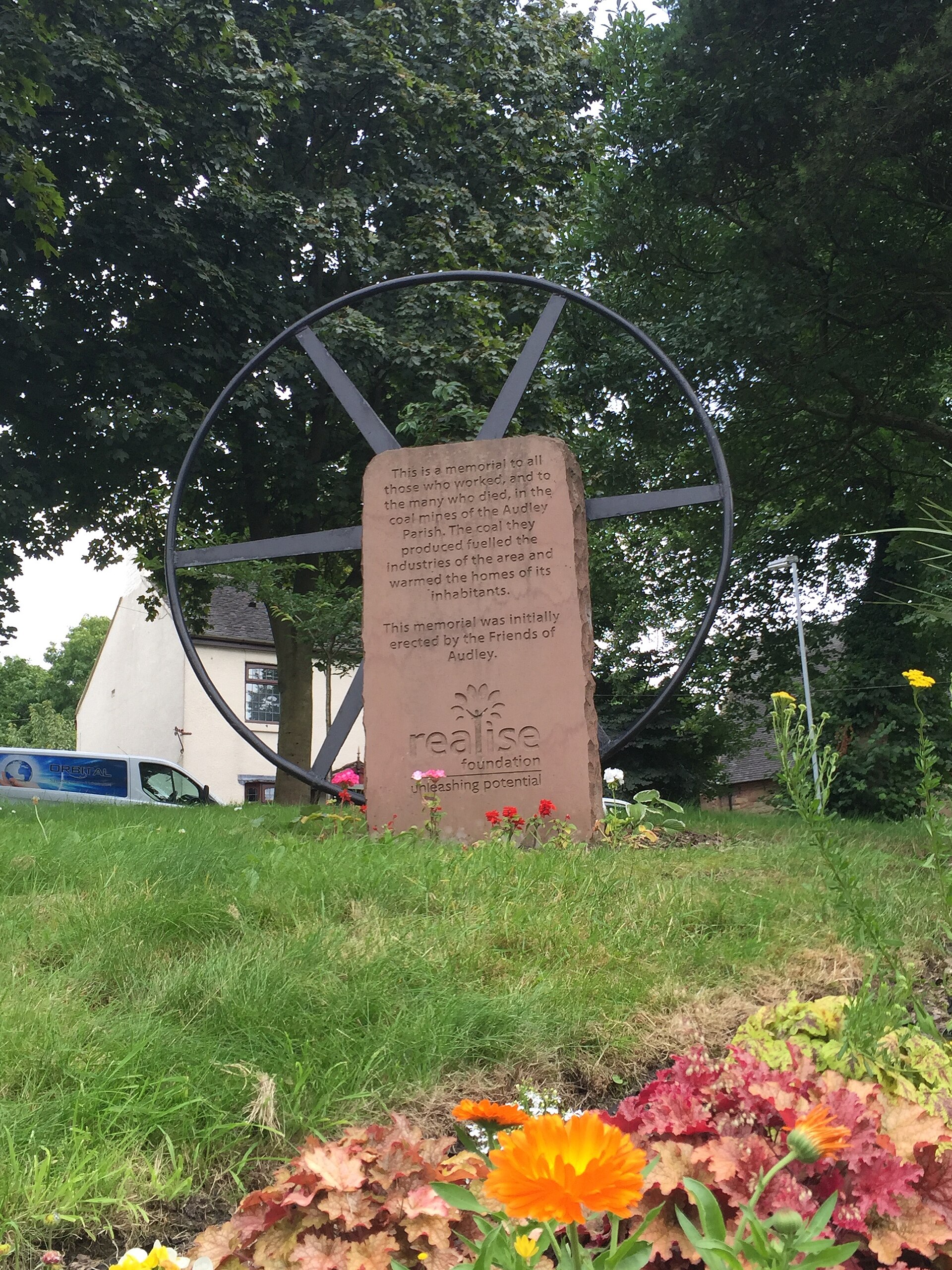
A North Staffordshire colliery at Bignall End, beside Audley station on the North Staffordshire Railway's Alsager to Keele line, sunk in 1870 by William Rigby and Company to the Seven, Eight and Ten Feet seams and known both as Diglake and as Audley Colliery. On 14 January 1895 water from the flooded workings of the old Diglake pit, abandoned since about 1850, broke into its new Ten Feet workings and drowned 77 men and boys, only three of whose bodies were ever recovered (see Disasters, below). The pit worked on at a reduced scale until June 1905; the remains of 72 men are still sealed in its workings, and a sculpture of two kneeling miners was unveiled at Audley Methodist Church on the 125th anniversary.
History
Coal was worked at Diglake from 1733 until about 1850-54, when the old pit, worked latterly by Sir Thomas Boughey, was given up for want of a canal or railway and left to fill with water; its Hams seam plan is dated 1865. The North Staffordshire Railway's Audley branch opened in 1870 and that year William Rigby and Company, lessees under Boughey, sank the new pit beside Audley station to the Seven, Eight and Ten Feet seams. Its two shafts, 36 yards apart and 217 yards deep, passed through faulted ground that displaced the strata about 80 yards down to the east, so that the Eight Feet Banbury was met 80 yards west of the shafts and the Seven Feet Banbury 155 yards east, each worked by an engine plane dipping 1 in 4; a crut from the shaft bottom connected 600 yards on with the higher Boyle's Hall shaft, and a rising crut cut the Ten Feet seam in June 1894. It was a wet pit, its men issued with special clothing and tin sheeting against the drip. About 300 were employed, many of them boys of thirteen to nineteen, and the returns give 479 in 1894. On 14 January 1895, after a winter of deep snow and thaw, a shot fired in the new Ten Feet workings by the fireman William Sproston was followed by an inrush from the old Diglake pond that killed 77 and left only three bodies recoverable (see Disasters, below). Frank Rigby, the managing partner, told the inquiry he had ordered boreholes stopped because the plans showed 80 yards of coal between the workings and the water; the inspector W. N. Atkinson thought the inherited plans misleading, and the jury found an unforeseen accident and a carefully managed colliery. The pit went on working: 242 were employed in 1896, 114 in 1900 on the Hams, Ten Feet and Two Row, and 25 in 1905, when it closed in June, though Wikipedia records a belief that coaling ceased after the disaster and a 1924 map showing the colliery disused. Mining moved to a new pit at Rookery to the north-east, and from it in 1932 a heading was driven towards the abandoned mine: three skeletons were found between September 1932 and March 1933, brought out and buried, and the roadway was then sealed, leaving 72 men where they died. In 2013 UK Coal's plan for an opencast site over the workings was opposed on that account and refused in 2014; on 14 January 2020 a sculpture of two kneeling miners was unveiled in Audley Methodist churchyard.
Geology
The pit worked the Middle Coal Measures of the north-western edge of the North Staffordshire coalfield, where the Ten Feet, Eight Feet Banbury, Seven Feet Banbury, Hams, Two Row, Bullhurst and Five Feet seams lie in a sequence broken by faulting: a fault crossing the shafts threw the strata about 80 yards down to the east, so that the Seven Feet Banbury was met east of the shafts 45 yards above the level at which the Eight Feet was met to the west. The Ten Feet's proximity to the flooded old Diglake workings, uncertainly plotted on inherited plans, was the cause of the 1895 disaster.
Geological setting: Faults and Fractures (well documented example), Sedimentary Beds and Seams (well documented example)
Workings
Two shafts 36 yards apart and 217 yards deep, with stone cruts driven east and west from the bottom, engine planes dipping 1 in 4 into the Eight Feet Banbury to the west and the Seven Feet Banbury to the east, and a crut rising 1 in 3 for 260 yards to the Ten Feet. The western crut connected 600 yards on with the Boyle's Hall shaft, formerly of the adjacent Boyles Hall Colliery and reopened for winding, through which 160 men and boys escaped in 1895. A dam of props, tubs and debris left by the flood at the foot of the dip made the drowned workings unreachable.
Closure
Closed in June 1905 with 25 employed, according to the Lists of Mines; Wikipedia records a belief that coaling ceased after the 1895 disaster. Working moved to the Rookery pit to the north-east.
What remains
A capped pit shaft beside the road at Halmer End carries an information board as a mining disaster memorial, photographed in December 2023, and the Audley mining memorial stands in the village; the 2020 sculpture of two kneeling miners is in Audley Methodist churchyard. Seventy-two bodies remain in the sealed workings, which is why an opencast scheme over the site was refused in 2014.
Capped shafts and memorials; no colliery buildings recorded.
Related mines
- Boyles Hall Colliery — Connected underground with Boyles Hall in 1896; the disused Boyles Hall workings were the escape route from the Diglake inundation.
- Bunker's Hill Colliery — Both were William Rigby and Company's pits in the Audley district of the North Staffordshire coalfield, and each is remembered for a disaster twenty years apart — the 1875 explosion here and the 1895 inundation at Diglake.
- Rookery Colliery — The neighbouring pit that the Rookery's flooded workings drowned in 1895, and whose work was afterwards transferred to the Rookery.
Nearby mines
- Rookery Colliery — 0.5 miles (0.8 km) NE
- Boyles Hall Colliery — 0.5 miles (0.9 km) W
- Jamage Colliery — 0.7 miles (1.2 km) NE
- Glasshouse Colliery — 1.0 miles (1.6 km) SE
- Talk o' th' Hill Colliery — 1.3 miles (2.0 km) NE
Straight-line distance, within 9 miles (15 km). Show on the map.
Disasters & major incidents
-
Diglake Colliery Inrush, 1895
14 January 1895 · Flooding / Inundation · 77 fatalities
At about 11.30 on the morning of Monday 14 January 1895, after a winter of deep snow and thaw, water from the flooded workings of the old Diglake pit, abandoned since about 1850, burst into the new Ten Feet workings of Diglake or Audley Colliery at Bignall End and poured down the dip through the mine, drowning 77 men and boys of the 240 or so underground. About 160 escaped through the Boyle's Hall shaft, many led out by the under-manager William Dodd and the collier John Boulton, who went back into the rising water again and again and were decorated for it. A dam of tubs and timber at the foot of the dip and the threat of further floods and gas forced the rescue to be abandoned within the week with only two bodies recovered. The inquiry could not show how the water got in, called it an unforeseen accident, and left the men where they lay; three skeletons were found in 1932-33 and the workings were sealed.
What's uncertain
Points where sources disagree or the record could not be settled; both accounts are kept. All open questions in the archive.
- Wikipedia gives three shafts of 790, 745 and 460 feet, the third formerly part of the adjacent Boyles Hall Colliery. (uncertain) 1
Recorded claims
Individual factual claims, each attached to the source(s) that support it below. Where sources disagree, both are kept.
- Coal was worked at Diglake from 1733 until about 1850-54, when the old pit was abandoned for lack of a canal or railway and left to fill with water. 1,2
- The new pit was sunk in 1870 by William Rigby and Sons, lessees of Sir Thomas Boughey, beside Audley station, to the Seven, Eight and Ten Feet seams. 3,2
- The two shafts were 36 yards apart and 217 yards deep, through faulted ground that displaced the strata about 80 yards down to the east; a crut connected 600 yards on with the Boyle's Hall shaft. 3
- Wikipedia gives three shafts of 790, 745 and 460 feet, the third formerly part of the adjacent Boyles Hall Colliery. (uncertain) 1
- The colliery employed 479 in 1894, 242 in 1896, 114 in 1900 and 25 in 1905, when it closed in June. 4
- On 14 January 1895 an inrush of water from the old Diglake workings drowned 77 men and boys; only three bodies were recovered. 1,4,3
- Mining moved to a new pit at Rookery to the north-east, from which a heading driven in 1932 reached the drowned workings; three skeletons were recovered between September 1932 and March 1933 and the roadway was sealed. 1,5
- UK Coal's 2013 plan for an opencast site over the workings, opposed for fear of disturbing the bodies, was refused in 2014. 1
- A sculpture of two kneeling miners was unveiled in Audley Methodist churchyard on 14 January 2020, the 125th anniversary. 1
- The catalogue holds an 1865 Hams seam plan for Audley and 1905 abandonment plans for Audley, Boyles Hall and Diglake covering the Hams, Ten Feet, Two Row, Eight Feet Banbury, Bullhurst and Five Feet. 6,7
Photographs & further reading
The fullest account of the pit's layout, the inrush and the rescue, with the names of the dead.
View sourceJohn Lumsdon's three-page account of the disaster, the inquiry and the 1932-33 discoveries, with Susan Bradley's research on the men.
View sourceThe disaster, the inquiry, the 1979 regulations, the 2013 opencast dispute and the 2020 memorial.
View sourceSources
- (secondary) Diglake Colliery Disaster — Wikipedia
- (secondary) Diglake Colliery Flooding 1895, page 1 (John Lumsdon) — Healey Hero (Ian Winstanley's mining history site)
- (secondary) Diglake Colliery Inrush, Audley, 1895 — Northern Mine Research Society
- (primary) Durham Mining Museum: Diglake Colliery — Durham Mining Museum
- (secondary) Diglake Colliery Flooding 1895, page 2: the inquiry (John Lumsdon, with Cowey and Haslam's report for the Miners' Federation) — Healey Hero
- (primary) Audley, Boyles Hall and Diglake abandonment plan, 1905: Hams, Ten Feet, Two Row, Eight Feet Banbury, Bullhurst and Five Feet seams (mine plans catalogue) — British Geological Survey / Mining Remediation Authority
- (primary) Audley abandonment plan: Hams seam, 1865 (mine plans catalogue) — British Geological Survey / Mining Remediation Authority
Record created: 9 September 2026 · Last researched: 9 September 2026