 MineArchive
Levant Mine man-engine disaster, 1919
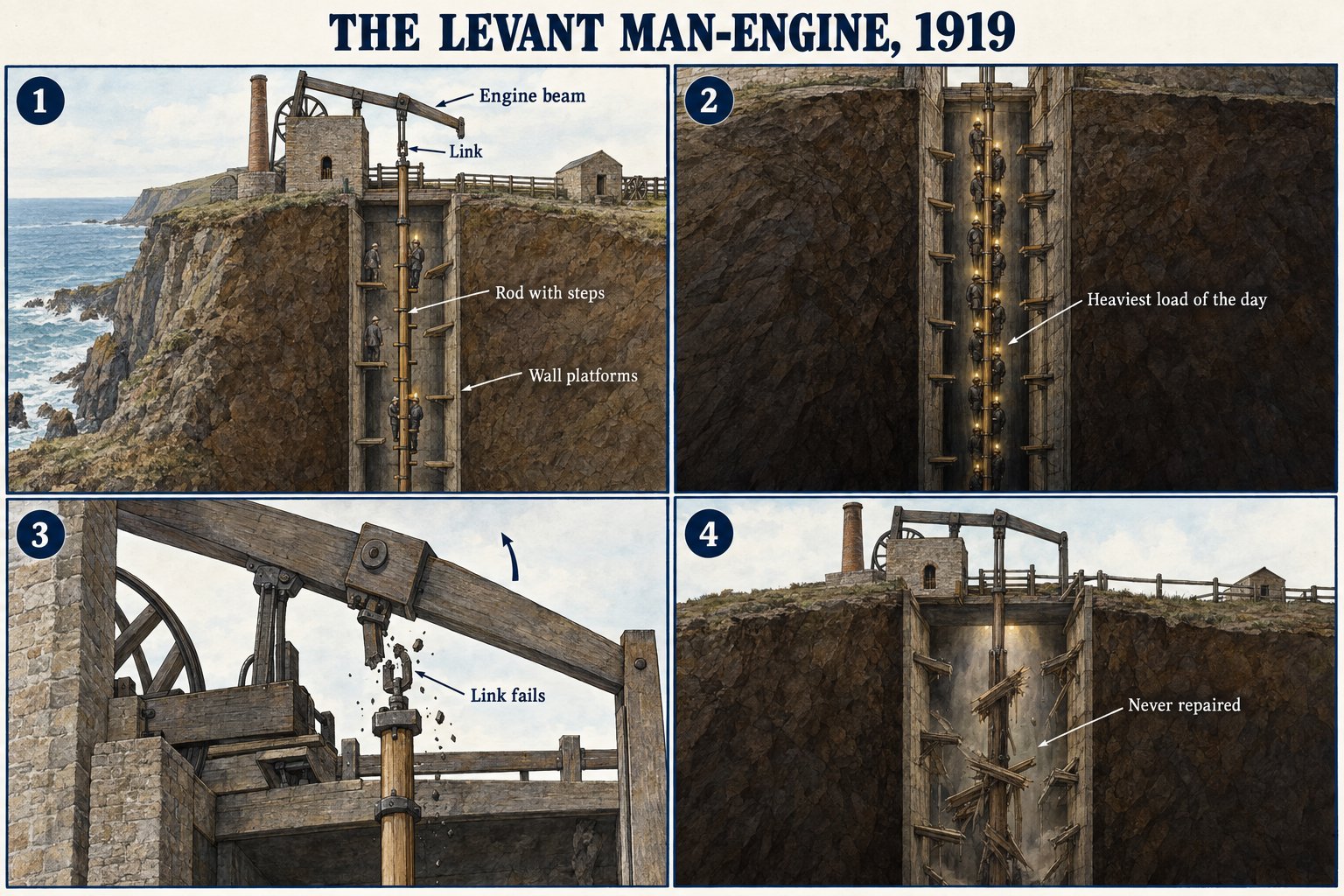
During a shift change at Levant Mine, a link between the man-engine's reciprocating rod and its surface beam broke, collapsing the engine down the shaft while 130-150 miners were using it.
| Date | 20 October 1919 |
|---|---|
| Mines involved | Levant Mine, Geevor Tin Mine (related workings) |
| Region | Cornwall |
| Type | Winding / Shaft Accident |
| Fatalities | 31 |
| Context | During active mining |
Location
Plotted at Levant Mine. Approximate location. The large pin is the mine; the small round markers are the nearest mines on record. Click one for its page. View on full map
Cause
A worn or fatigued link connecting the man-engine's reciprocating rod to the beam at surface failed at the shift change, when the man-engine was under its heaviest load of the day. The link was one of the two wrought-iron strap plates, or caps, that held the rod to the quadrant beam at surface. Tests at Sheffield found the faggoted iron of the caps uneven in quality, and the inquest put the break down to fatigue in a defective part of the metal, which, the Home Secretary was advised, no external examination could have detected.
Contributing factors
By 1919 the man-engine was 62 years old and the only one still at work in Cornwall; in 1914 a Royal Commission had called such engines a survival from the past. When the cap broke, the top of the rod swung out of line, so the catches meant to hold a falling rod engaged only partly and gave way in the upper part of the shaft. The rod also snapped about 60 fathoms below the cap, and that upper length, carrying about 30 men, fell 46 fathoms to the 70-fathom level, destroying the platforms as it went.
What happened
On 20 October 1919, as the afternoon shift change began, a link between the man-engine's reciprocating rod and beam broke. The engine collapsed down the shaft while between 130 and 150 miners were using it to travel between levels. The break came on the upstroke, with the rod within 18 inches of the top of its stroke; it dropped about 10 feet 6 inches onto the first of its catches (the Times put it at 12 feet), tearing away the timberwork the men stood on. Robert Penaluna, riding the rod, remembered the men gripping it 'like grim death'. 31 men died and nineteen were injured. The man-engine, installed in 1857, was never repaired, and the deepest sections of the mine it served were never worked again.
Rescue & recovery
The falling rod stripped the shaft of its ladders and platforms. Below the wreckage most of the men could make their own way into the levels and up the ladders of the pumping shaft; above it the dead and injured were stranded where they could barely be reached. Men came from Geevor and from East Pool, near Redruth, to help, and the last body was recovered on the morning of 25 October.
Investigation & inquiry
The inquest, held by Edward Boase, coroner for the Western District, in the Levant Mining Company's offices, took two full days. The jury returned a verdict of accidental death, the cause being the breaking of a strap plate through fatigue of a defective part of the metal. H. A. Abbott, one of HM Inspectors of Mines, reported on the disaster to the Home Secretary in December 1919, and that month the Home Secretary told the Commons that no inspector had reported the shaft arrangements as unsafe.
Changes to practice & legislation
The man-engine was never repaired or replaced; men went in and out by the ladders, pending a vertical winding shaft the company was considering. Levant went on working its shallower sections using conventional shaft haulage until closure in 1930.
Memorials & commemoration
A memorial plaque to the men, once in Trewellard Wesleyan Chapel, is now in the Hard Rock Museum at Geevor.
What's uncertain
Points where sources disagree or the record could not be settled; both accounts are kept. All open questions in the archive.
- When the connecting rod broke at the top of its stroke, the beam with its load fell 12 feet, smashing many of the shaft platforms. (disputed) 5
- The rod fell 10 feet 6 inches to the catches. (disputed) 1
Recorded claims
Individual factual claims, each attached to the source(s) that support it below. Where sources disagree, both are kept.
- 31 men died when the man-engine collapsed during the shift change on 20 October 1919. 1
- Thirty-one men were killed and nineteen injured. 1,2
- The inquest jury found accidental death, the cause being the breaking of a strap plate through fatigue of a defective part of the metal. 1,2
- The rod broke about 60 fathoms below the cap, and that length, carrying about 30 men, fell 46 fathoms to the 70-fathom level. 1,3
- The last body was recovered on the morning of 25 October 1919. 1
- The man-engine, installed in 1857, was the only one still in use in Cornwall in 1919. 4,1,3
- When the connecting rod broke at the top of its stroke, the beam with its load fell 12 feet, smashing many of the shaft platforms. (disputed) 5
- The rod fell 10 feet 6 inches to the catches. (disputed) 1
Related terminology
Mining terms this disaster is structurally linked to, with the nature of the relationship.
- Fathom (contextual relationship)
Named twice in this record, first in the contributing factors: “…way in the upper part of the shaft. The rod also snapped about 60 fathoms below the cap, and that upper length, carrying about 30 men, fell 46…” - Ladders (contextual relationship)
Named 3 times in this record, first in the rescue and recovery: “The falling rod stripped the shaft of its ladders and platforms. Below the wreckage most of the men could make their…” - Level (contextual relationship)
Named in this record’s narrative: “…while between 130 and 150 miners were using it to travel between levels. 31 men died and many more were injured. The man-engine, installed…” - Man-engine (direct cause)
The disaster was a direct mechanical failure of the man-engine itself. - Royal Commission (contextual relationship)
Named in this record’s contributing factors: “…62 years old and the only one still at work in Cornwall; in 1914 a Royal Commission had called such engines a survival from the past. When the cap…”
Sources
- (secondary) Accident at Levant Tin Mine 1919 — Northern Mine Research Society
- (primary) Cornish Mine Disaster (HC Deb 10 December 1919, written answers) — UK Parliament (Hansard)
- (secondary) Disaster at Levant Mine, 20th October 1919 (Penwith Local History Group, On this Day) — Penwith Local History Group
- (secondary) History of Levant Mine and Beam Engine — National Trust
- (secondary) The Levant mine disaster (Bernard Deacon, Cornish studies resources) — Bernard Deacon
- (secondary) The Levant Mine Disaster (Cornwall For Ever!) — Cornwall For Ever!
Record created: 20 August 2026 · Last researched: 20 November 2026