 MineArchive
Houghton Main Colliery
| Location | Little Houghton, South Yorkshire — 53.5494, -1.3667 (approximate) |
|---|---|
| Commodity | Coal |
| Type | Coal |
| Worked | 1873-78–c. 1992/93 |
| Maximum depth | 823 yards (No. 3 shaft, deepened 1937-40) |
| Operators | Houghton Main Coal Co. (1873–1947), National Coal Board (1947–?) |
Overview
A Barnsley-area colliery sunk in the 1870s whose ninety-year working life was marked by three separate disasters, each with a fully named list of the dead, spanning a Victorian cage accident, an inter-war explosion and a 1975 blast that led to a major public inquiry.
History
Houghton Main Colliery was sunk at Little Houghton, around five miles east of Barnsley, with two shafts started between 1873 and 1878 by the Houghton Main Coal Co., later Houghton Main Colliery Co. Ltd. Both original shafts were 14 feet in diameter, deepened in 1919-21, No. 2 reaching the Thorncliffe seam at 816 yards, and a third, 20-foot-diameter upcast shaft was sunk in 1924-28, later deepened to 823 yards by 1937-40. The colliery worked the Barnsley, Thorncliffe, Meltonfield, Beamshaw, Parkgate and Winter seams over its lifetime, with coal from the upper seams transported underground to be wound at the neighbouring Grimethorpe Colliery; by 1967 all of its output went that way, 1,590 men producing 753,000 tons a year from fully mechanised faces. Employment grew from around 990 in 1894 to a peak of over 2,600 by 1947, and output reached 1,120,500 tons in 1940; the colliery stood as one of eighteen collieries in the NCB's Barnsley Area after nationalisation in 1947. The colliery's working life was marked by three separate disasters, each killing five or more men (see Disasters, below): a cage overwinding accident on 30 December 1886 that killed 10; an explosion during shot-firing on 12 December 1930 that killed 7; and an explosion in the Meltonfield seam on 12 June 1975 that killed 5 and led to a major public inquiry into ventilation and shot-firing practice across the industry. Houghton Main closed in the early 1990s, with production ceasing around October 1992, though some accounts place the final closure in 1993, the date carried on the memorial winding wheel at Little Houghton.
Geology
The colliery worked the Barnsley, Thorncliffe, Meltonfield, Beamshaw, Parkgate and Winter seams of the Yorkshire coalfield, the Thorncliffe lying at about 816 yards.
Geological setting: Sedimentary Beds and Seams (well documented example)
Workings
Two shafts sunk 1873-78, deepened 1919-21; a third, upcast shaft sunk 1924-28 and deepened to 823 yards by 1937-40, drawing coal from the Barnsley, Thorncliffe, Meltonfield, Beamshaw, Parkgate and Winter seams.
Closure
Production ceased around October 1992, with some accounts giving final closure in 1993; the precise date is not recorded.
What remains
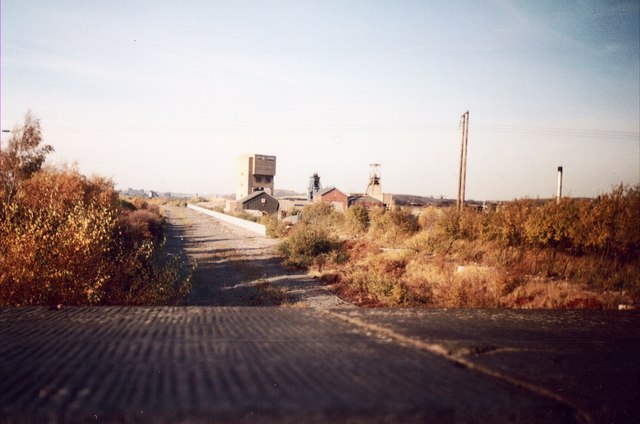
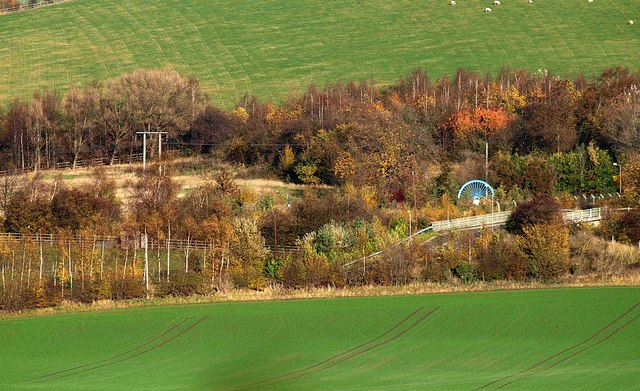
The colliery has been demolished: in 2006 the former site was being prepared for a new warehouse, and by 2009 its spoil heap, the 'muck stack', had been reclaimed as grazed grassland.
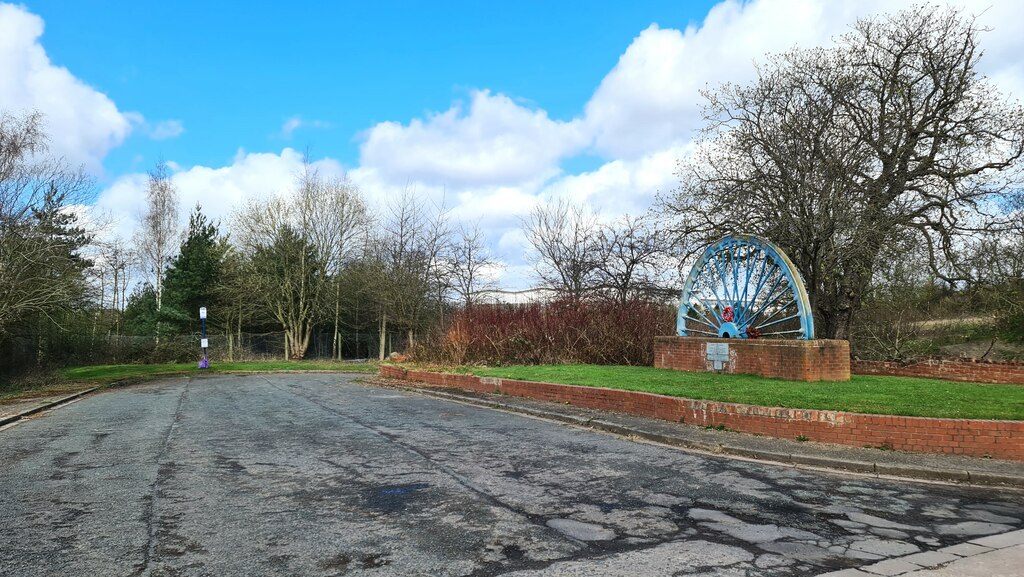
A winding wheel preserved as a memorial at the Little Houghton bus terminus, inscribed 'Houghton Main Colliery 1873-1993', and a memorial clock and plaque on Middlecliffe Lane to the area's miners who worked through the First World War.
Related mines
- Darfield Main Colliery — Darfield Main was merged with Houghton Main from 1986 to work the Silkstone seam, and closed in 1989 as its Darfield section.
- Grimethorpe Colliery — Coal from Houghton Main's upper seams was wound to the surface at Grimethorpe via connecting underground roadways.
Nearby mines
- Grimethorpe Colliery — 1.5 miles (2.4 km) W
- Darfield Main Colliery — 1.7 miles (2.8 km) SW
- Ferrymoor Colliery — 1.7 miles (2.8 km) NW
- Mitchell Main Colliery — 2.1 miles (3.3 km) SW
- Highgate Colliery — 2.3 miles (3.8 km) SE
Straight-line distance, within 9 miles (15 km). Show on the map.
Disasters & major incidents
-
Houghton Main Colliery shaft accident, 1886
30 December 1886 · Winding / Shaft Accident · 10 fatalities
An overwound cage struck the headframe and fell 535 yards down the shaft at Houghton Main Colliery on the morning of 30 December 1886, killing all 10 men and boys riding in it; the engineman was tried for manslaughter and acquitted. -
Houghton Main Colliery explosion, 1930
12 December 1930 · Explosion · 7 fatalities
A firedamp explosion during ripping operations at Houghton Main Colliery killed seven men in December 1930, after a deputy fired a fourth shot hole despite reportedly detecting a break in the coal that should have prompted a check for gas. -
Houghton Main Colliery explosion, 1975
12 June 1975 · Explosion · 5 fatalities
An explosion in the Meltonfield seam at Houghton Main Colliery on 12 June 1975 killed five men after firedamp, which had accumulated in an unventilated heading for nine days, was ignited by frictional sparking from an auxiliary fan; a major public inquiry followed.
Culture
- Houghton Main Colliery Band (Music)
The colliery's band from 1906, when the Wombwell Temperance Band was re-formed under its name; in 1955 the colliery manager was its honorary president and its players were pit families. - Houghton Main Colliery F.C. (Sports)
The Darfield club played as Houghton Main Colliery from 1920 to 1923, taking the colliery's name; its later successor is Houghton Main (Wikipedia, Football Club History Database). - The Price of Coal (Screen)
Part two was written in the winter after the 1975 Houghton Main explosion and the inquiry into it in Barnsley.
Recorded claims
Individual factual claims, each attached to the source(s) that support it below. Where sources disagree, both are kept.
- Two shafts, each 14 feet in diameter, were sunk between 1873 and 1878 by the Houghton Main Coal Co. 1,2
- A third, 20-foot-diameter upcast shaft was sunk in 1924-28, and later deepened to 823 yards by 1937-40. 1,2
- After nationalisation in 1947, Houghton Main was one of eighteen mines in the NCB's Barnsley Area. 1
- The colliery suffered three separate disasters each killing five or more: a cage accident in 1886 (10 dead), an explosion in 1930 (7 dead) and an explosion in 1975 (5 dead). 2
- Output was 750,000 tons in 1923 and 1933 and reached 1,120,500 tons in 1940; employment peaked at 2,636 in 1947. 2
- By 1967 all the output from Houghton Main's fully mechanised workings was carried underground and wound at Grimethorpe Colliery, with 1,590 men producing 753,000 tons from the Beamshaw, Parkgate and Winter seams. 2
- No. 2 shaft was deepened to the Thorncliffe seam at 816 yards in 1919, and No. 3 shaft, 20 feet in diameter, was sunk to the same horizon from 1924 as the upcast. 1,2
- A winding wheel stands as a memorial at the Little Houghton bus terminus, inscribed 'Houghton Main Colliery 1873-1993' when photographed in 2025. 3
- In 2006 earthmoving on the former colliery site was preparing the ground for a new warehouse, and by 2009 the colliery's spoil heap had been reclaimed as grassland. 4,5
Photographs & further reading
Owners, output and employment figures by year, the seams worked, and the names of men known to have died at the colliery.
View sourceA short history of the shafts and seams, with links to the NMRS accounts of the 1886, 1930 and 1975 disasters.
View sourceThe memorial clock and plaque at Little Houghton to local miners who worked through the First World War and those who served with the York and Lancaster Regiment.
View sourceSources
- (secondary) Houghton Main Colliery — Northern Mine Research Society
- (primary) Durham Mining Museum - Houghton Main Colliery — Durham Mining Museum
- (observational) Bus terminus and Commemorative Winding Wheel, Little Houghton (Geograph photo 8007560, Chris Morgan, 2025) — Geograph Britain and Ireland
- (observational) Earthmoving equipment on site of former Houghton Main Colliery (Geograph photo 493274, Steve Fareham, 2006) — Geograph Britain and Ireland
- (observational) The bridleway from Great Houghton to Little Houghton (Geograph photo 1287174, Steve Fareham, 2009) — Geograph Britain and Ireland
- (primary) Houghton Main (BGS mine plans catalogue, item 21860592) — British Geological Survey
- (secondary) Houghton Main Colliery memorial clock and plaque (War Memorials Online 175147) — War Memorials Online
Record created: 27 August 2026 · Last researched: 18 September 2026