 MineArchive
Houghton Main Colliery explosion, 1930
A firedamp explosion during ripping operations at Houghton Main Colliery killed seven men in December 1930, after a deputy fired a fourth shot hole despite reportedly detecting a break in the coal that should have prompted a check for gas.
| Date | 12 December 1930 |
|---|---|
| Mine | Houghton Main Colliery |
| Region | South Yorkshire |
| Type | Explosion |
| Fatalities | 7 (This record follows the Northern Mine Research Society's account, which gives the date as 12 December 1930 and names seven dead: Albert Holden, James Lackey, Jacob Newberry, Norman Nicholson, John Pearson, William Richards and Charles Watson. A local-history account of the same colliery's December 1930 explosion instead gives the date as 19 December 1930 and a toll of five dead, naming Norman Nicholson, John Pearson, Albert Holden, James Lackey and William Richards — five of the same seven names, but omitting Jacob Newberry and Charles Watson, and a week's difference in date. This is presented as a genuine, unresolved discrepancy between sources rather than silently picked one way: it is plausible the smaller, earlier toll reflects an initial press report before further deaths were confirmed, but this record does not assert that explanation as fact.) |
| Injuries | Ten men sustained burns, per the Northern Mine Research Society; a separate local-history account gives seventeen injured, twelve of them hospitalised. |
| Context | During active mining |
Cause
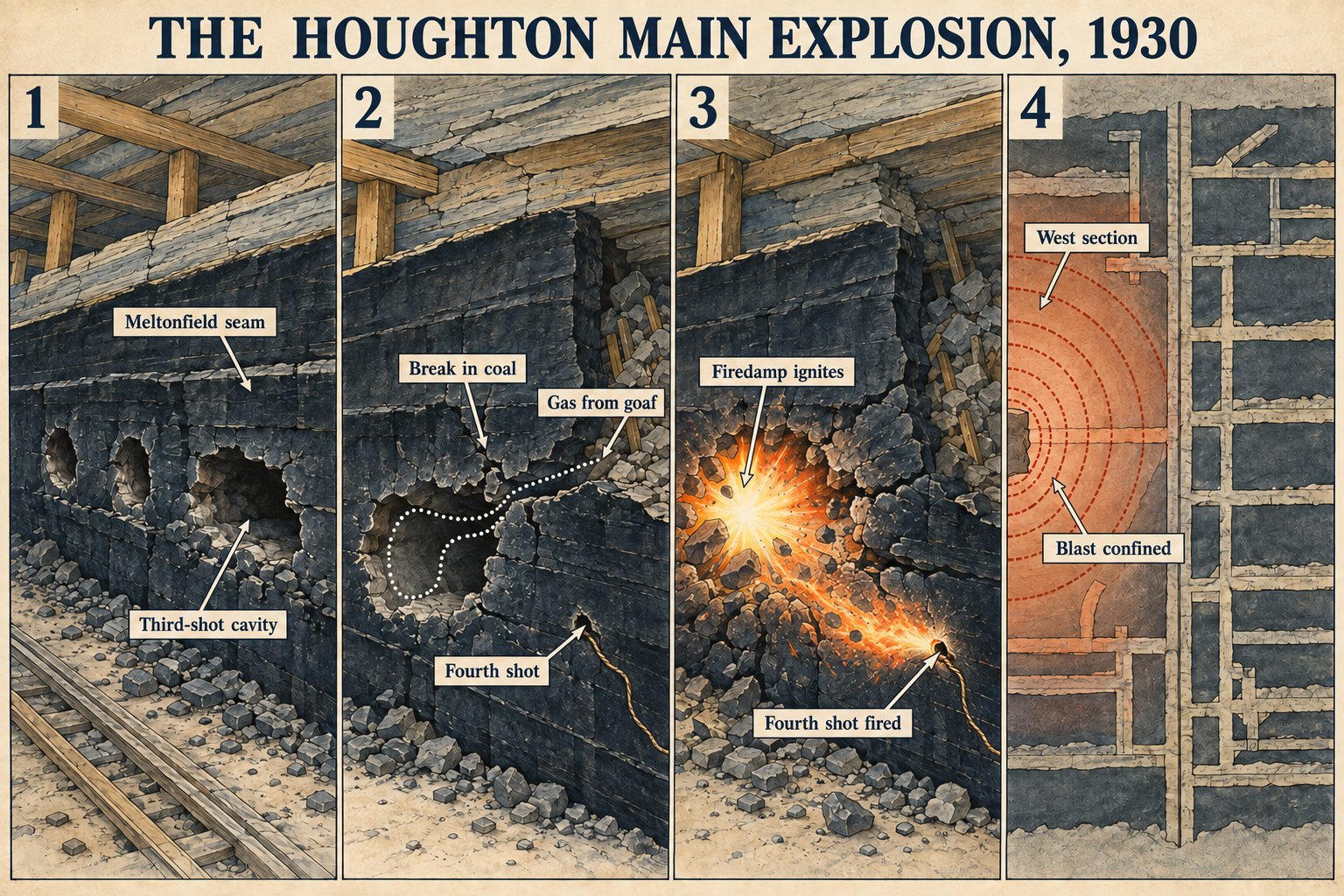
The deputy, Joseph Netherwood, was firing shot holes during ripping work when he fired the fourth hole despite reportedly having detected a break, or fracture, in the coal. Firedamp present in the cavity left by the third shot, and gas reaching in from the goaf, is understood to have ignited from the fourth shot.
Contributing factors
H.M. Divisional Inspector E.H. Frazer's report into the disaster identified three separate negligence failures, chief among them the deputy's failure to examine the shot holes for breaks before firing them.
What happened
The explosion struck shortly after midnight in the Meltonfield seam, where around 200 miners were working, though the blast itself was confined to the west section of the district. Witnesses described a sudden gust of wind, 'like a whirlwind', followed by a bang and a flash. Dr W.F.L. Castle of Darfield went down the pit himself to give emergency treatment to the injured during the initial rescue effort.
Rescue & recovery
Dr W.F.L. Castle descended into the pit to treat injured miners as part of the initial rescue response.
Investigation & inquiry
A coroner's inquest jury found the men died from explosion-related burns but stated they were 'not satisfied there was neglect'. H.M. Divisional Inspector E.H. Frazer's subsequent official report disagreed, identifying three specific negligence failures centred on the deputy's conduct.
What's uncertain
Points where sources disagree or the record could not be settled; both accounts are kept. All open questions in the archive.
- NMRS names seven dead: Albert Holden, James Lackey, Jacob Newberry, Norman Nicholson, John Pearson, William Richards and Charles Watson. A local-history account of the same explosion instead gives five dead and a date a week later. (disputed) 1,2
Recorded claims
Individual factual claims, each attached to the source(s) that support it below. Where sources disagree, both are kept.
- NMRS names seven dead: Albert Holden, James Lackey, Jacob Newberry, Norman Nicholson, John Pearson, William Richards and Charles Watson. A local-history account of the same explosion instead gives five dead and a date a week later. (disputed) 1,2
- The deputy fired a fourth shot hole during ripping work despite reportedly detecting a break in the coal; firedamp present in the cavity from the third shot, and gas from the goaf, is understood to have ignited. 1
- A coroner's inquest jury found the deaths were from explosion-related burns and stated they were not satisfied there was neglect, but H.M. Divisional Inspector E.H. Frazer's subsequent report identified three negligence failures. 1
Related terminology
Mining terms this disaster is structurally linked to, with the nature of the relationship.
- Coal (contextual relationship)
Named twice in this record, first in the summary: “…fired a fourth shot hole despite reportedly detecting a break in the coal that should have prompted a check for gas.” - Deputy (contextual relationship)
Named 4 times in this record, first in the summary: “…at Houghton Main Colliery killed seven men in December 1930, after a deputy fired a fourth shot hole despite reportedly detecting a break in the…” - Firedamp (contextual relationship)
Named twice in this record, first in the summary: “A firedamp explosion during ripping operations at Houghton Main Colliery killed…” - Goaf (contextual relationship)
Named in this record’s cause: “…in the cavity left by the third shot, and gas reaching in from the goaf, is understood to have ignited from the fourth shot.” - Ripping (contextual relationship)
Named twice in this record, first in the summary: “A firedamp explosion during ripping operations at Houghton Main Colliery killed seven men in December…”
Sources
- (secondary) Houghton Main Colliery Explosion - Barnsley - 1930 — Northern Mine Research Society
- (secondary) Disastrous Explosion at Houghton Main – Five Dead: Twelve Injured — Dearne Valley History
Record created: 27 August 2026 · Last researched: 27 August 2026