 MineArchive
Grimethorpe Colliery
| Location | Grimethorpe, near Barnsley, South Yorkshire — 53.5556, -1.4014 (approximate) |
|---|---|
| Commodity | Coal |
| Type | Coal |
| Worked | From 1894 (sinking)–May 1993 |
Overview
A South Yorkshire colliery that turned a tiny hamlet into an industrial town of thousands, home to the world-renowned Grimethorpe Colliery Band, and whose 1993 closure — while still profitable — left the village named Britain's most deprived, an experience that inspired the film Brassed Off.
History
Grimethorpe Colliery was sunk by the Mitchell Main Colliery Company, which held a 'Turning of the First Sod' ceremony on 8 October 1894, with guests brought in by a specially built railway branch line. Company director Joseph Mitchell predicted the new colliery would produce 2,500 tons of coal a day from workings eventually extending across 3,000 acres. The thick, seven-foot Barnsley steam-coal seam was reached in 1897 at a depth of 560 yards down two shafts, with production beginning that same year. Ownership passed from Mitchell Main to the newly formed Grimethorpe Colliery Company in 1896, and on to the Carlton Main Colliery Company from 1901; when the nearby Ferrymoor Colliery was sunk in 1915, it too was absorbed into Carlton Main's operations by 1919. Workings were deepened to reach the Parkgate seam — 'an excellent coking coal' — at 839 yards in 1925.
The colliery utterly transformed its surroundings: the hamlet's population grew from just 87 in 1891 to 3,262 by 1911 and 5,208 by 1931, as migrant workers arrived from across Britain and Ireland to build a fully-fledged industrial village complete with shops, churches, schools and recreational facilities. Among the most enduring of these was the Grimethorpe Colliery Band, founded by the miners themselves in 1917 and later promoted heavily by the National Coal Board after nationalisation in 1947, playing as many as 200 concerts a year. Under NCB ownership the pit continued working, its mechanised faces in the Melton Field, Winter and Parkgate seams producing 526,000 tons a year from a workforce of 1,890 in its later NCB years, with coal from the neighbouring Houghton Main Colliery also wound to the surface at Grimethorpe via connecting underground roadways.
Grimethorpe closed in May 1993 after 97 years of production — a closure made especially bitter locally because the pit was considered economically viable at the time, and reportedly turned a profit of a million pounds in its final year. The closure came as part of the wider 'Dash for Gas' shift in British electricity generation away from coal, driven by EU regulations permitting gas-fired power stations and government policy favouring cheap imported coal from Colombia and South Africa over domestic production; some 6,000 mining jobs were lost across the district between 1985 and 1995. Within a year Grimethorpe was named Britain's most deprived village, unemployment reaching 33% by 1994; the associated power station, Coalite plant and coal preparation works all closed by 1995, and 1,917 residents left the village between 1993 and 2001. The Grimethorpe Colliery Band survived its parent pit by decades, remaining one of Britain's leading brass bands and providing the real-life inspiration, and soundtrack, for the 1996 film Brassed Off, which dramatised the closure. A Grimethorpe Regeneration Executive worked from 1997 to 2008 to rebuild the village's economy and housing.
Geology
Coal of the South Yorkshire field: the Barnsley steam-coal seam, seven feet thick, reached at 560 yards in 1897, and the Parkgate — 'an excellent coking coal' — at 839 yards from 1925.
Workings
Twin shafts reached the seven-foot Barnsley seam at 560 yards in 1897, later deepened to the Parkgate seam at 839 yards in 1925; mechanised faces in later years worked the Melton Field, Winter and Parkgate seams, with coal from the neighbouring Houghton Main Colliery also wound up at Grimethorpe via connecting roadways.
Closure
The pit closed in May 1993 despite reported profitability, as part of the national 'Dash for Gas' shift away from coal-fired power generation; the closure devastated the local economy, with Grimethorpe named Britain's most deprived village within a year.
What remains
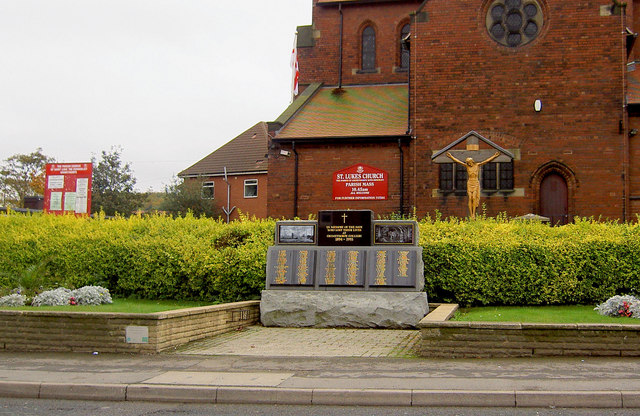
The colliery site has been landscaped, including the former spoil heap or 'muck stack', now a grassed viewpoint. A memorial to those who lost their lives working the pit stands outside St Luke's church, near the village war memorial.
Related mines
- Carlton Main Colliery — Grimethorpe was transferred to the Carlton Main Colliery Company in 1896, while this colliery was still employing over a thousand men; both of the company's acquisitions outlived it by nearly a century, working until 1993.
- Ferrymoor Colliery — Ferrymoor was started in 1915 six hundred metres from Grimethorpe Colliery as the village's second pit, and both were absorbed into the Carlton Main Colliery Company's operations by 1919.
- Houghton Main Colliery — Coal from Houghton Main's upper seams was wound to the surface at Grimethorpe via connecting underground roadways.
Nearby mines
- Ferrymoor Colliery — 1.4 miles (2.2 km) NE
- Houghton Main Colliery — 1.5 miles (2.4 km) E
- Mitchell Main Colliery — 1.6 miles (2.6 km) S
- Monk Bretton Colliery — 1.7 miles (2.7 km) N
- Darfield Main Colliery — 1.8 miles (2.8 km) S
Straight-line distance, within 9 miles (15 km). Show on the map.
Culture
- Brassed Off (Screen)
The film's Grimley is Grimethorpe: its story follows the colliery's 1992 closure announcement and the band's win four days later, and it was largely filmed in the village in 1995. - Grimethorpe Colliery Band (Music)
The colliery whose workforce founded the band in 1917; its closure was announced on 13 October 1992, four days before the band's most famous victory, and it closed in 1993.
Recorded claims
Individual factual claims, each attached to the source(s) that support it below. Where sources disagree, both are kept.
- The colliery was sunk from 1894 by the Mitchell Main Colliery Company; the Barnsley seam was reached in 1897 at 560 yards depth, with production beginning that year. 1
- Ownership passed to the Grimethorpe Colliery Company in 1896 and to the Carlton Main Colliery Company from 1901, which also absorbed the nearby Ferrymoor Colliery (sunk 1915) by 1919. 1
- The hamlet's population grew from 87 in 1891 to 3,262 by 1911 and 5,208 by 1931 as migrant workers arrived to work the colliery. 1
- The Grimethorpe Colliery Band was founded by the miners themselves in 1917. 1
- The colliery closed in May 1993 after 97 years, despite being considered economically viable and reportedly profitable in its final year, as part of the national 'Dash for Gas' shift away from coal. 2
- Grimethorpe was named Britain's most deprived village within a year of closure, with unemployment reaching 33% by 1994 and 1,917 residents leaving the village between 1993 and 2001; a Grimethorpe Regeneration Executive worked from 1997 to 2008. 2
Sources
- (secondary) Grimethorpe Colliery - Profile & History — ON Magazine
- (secondary) Grimethorpe village walk — Discovering Britain (Royal Geographical Society)
Record created: 26 August 2026 · Last researched: 26 August 2026