 MineArchive
Banksman
| Also known as | Bankman (An older/variant form of the same title.) |
|---|---|
| Category | Labour & Roles |
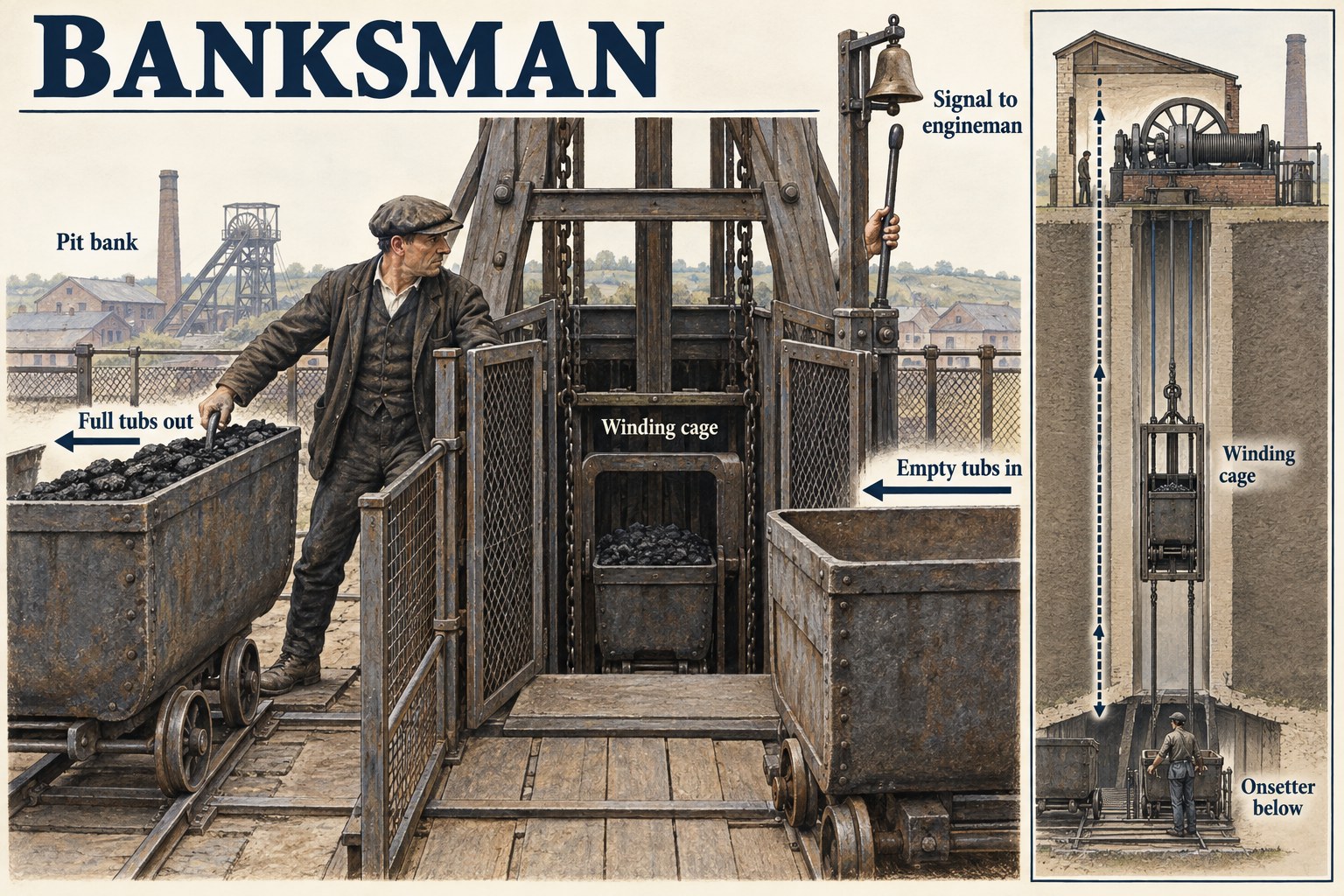
The person in charge of the pit bank — the surface area at the top of the shaft — responsible for loading and unloading the winding cage and signalling the winding engineman, working as the surface counterpart to the underground Onsetter.
Historical usage
The role's exact duties shifted as winding technology developed. An 1825 definition describes the banksman as 'the man stationed at the bank or top of a pit who unhooked and emptied the laden corves into carts or wagons, from a frame or stage'; by 1849 he 'drew the full tubs from the cages at the surface, when wound up by the engine, and replaced them with empty ones,' also weighing and tipping the coal; by 1894 the role had narrowed toward its modern form, 'a person who controlled the unloading and loading of the cage at the pit top, and signalled the descent of the workmen.' In the Midlands and County Durham the role, and title, went back at least to the 16th century.
How it worked
The banksman stood at the pit bank to receive and dispatch the cage, loading and unloading tubs or men, and operated the signalling system — usually a coded sequence of bell or knocker signals — to tell the winding engineman when to raise, lower, or stop. He worked in direct coordination with the Onsetter below, who signalled up from the shaft bottom, and the winding engineman, who could see neither man and depended entirely on their signals to wind safely.
Why it was used
Winding was the single most dangerous routine operation at a colliery, moving men, coal and materials past each other at speed in a confined vertical space the engineman himself could not see into. A banksman gave the engineman eyes at the surface end of that blind operation, and the strict signalling code both men used was one of the few safeguards against a winding accident.
Risks & limitations
A banksman's own position was safer than most underground roles, but a missed, mistimed or misread signal from the bank could still be fatal for everyone in the cage — a class of accident recorded at collieries across the country whenever the signalling chain between banksman, onsetter and engineman broke down.
Regional variation
Recorded as 'Bankman' in some usage; both forms describe the same role.
Related terminology
Mines associated with this term
5 examples chosen from 18 linked records — the term page is not an index.
- Alexandra Colliery — Merseyside (well documented example)
Named 4 times in this record, first in the history: “…was run over by the next tub. On the morning of 22 October 1879 the banksman Martin Mullen had sent three cages of men down without incident.…” - Bulwell Colliery — Nottinghamshire (well documented example)
Named in this record’s history: “…was killed in the shaft by a chain falling from the surface and the banksman was charged with manslaughter. In 1894 171 men worked the Top Hard…” - Carberry Colliery — East Lothian (well documented example)
Named in this record’s workings: “…to the railway fourteen feet below by a returning tub in 1903 and a banksman knocked back into the shaft as the cage descended in 1913.” - Cross Knave Colliery — Gloucestershire (well documented example)
Named in this record’s history: “…at the Globe Inn, Five Acres, heard how the colliery was worked. The banksman, John Harris, had gone off hauling coal to Coleford with the horse…” - Digby Colliery — Nottinghamshire (well documented example)
Named in this record’s history: “…at Giltbrook was sunk in 1866, and the first recorded death there, a banksman named Meshach Chambers who fell down the shaft in October 1866 with…”
Disasters associated with this term
5 examples chosen from 36 linked records, most direct relationship first.
- Gwaun Cae Gurwen Colliery shaft accident, 1847 (contributing factor)
No one but the engineman was at the pit top; the juries asked for a person at the pit mouth. - Aberpergwm Colliery runaway tram, 1901 (contextual relationship)
Named in this record’s narrative: “…have prevented it, and the Inspector of Mines, Mr Robson, said a banksman should have been stationed at the top of the slant. The jury…” - Alexandra Colliery overwinding accident, 1879 (contextual relationship)
Named twice in this record, first in the contributing factors: “…not see the cage; the catches were set back for the descent; the banksman had turned to chalk the number of men on the board. Naylor,…” - Black Mine Pit explosion, 1842 (contextual relationship)
Named in this record’s narrative: “…explosion happened on the level about 200 yards from its end. The banksman heard a terrible rumbling and saw flames at the pit…” - Black Vein Colliery explosion, 1860 (contextual relationship)
Named in this record’s narrative: “…passing the main intake, and was at the Rock Vein pit when the banksman ran to tell him that 'sulphur had gone off'. Evans placed the…”
Sources
- (secondary) Banksman — Wikipedia
- (secondary) Local Mining Terms — Trimdon Snippets
Record created: 27 August 2026 · Last researched: 27 August 2026