 MineArchive
Dawdon Colliery
| Location | Dawdon, Seaham, County Durham — 54.8230, -1.3210 (approximate) |
|---|---|
| Commodity | Coal |
| Type | Coal |
| Worked | From March 1900 (sinking)–25 July 1991 |
| Maximum depth | Over 1,650 feet |
| Operators | Londonderry Collieries Ltd (1899–1947), National Coal Board (1947–1991) |
Overview
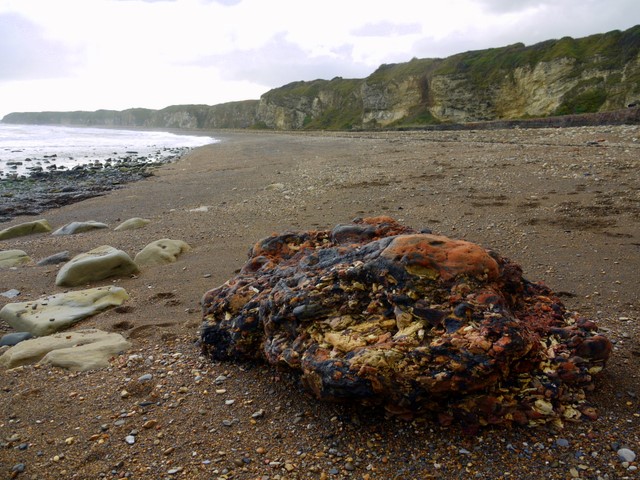
A Londonderry family colliery sunk at Seaham to reach coal reserves that had become uneconomic to work from the older Seaham Colliery, its shafts frozen through water-bearing ground during sinking, and its coastal spoil heaps still fused together on the beach below by the heat of their own spontaneous combustion.
History
By the end of the 19th century, coal reserves to the south-east of the Londonderry family's existing Seaham Colliery were proving increasingly uneconomic to reach from that pit, and in 1899 the 6th Marquess of Londonderry decided to sink an entirely new colliery at Dawdon, on the coast at Noses Point, to work them instead. Sinking began in March 1900 through difficult, water-bearing ground, requiring freezing techniques to hold the strata stable while the shafts — named Castlereagh and Theresa, after the family's other titles and the Marchioness of Londonderry — were sunk to a depth of over 1,650 feet; production finally began on 5 October 1907.
Dawdon grew quickly into one of the larger Durham coastal collieries, reaching peak employment of almost 3,900 workers by 1925 and producing over a million tons of coal annually. On the night of 15 August 1940, German bombing devastated the surrounding settlement, killing 12 people, destroying 5 houses and leaving 119 people homeless, and damaging Dawdon's parish church, vicarage and 230 further houses — though the colliery itself largely escaped the underground mass-casualty disasters that struck neighbouring Seaham and Easington. Dawdon passed to the National Coal Board on the 1947 nationalisation of the coal industry, remaining a substantial producer for decades afterward; by 1988, however, safety concerns led to an estimated million tons of coal being abandoned in the 'G' seam rather than worked. Dawdon Colliery finally closed on 25 July 1991.
Geology
Dawdon worked several seams of the Durham coalfield — Low Main, Maudlin, Hutton, Main Coal, High Main and 'C' seam — reached through shafts sunk over 1,650 feet through water-bearing strata that required freezing during sinking to hold stable; by 1988 an estimated million tons remained in the 'G' seam, abandoned on safety grounds rather than worked.
Workings
The colliery's twin shafts, Castlereagh and Theresa, were sunk from 1900 using freezing techniques against heavy water ingress in the surrounding rock, reaching over 1,650 feet before production began in 1907.
Closure
Dawdon Colliery closed on 25 July 1991, by which point an estimated million tons of coal had already been abandoned in the 'G' seam on safety grounds rather than worked.
What remains
The former colliery and adjoining ironworks sites have been reclaimed and redeveloped as a modern industrial estate. Along the coast below the former colliery, spoil dumped on what is now known as Blast Beach still survives as a fused mass of ash and shale, the material having been welded together by the heat of its own spontaneous combustion.
Colliery spoil on Blast Beach survives as a fused mass of ash and shale, welded together by spontaneous combustion in the waste itself; no colliery buildings survive on the reclaimed site, now an industrial estate.
Related mines
- Seaham Colliery — Dawdon was sunk specifically to reach coal reserves that had become uneconomic to work from the older Seaham Colliery.
Nearby mines
- Vane Tempest Colliery — 0.8 miles (1.3 km) NW
- Seaton Colliery — 1.9 miles (3.1 km) NW
- Seaham Colliery — 2.0 miles (3.2 km) NW
- Murton Colliery — 2.2 miles (3.6 km) W
- Easington Colliery — 2.5 miles (4.1 km) S
Straight-line distance, within 9 miles (15 km). Show on the map.
Disasters & major incidents
-
Dawdon Colliery shaft accident, 1907
11 September 1907 · Winding / Shaft Accident · 3 fatalities
Three men sinking the Londonderry family's new Dawdon Colliery at Seaham were thrown from their cradle to the bottom of the pit on 11 September 1907.
Culture
- Alien 3 at Dawdon Colliery (Screen)
The film used Blast Beach below Nose's Point, the shore built up from the waste Dawdon Colliery and its neighbours tipped over the cliffs. - Billy Elliot (Screen)
Dawdon's Miners' Welfare Hall and Embleton Street were locations for the film. - The Big Hewer (Music)
The sound of the high-speed haulage under the Theresa shaft at Dawdon was recorded for the programme in 1961.
Recorded claims
Individual factual claims, each attached to the source(s) that support it below. Where sources disagree, both are kept.
- The 6th Marquess of Londonderry decided to sink Dawdon Colliery in 1899 to reach reserves that had become uneconomic from the older Seaham Colliery; sinking began in March 1900 through water-bearing ground requiring freezing techniques, with the Castlereagh and Theresa shafts reaching over 1,650 feet before production began on 5 October 1907. 1,2
- Employment peaked at almost 3,900 workers by 1925, with the colliery producing over a million tons of coal annually. 2
- On the night of 15 August 1940, German bombing killed 12 people, destroyed 5 houses and left 119 people homeless in Dawdon, also damaging the parish church, vicarage and 230 further houses. 2
- By 1988, safety concerns led to an estimated million tons of coal being abandoned in the 'G' seam rather than worked. 2
- The colliery was owned by Londonderry Collieries Ltd from 1899 and passed to the National Coal Board on the 1947 nationalisation of the coal industry, closing on 25 July 1991. 1
Sources
- (primary) Dawdon Colliery — Durham Mining Museum
- (secondary) Dawdon — co-curate.ncl.ac.uk (Newcastle University)
Record created: 27 August 2026 · Last researched: 27 August 2026