 MineArchive
Vane Tempest Colliery
| Location | Seaham, County Durham — 54.8330, -1.3320 (approximate) |
|---|---|
| Commodity | Coal |
| Type | Coal |
| Worked | From December 1923 (sinking)–23 October 1992 |
| Maximum depth | Unknown. |
| Operators | Londonderry Collieries Ltd (1923–1947) |
Overview
A cliff-top Seaham colliery sunk by the Londonderry family's mining company using the freezing process, worked in tandem with two neighbouring pits under seams running miles out beneath the North Sea, and the last of Seaham's mines to close, in 1993.
History
Londonderry Collieries Ltd made public its decision to sink a new shaft at Seaham in January 1923, with work beginning that December; two shafts, named Vane and Tempest, were sunk using the freezing process and completed in 1926. The colliery worked the Five Quarter, Hutton and Low Main seams initially, later adding the Main, Maudlin, High Main and Yard seams at different periods, extracting coal from workings that ran miles out under the North Sea alongside Seaham's other two collieries. Employment grew from 750 in 1930 to a peak of 1,819 in 1950, before declining steadily over the following decades.
Ownership passed to the National Coal Board at nationalisation in 1947 and to British Coal Corporation in 1986. Vane Tempest combined operations with the neighbouring Seaham Colliery on 11 July 1983, and was the longest-surviving of Seaham's mines, outlasting both. The last working shift took place on 23 October 1992, with the colliery formally closing on 4 June 1993.
Geology
Coal of the Durham field, won from under the sea: the Five Quarter, Hutton and Low Main seams at first, with the Main, Maudlin, High Main and Yard added later. The shafts were sunk through waterlogged ground by the freezing process.
Workings
Worked from twin shafts, Vane and Tempest, sunk using the freezing process between 1923 and 1926, extracting coal from the Five Quarter, Hutton, Low Main, Main, Maudlin, High Main and Yard seams at different periods, from workings extending miles out beneath the North Sea.
Closure
Last working shift 23 October 1992; formally closed 4 June 1993, the last of Seaham's three collieries to do so.
What remains
The site has been redeveloped, largely for housing.
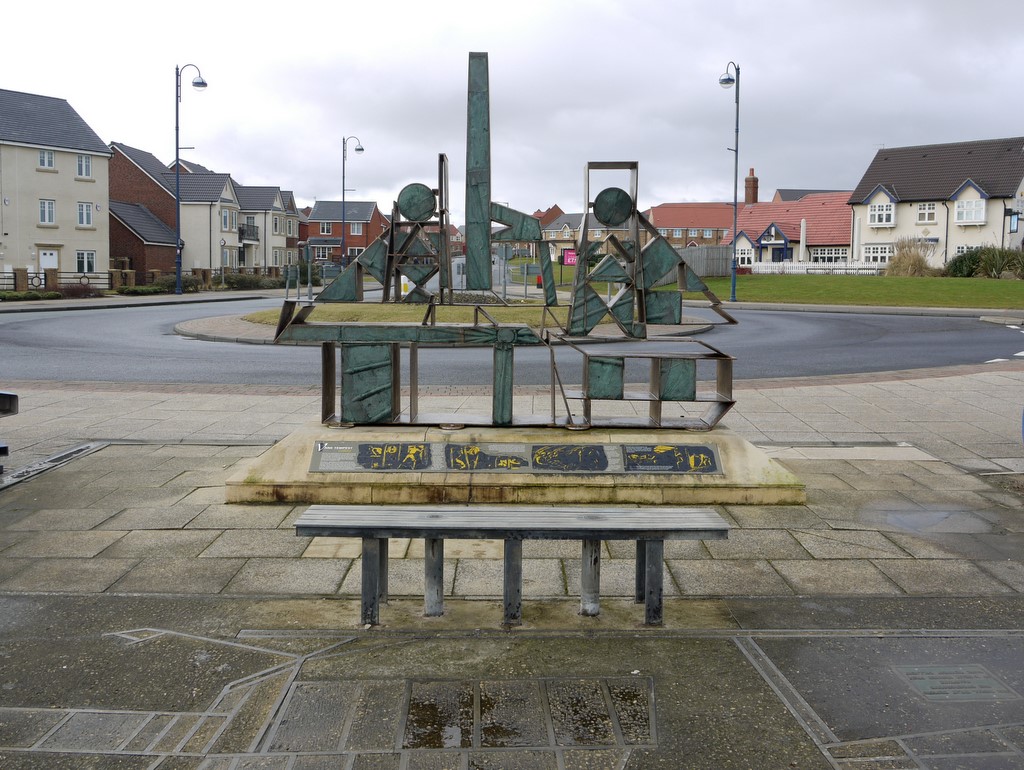
A large public sculpture at Seaham, made of steel, bronze and plastic, depicts the profile of the colliery's surface buildings and serves as both a memorial to miners killed there and an interpretive installation on the mine's history.
Related mines
- Seaham Colliery — Merged operations on 11 July 1983 and were worked together thereafter.
Nearby mines
- Dawdon Colliery — 0.8 miles (1.3 km) SE
- Seaton Colliery — 1.2 miles (1.9 km) W
- Seaham Colliery — 1.2 miles (2.0 km) NW
- Murton Colliery — 2.0 miles (3.3 km) SW
- Hawthorn Combined Mine — 3.1 miles (5.0 km) SW
Straight-line distance, within 9 miles (15 km). Show on the map.
Recorded claims
Individual factual claims, each attached to the source(s) that support it below. Where sources disagree, both are kept.
- Londonderry Collieries Ltd began sinking two shafts, Vane and Tempest, in December 1923, using the freezing process; both were completed in 1926. 1
- Employment grew from 750 in 1930 to a peak of 1,819 in 1950. 1
- Durham Mining Museum's own fatality register for this colliery records no disaster of five or more deaths, while listing individual fatal accidents (falls of stone, being run over by tubs) throughout its working life. 1
- Vane Tempest combined operations with the neighbouring Seaham Colliery on 11 July 1983, and was the longest-surviving of Seaham's mines. 1
- A large public sculpture at Seaham, in steel, bronze and plastic, depicts the profile of the colliery's surface buildings and serves as a memorial to miners killed there. 2
Sources
- (primary) Durham Mining Museum - Vane Tempest Colliery — Durham Mining Museum
- (secondary) Vane Tempest Sculptures in Seaham — Atlas Obscura
Record created: 27 August 2026 · Last researched: 27 August 2026