 MineArchive
Ground Freezing
| Also known as | Freezing Process (the everyday British mining-industry name for the same technique), Poetsch Process (named for its patentee, F. H. Poetsch) |
|---|---|
| Category | Mine Workings & Access |
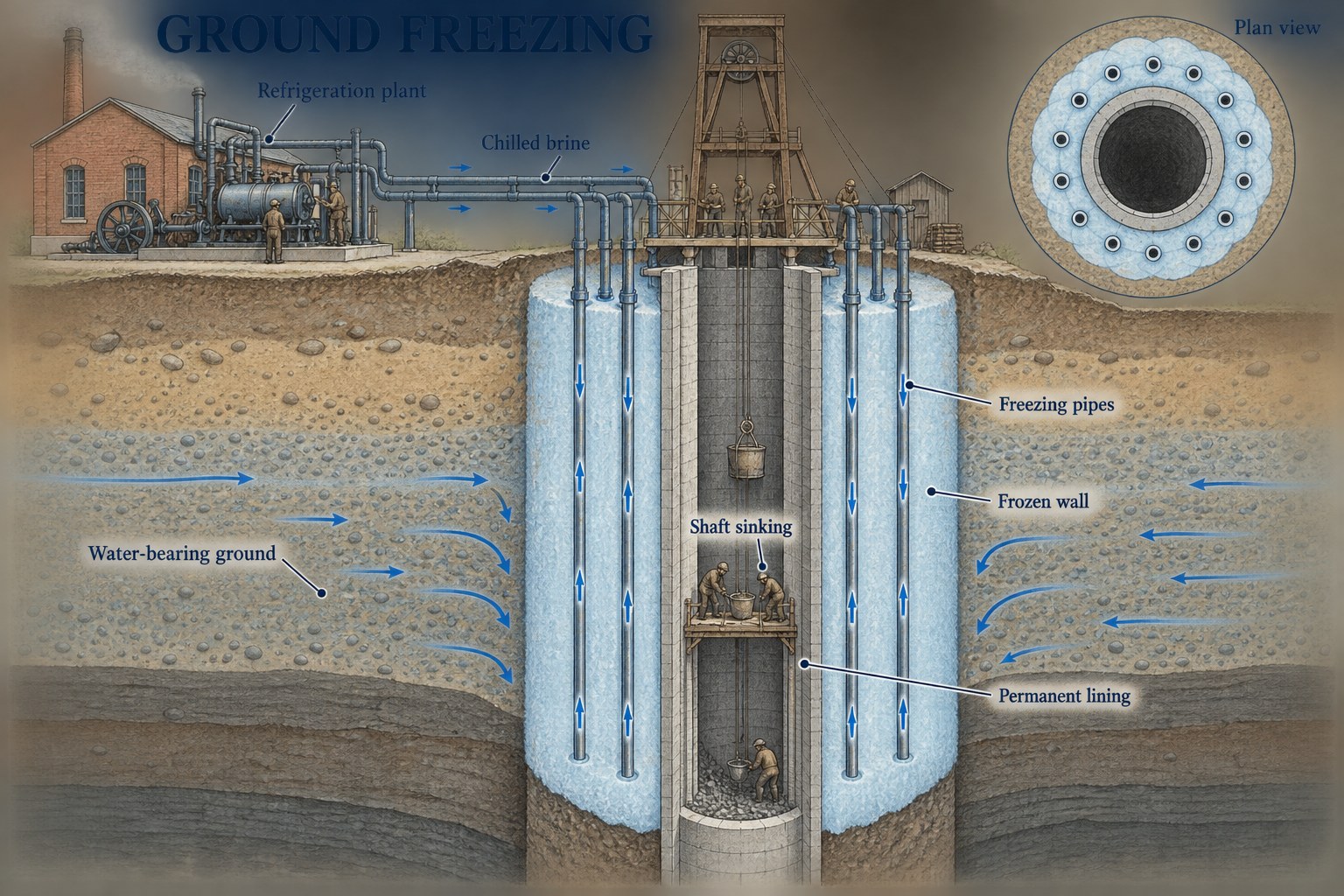
A shaft-sinking technique that freezes water-bearing or unstable ground solid before excavation, turning loose, waterlogged strata into a stable, temporarily watertight wall long enough to sink and line a shaft through it.
Historical usage
Patented in Germany in 1883 by the mining engineer F. H. Poetsch, though Wikipedia credits Siebe Gorman & Co. with using essentially the same idea for a coal-mine shaft at Swansea, South Wales, as early as 1862. The Poetsch process itself became extremely popular across Germany, France, Poland, the Netherlands and Belgium, where it sank over a hundred shafts by the early 20th century. Its most notable British use was in the Durham coalfield, where the 6th Marquess of Londonderry's Dawdon Colliery used freezing to sink its Castlereagh and Theresa shafts through water-bearing ground from 1900, and Londonderry Collieries Ltd used it again at Seaham for the Vane and Tempest shafts, sunk 1923-26. Its German origins caused genuine wartime difficulty: at Thorne Colliery in Yorkshire, where freezing was in use from 1913 to overcome persistent water problems, the German engineers running the freezing plant were arrested and taken to York Castle within days of the outbreak of the First World War in 1914 -- released the next day and briefly allowed back to work once registered, then re-arrested a week later. Sinking at Thorne was effectively suspended for the rest of the war, not resuming until 1919 and not reaching coal until 1924.
How it worked
A ring of boreholes is drilled around the shaft line and steel freezing pipes run down them; a chilled brine (traditionally a calcium or magnesium chloride solution, cooled by an ammonia refrigeration plant at the surface) is circulated through the pipes, drawing heat out of the surrounding ground until the water within it freezes solid. Once a continuous frozen wall has formed around the shaft, sinking and lining can proceed through what was previously loose, waterlogged ground; the freezing plant is kept running throughout sinking and lining, and only shut down once the permanent lining is complete and able to hold back the ground and any water on its own.
Why it was used
Used where a shaft has to be sunk through thick water-bearing sands, gravels or similar unstable strata that would otherwise flood or collapse a sinking shaft faster than pumping alone could cope with -- the situation the Durham coalfield's water-bearing Permian strata created repeatedly for shafts sunk near the coast.
Risks & limitations
A major, expensive undertaking in its own right: a dedicated refrigeration plant had to be built and run continuously at the surface for as long as sinking and lining took, often many months, and the technique only works for as long as the freezing plant keeps operating -- interrupt it, as happened involuntarily at Thorne Colliery when its German freezing engineers were interned in 1914, and sinking can be delayed for years.
Related terminology
Mines associated with this term
Included only where MineArchive's own research gives a reasonable evidential basis — not every mine where this might plausibly apply.
- Bullcroft Colliery — South Yorkshire (well documented example)
The defining fact of this colliery's sinking. Pumps rated at 6,250 gallons a minute could not hold the water, so the pumps were withdrawn and the ground frozen instead — a first attempt from January 1910 failed, and a second from February 1911, after iron tubbing was installed, got the shafts through to the coal measures in December 1911. - Thorne Colliery — South Yorkshire (well documented example)
Named twice in this record, first in the history: “…again in 1912 and would only resume if the royalty owners took less. Ground freezing was used in 1913 under German supervision, with eighteen months'…” - Dawdon Colliery — County Durham (well documented example)
Dawdon's Castlereagh and Theresa shafts were sunk from 1900 using freezing to hold back water-bearing ground, one of the earliest well-documented British uses of the technique. - North Selby Mine — North Yorkshire (well documented example)
Named in this record’s geology: “…Sandstone and Upper Permian Marl, which the shafts crossed by ground freezing to about 280 metres. The depth caused extreme floor heave in the…” - Vane Tempest Colliery — County Durham (well documented example)
The Vane and Tempest shafts at Seaham were sunk 1923-26 using the freezing process, explicitly named as such in the colliery's own history.
Disasters associated with this term
Included only where MineArchive's own research gives a reasonable evidential basis, with the nature of the relationship stated — not every disaster where this term might plausibly apply.
- Washington Glebe Colliery explosion, 1908 (contextual relationship)
Named twice in this record, first in the summary: “…ponies. Its shafts had been sunk through the surface deposits by the freezing process to the Low Main seam at 114 fathoms, and it was in the Low Main,…”
Sources
- (secondary) Ground freezing — Wikipedia
- (secondary) The evolution of shaft sinking, 1800-1900 — CIM Magazine, Canadian Institute of Mining
- (secondary) Thorne Colliery — Wikipedia
Record created: 31 August 2026 · Last researched: 31 August 2026