 MineArchive
Seaham Colliery Explosion, 1871
An outburst of gas from the roof of Seaham Colliery's No. 3 pit was ignited during blasting, killing 26 men and boys — nine years before the far larger disaster that would make the colliery's name.
| Date | 25 October 1871 |
|---|---|
| Mine | Seaham Colliery |
| Region | County Durham |
| Type | Explosion |
| Fatalities | 26 (Twenty-six men and boys died: Thomas Hutchinson jnr. (25, stoneman), Robinson Hunter (45, shifter), Charles Lawson (28, furnaceman), Thomas Spence (39, master shifter), Matthew Brown (38, shifter), Thomas Jones (64, shifter), Ralph Hepplewhite (55, shifter), George Shipley (34, shifter), Thomas Bousfield (49, shifter), David Ballantine (69, shifter), Thomas Norris (60, shifter), Thomas Proud (58, shifter), William Coates (30, shifter), John Weddle (52, shifter), William Young (67, shifter), Robert Straughair (24, shifter), William Robins (28, shifter), John Richardson (50, shifter), Edward Laing (43, hewer), William Burdon (46, hewer), James Aspin (41, hewer), Edward Campbell (30, hewer), William Dunn (37, hewer), John Hay (60, deputy), George Parker (16, putter) and Thomas Dobson (13, driver).) |
| Context | During active mining |
Cause
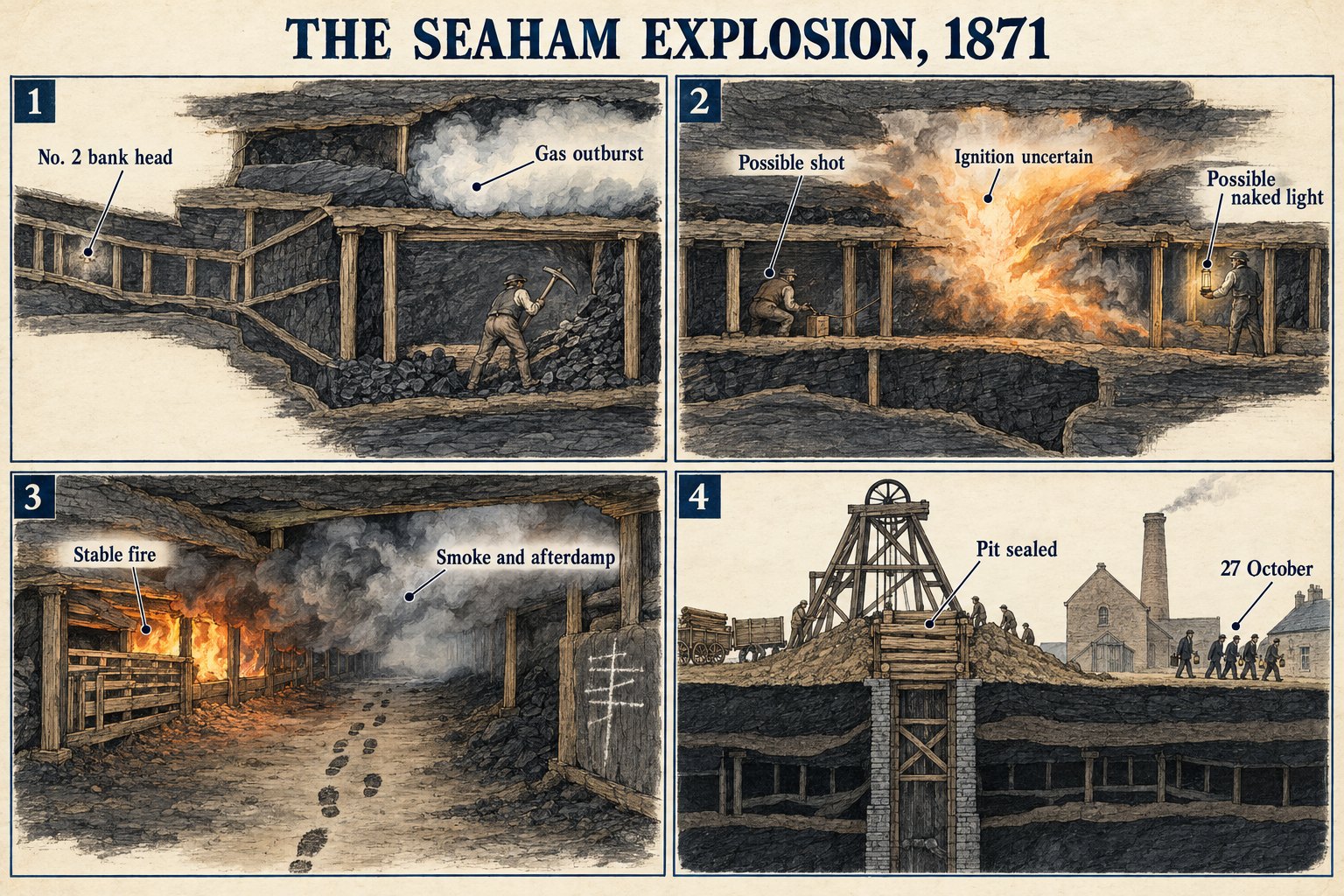
An outburst of gas from the roof of the No. 2 bank head in the No. 3 pit; NMRS's account attributes ignition to a blasting shot fired by stoneman Thomas Hutchinson, while Durham Mining Museum's own record instead states the gas was 'probably ignited by naked light' — both sources agree on the outburst itself but differ on the precise ignition source, and both are preserved here rather than one being silently discarded.
What happened
At around 11:30pm — on 25 October 1871 according to Durham Mining Museum's own record, or 21 October according to NMRS's summary — an outburst of gas from the roof of the No. 2 bank head in Seaham Colliery's No. 3 pit exploded. NMRS attributes the ignition to a blasting shot fired by stoneman Thomas Hutchinson during routine work; Durham Mining Museum instead records it as probably ignited by a naked light. A fire subsequently broke out in the stables area of the pit. Twenty-six men and boys died, their ages ranging from 13 to 69. Evidence gathered afterward showed that some survivors lived for several hours after the explosion — chalked messages found later indicated men were still alive at 10am the following morning — and one experienced miner survived longest of all by sealing an air door with grease to keep out smoke and afterdamp. Exploring parties continued searching until noon the next day, when the ongoing fire was discovered, and the decision was made to seal the pit rather than risk further lives; sealing was completed on 27 October 1871. The mine was reopened on 16 December 1871, and the bodies of the dead were recovered gradually as the sealed section was examined.
Rescue & recovery
Exploring parties searched until the fire was discovered around noon the following day; the pit was sealed on 27 October 1871 and reopened on 16 December 1871, with bodies recovered gradually as the sealed section was examined. Footprints in the dust and chalked messages showed some men had tried to escape and survived for hours after the initial explosion.
Investigation & inquiry
The coroner's jury found the deaths accidental, resulting from an explosion caused by an outburst of gas, with no negligence in the examination of the roof cavity involved since gas had never previously been detected there; ventilation was found to have been adequate, and the jury concluded that sealing the pit had been the only safe course of action and that nothing could have been done to save the men once the fire took hold.
Memorials & commemoration
No dedicated memorial to this specific 1871 explosion is known, distinct from any memorial to Seaham Colliery's later, much larger 1880 disaster.
What's uncertain
Points where sources disagree or the record could not be settled; both accounts are kept. All open questions in the archive.
- Durham Mining Museum's own record gives the date as 25 October 1871 (with a matching 11:30pm timestamp on individual victims' entries) and attributes ignition to a naked light, while NMRS's account gives 21 October and attributes ignition to a blasting shot fired by stoneman Thomas Hutchinson; the underlying outburst-of-gas event and 26-death toll are consistent across both. (disputed) 2
Recorded claims
Individual factual claims, each attached to the source(s) that support it below. Where sources disagree, both are kept.
- Twenty-six men and boys died, ranging in age from 13 to 69, including stonemen, shifters, hewers, a deputy, a putter and a driver. 1
- An outburst of gas from the roof of the No. 2 bank head in the No. 3 pit was ignited around 11:30pm when stoneman Thomas Hutchinson fired a shot during blasting; a fire subsequently broke out in the nearby stables. 1
- Some survivors lived for hours after the explosion — chalked messages found later showed men were still alive at 10am the following morning, and one man survived longest by sealing an air door with grease to keep out smoke and afterdamp. 1
- The pit was sealed on 27 October 1871 once the fire was discovered, and reopened on 16 December 1871, with bodies recovered gradually as the sealed section was examined. 1
- Durham Mining Museum's own record gives the date as 25 October 1871 (with a matching 11:30pm timestamp on individual victims' entries) and attributes ignition to a naked light, while NMRS's account gives 21 October and attributes ignition to a blasting shot fired by stoneman Thomas Hutchinson; the underlying outburst-of-gas event and 26-death toll are consistent across both. (disputed) 2
Related terminology
Mining terms this disaster is structurally linked to, with the nature of the relationship.
- Firedamp (direct cause)
The disaster began with an outburst of firedamp from the mine roof, ignited by a blasting shot. - Naked Light (contextual relationship)
Named twice in this record, first in the cause: “…Museum's own record instead states the gas was 'probably ignited by naked light' — both sources agree on the outburst itself but differ on the…” - Outburst (contextual relationship)
Named 5 times in this record, first in the summary: “An outburst of gas from the roof of Seaham Colliery's No. 3 pit was ignited…” - Shot-firing (contextual relationship)
Named 3 times in this record, first in the summary: “…gas from the roof of Seaham Colliery's No. 3 pit was ignited during blasting, killing 26 men and boys — nine years before the far larger disaster…” - Stoneman (contextual relationship)
Named twice in this record, first in the cause: “…of the No. 2 bank head in the No. 3 pit, ignited around 11:30pm when stoneman Thomas Hutchinson fired a shot during blasting operations; a fire…”
Sources
- (primary) Seaham Colliery Explosion — Seaham — 1871 — Northern Mine Research Society
- (primary) Durham Mining Museum: Seaham Colliery — Durham Mining Museum
Record created: 26 August 2026 · Last researched: 2 September 2026