 MineArchive
Wheal Owles flooding disaster, 1893
Miners broke through into the flooded, long-abandoned workings of Wheal Drea, trapping and drowning twenty men and boys underground.
| Date | 10 January 1893 |
|---|---|
| Mines involved | Wheal Owles, Boscean Mine (related workings), Wheal Drea (related workings), Wheal Edward (related workings) |
| Region | Cornwall |
| Primary type | Flooding / Inundation |
| Associated types | Entrapment |
| Fatalities | 20 |
| Context | During active mining |
Location
Plotted at Wheal Owles. Recorded location. The large pin is the mine; the small round markers are the nearest mines on record. Click one for its page. View on full map
Cause
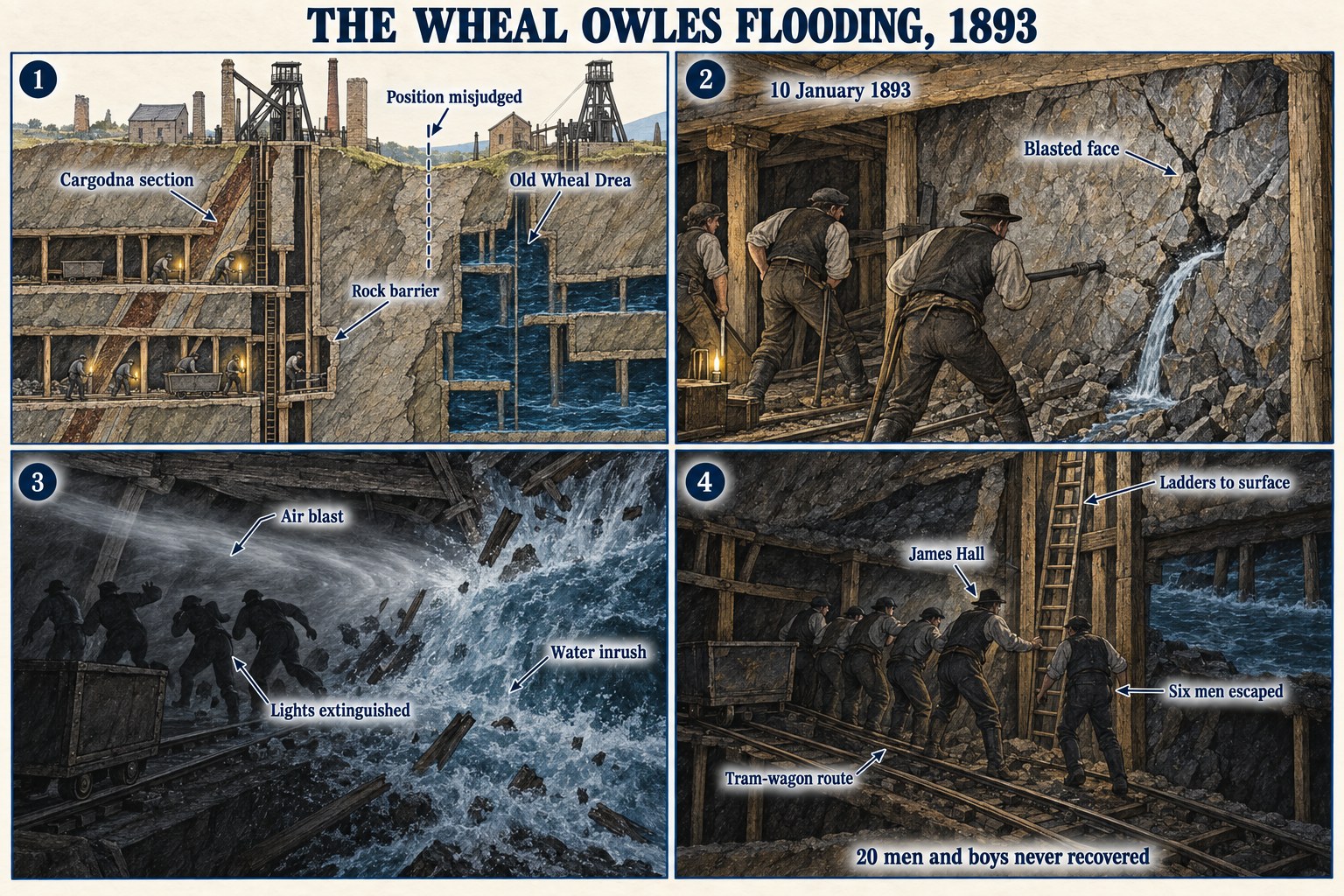
A surveying error meant the miners working the Cargodna section did not realise how close they had come to the old, flooded workings of the neighbouring Wheal Drea, and blasted straight through into them. The mine plan, laid down from a meridian marked on it in 1841, had never allowed for the shifting variation of the compass needle, and by 1893 it was out by well over 100 feet. It showed about 19 fathoms of solid ground between the working place and Wheal Drea, where in fact the Cargodna and Drea lodes had run together.
Contributing factors
The manager and purser, Richard Boyns, kept the plan himself but had been too ill to visit the mine for two or three years; the underground agent, Thomas Tregeare, surveyed the workings without allowing for the variation either. In September 1892 the inspector, Joseph Martin, had pointed out that they seemed to be working between two ranges of flooded old workings and asked whether their plans were accurate, and was told they were.
What happened
On the morning of 10 January 1893, miners working the Cargodna section broke through into the adjoining, long-flooded workings of Old Wheal Drea. About 40 men had gone down the Cargodna Shaft at seven. At around a quarter to nine charges were fired in a cross-cut at the 65-fathom level and the water broke in. The men worked five levels, from 45 to 85 fathoms below adit; Wheal Drea, next door but not connected, had been abandoned in 1884. The inrush of water pushed a powerful blast of air ahead of it that blew out every light underground. Nineteen men and a boy died in the resulting darkness and were never recovered. Nobody on the 65 or the 85 came out; of the eight men on the 75, four who happened to be near the shaft escaped. The water is estimated to have risen 95 fathoms in half an hour. Wheal Owles never reopened.
Rescue & recovery
A miner working nearby, James Hall, felt the ground shaking and saw gravel falling, understood the danger, and led five other men through the darkness along a tram-wagon route to the ladders. Of the 41 men underground that day, twenty were killed; the other twenty-one, including those Hall led out, survived. None of the twenty victims' bodies were ever recovered: they remain in the flooded workings. Hall himself died in July 1895 from lung disease attributed to his mining work.
Investigation & inquiry
No inquest was held. The inspector worked out that the plan had made no allowance for magnetic variation, and a corrected plan by Henderson and Son of Truro showed where the mistake lay. In April 1893 Richard Boyns was prosecuted at the West Penwith Petty Sessions under section 19 of the Metalliferous Mines Regulation Act 1872 for not keeping an accurate plan. His defence, that he had been ignorant of the inaccuracy, failed, and the magistrates fined him £15.
Memorials & commemoration
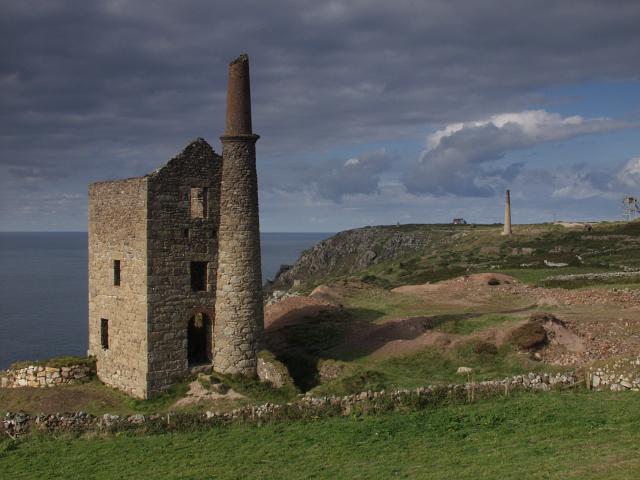
A memorial to the men was erected at surface near the mine, and a plaque listing their names was placed on the wall of the engine house.
Recorded claims
Individual factual claims, each attached to the source(s) that support it below. Where sources disagree, both are kept.
- The twenty victims were, by working level: Level 65 — William Davey, William Eddy, James Rowe, William Roberts, John Taylor, Mark Taylor, James Edwards Trembath, Edward White; Level 75 — Thomas Ellis, Peter Dale, James Thomas, James Williams; Level 85 — Thomas Allen, John Grose, Thomas Grose, John Olds, William Stevens Thomas, Charles Hichens Thomas, Lewis Blewett Wilkins, Edward Williams. 1
- James Hall recognised the ground shaking and gravel falling as signs of the impending breach and led five other miners to safety by tram-wagon before the flood struck; he died in 1895 of lung disease attributed to his mining work. 1
- The mine plan made no allowance for magnetic variation and was wrong by more than 100 feet. 2,3
- In September 1892 the inspector, Joseph Martin, warned that the men appeared to be working between two ranges of flooded old workings. 2
- No inquest was held; in April 1893 the manager, Richard Boyns, was fined £15 at West Penwith Petty Sessions for not keeping an accurate plan. 2
- Nineteen men and a boy died, and their bodies were never recovered. 1,4,3
- About forty men went down on the morning core to five levels from 45 to 85 fathoms below adit; the neighbouring Wheal Drea section had been abandoned in 1884. 5
- The water is estimated to have risen 95 fathoms in 30 minutes. 5
- Wheal Owles never reopened after the flooding. 5
Related terminology
Mining terms this disaster is structurally linked to, with the nature of the relationship.
- Inrush (contextual relationship)
The inrush from Old Wheal Drea pushed a blast of air ahead of it strong enough to blow out every light underground before the water itself arrived. - Ladders (contextual relationship)
Named in this record’s rescue and recovery: “…along a tram-wagon route, guiding them through the darkness to the ladders. Of the 41 men underground that day, twenty were killed; the other…” - Purser (contextual relationship)
Named in this record’s contributing factors: “The manager and purser, Richard Boyns, kept the plan himself but had been too ill to visit…” - Submarine Mining (contextual relationship)
The disaster happened in a mine working seaward ground, where survey error and water were the standing hazards. - Wheal (contextual relationship)
Two Cornish 'Wheal' mines in one disaster: miners in Wheal Owles broke through into the long-abandoned flooded workings of Wheal Drea next door.
Sources
- (secondary) Wheal Owles Mine Disaster, 1893 — West Penwith Resources
- (secondary) Wheal Owles Flooding - St Just - 1893 — Northern Mine Research Society
- (secondary) Wheal Owles disaster, 10th January 1893 (Penwith Local History Group, On this Day) — Penwith Local History Group
- (secondary) Wheal Owles — Wikipedia
- (secondary) The Wheal Owles disaster of 1893 (Bernard Deacon, Cornish studies resources) — Bernard Deacon
Record created: 20 August 2026 · Last researched: 20 November 2026