 MineArchive
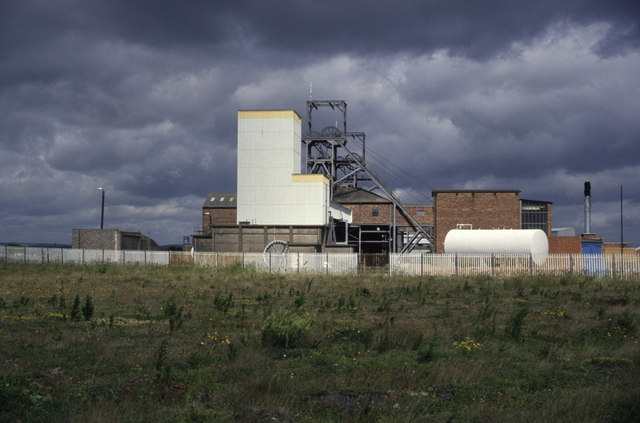
Ellington Colliery
| Location | Ellington, near the Northumberland coast, Northumberland — 55.2192, -1.5575 (exact) |
|---|---|
| Commodity | Coal |
| Type | Coal |
| Worked | 1909 (sinking)–26 January 2005 |
| Maximum depth | 800m (2,600ft) |
| Operators | Ashington Coal Company (1909–1947) |
Overview
Known as 'the Big E', Ellington Colliery was sunk from 1909 near the Northumberland coast and became, by the time of its closure, the last operating deep coal mine of the Great North Coalfield. Its workings extended around 15 miles out under the North Sea and were linked underground to the neighbouring Lynemouth Colliery, together reputedly the largest undersea mine in the world during the 1980s. It closed abruptly on 26 January 2005 after an uncontrollable flood inundated a new coal face, entombing an estimated £8 million of equipment and costing 340 jobs; the site has since been redeveloped for housing.
History
Sinking began in 1909 and was completed by 1913, under the Ashington Coal Company, which operated the colliery until nationalisation into the National Coal Board in 1947. Early coal from the pit was of poor quality, low-volatile and difficult to burn, an early technical setback. Ownership passed to British Coal in the 1986 reorganisation, then to RJB Mining plc in 1994, which rebranded as UK Coal in 2001 and ran the colliery through to its closure. Workforce peaked at around 2,170-2,179 men during the mid-1980s, and pit ponies — around 50 at peak — were used until 1994, among the last commercial use of pit ponies in England.
The colliery's most notable engineering feature was the extent of its undersea workings, reaching roughly 15 miles out under the North Sea to a maximum depth of 800 metres. Ellington was linked underground to the neighbouring Lynemouth Colliery, and together the two formed what has been described as the biggest undersea mine in the world during the 1980s. Production peaked at 2,326,000 tonnes in 1988/89, and the pit achieved a million tonnes in just 29 weeks during 1983; at closure it produced around 69% of Northumberland's mined coal and supplied the nearby Alcan aluminium smelter's power station. Chronic water ingress was a long-standing feature of the mine, with at times three tons of water raised for every ton of coal wound and up to 1,020,000 gallons pumped daily.
The colliery closed abruptly on 26 January 2005 — see below — ending large-scale deep coal mining in North East England, since Ellington was already the last operating deep mine of the Great North Coalfield. Displaced miners subsequently received £6,000 each after an employment tribunal found UK Coal had violated statutory redundancy-consultation requirements.
Geology
Coal of the Northumberland field, worked out under the North Sea: the Ashington, High Main, Main, Yard, Low Main and Brass Thill seams.
Workings
Seams worked included the Ashington, High Main, Main, Yard, Low Main and Brass Thill; the BGS mine plans catalogue holds numerous plans for the Ashington 'D/E' seam, abandoned in December 1969, corroborating the seam list. A new working face developed in the early 2000s, expected to sustain the pit for at least five more years, was the site of the fatal 2005 flood.
Closure
An unusually heavy inflow of water broke into the mine's new working face in mid-January 2005; round-the-clock emergency pumping over the following 13 days failed to lower water levels on the face and its supply roads. UK Coal announced closure on 26 January 2005; chief executive Gerry Spindler said the company had 'contained the flow, [but] the face is flooded and mining adjacent reserves carries unacceptable levels of risk. We are left with no realistic option but to close the mine.' The flooded coal face and its equipment, valued at around £8 million, was a total loss; 340 jobs were lost, and the closure came after Ellington had already made an estimated £11 million loss in 2004. No injuries or fatalities resulted from the flood itself.
What remains
Colliery buildings have been demolished and the site redeveloped for housing, with a commemorative bronze miner statue installed within the new development.
Related mines
- Ashington Colliery — Both belonged to the Ashington Coal Company, whose Ashington, Linton, Woodhorn and Ellington pits together sold about three million tons of coal a year between the wars.
- Linton Colliery — The two collieries lie a mile apart, shared an owner before nationalisation, and were developed on the same pattern; a winder was installed at Linton, Ellington and Lynemouth alike.
- Lynemouth Colliery — Lynemouth and Ellington were connected underground and worked together as the Ellington Combine, described in the 1980s as the biggest undersea mine in the world.
Nearby mines
- Lynemouth Colliery — 1.4 miles (2.2 km) SE
- Linton Colliery — 1.5 miles (2.4 km) W
- Woodhorn Colliery — 2.1 miles (3.4 km) S
- Longhirst Drift — 2.5 miles (4.1 km) SW
- Newbiggin Colliery — 2.6 miles (4.2 km) SE
Straight-line distance, within 9 miles (15 km). Show on the map.
Culture
- Billy Elliot (Screen)
The film's mining scenes were shot at Ellington and Lynemouth, because Easington no longer had a working pit. - The Ashington Group (Art)
With Woodhorn, the colliery that employed most of the group's members.
Recorded claims
Individual factual claims, each attached to the source(s) that support it below. Where sources disagree, both are kept.
- Workings extended roughly 15 miles out under the North Sea to a maximum depth of 800 metres; Ellington was linked underground to the neighbouring Lynemouth Colliery, together described as the biggest undersea mine in the world during the 1980s. 1,2
- Production peaked at 2,326,000 tonnes in 1988/89, with a workforce of around 2,170-2,179 men in the mid-1980s; the pit achieved a million tonnes of output in just 29 weeks during 1983. 1,2
- An unusually heavy water inflow struck the mine's new working face in mid-January 2005; despite round-the-clock emergency pumping, UK Coal announced closure on 26 January 2005, with the flooded face and around £8 million of equipment a total loss and 340 jobs lost. 1,2,3
- Displaced miners subsequently received £6,000 each after an employment tribunal found UK Coal had violated statutory redundancy-consultation notification requirements. 1
- Six individual, single-fatality accidents are recorded at the colliery between 1927 and 1971 (run over by tub, crushed by cage, struck by tubs, and two falls of stone), none rising to the significance of a standalone mining disaster. 4
- The BGS/Coal Authority mine plans catalogue holds numerous records for the Ashington 'D/E' seam at Ellington, abandoned 1 December 1969. 5
Sources
- (secondary) Ellington Colliery — Subterranea Britannica
- (secondary) Ellington Colliery | 1909-2005 — North East Museums
- (primary) Flood closes Ellington — MiningMonthly, 28 January 2005
- (primary) Fatal Accidents at Ellington Colliery — Durham Mining Museum
- (primary) Ellington (Ashington D/E seam) mine plan record — British Geological Survey / Coal Authority mine plans catalogue
Record created: 26 August 2026 · Last researched: 26 August 2026