 MineArchive
Britannia Copper Mine
| Also known as | Cwm Dyli Mine, Snowdon Copper Mine, Great Snowdon Copper Mine |
|---|---|
| Location | Llyn Llydaw, Snowdon, Gwynedd — 53.0734, -4.0292 (exact) |
| Commodity | Copper |
| Type | Metal |
| Worked | Around 1800–1916 |
| Operators | Britannia Copper Mine Ltd (1898–1915) |
Overview
A copper mine on the side of Snowdon, whose ruined crushing mill sits beside Llyn Llydaw on the Miners' Track — probably the most-walked-past mine remains in Britain. Seven companies tried it in a century; the last gave up in 1916.
History
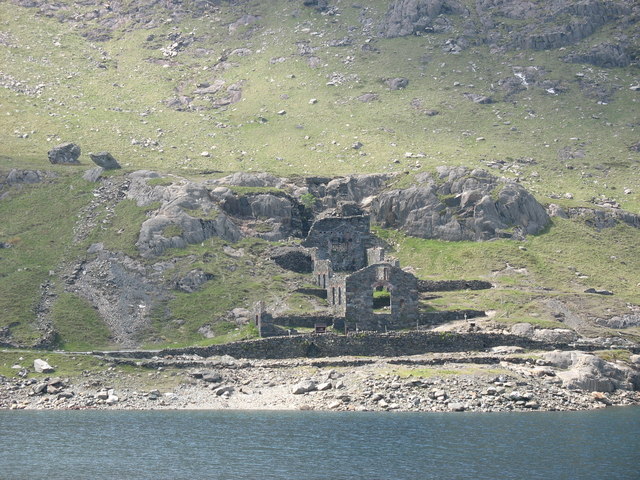
The mine is first mentioned around 1800 and was worked intermittently for over a hundred years by a succession of companies — the Snowdon and Dalawin Copper Mines in 1847, the Cwm Dyle Rock and Green Lake Copper Mining Company in 1851, Cwmdyle Copper in 1857, the Great Snowdon Copper Mining Company in 1873, North Wales United Mines in 1890, the Britannia Copper Mine Ltd in 1898 and finally the Penypass Copper Company in 1915. It closed the following year, in 1916. The scale it reached at its best is easiest to read from the barracks built beside the lake to house a hundred men.
Geology
Copper worked from the volcanic rocks of the Snowdon massif, above Llyn Glaslyn and Llyn Llydaw — a high, exposed setting where the ore had to be brought down the mountain before it could be processed at all.
Geological setting: Hydrothermal Deposits (well documented example)
Workings
Extensive working on a number of interconnected levels, eight of them, some still open. The Britannia company built a crushing mill on the shore of Llyn Llydaw in 1898, powered by water piped down from Glaslyn to a Pelton wheel, with ore delivered to it from the workings above by aerial cableway. Getting the copper off the mountain shaped the landscape as much as the mining did: a causeway was built across Llyn Llydaw in 1853 to replace the raft on which horses and loaded wagons had been ferried across, and a prehistoric oak canoe was found during its construction. Ore went by horse and sledge down to Llyn Cwellyn and on by cart to Caernarfon until the Llanberis road made the Miners' Track the better route.
Closure
The Penypass Copper Company took the mine on in 1915 and closed it in 1916 — the last of seven attempts in a little over a century.
What remains
The mill ruins and part of the miners' barracks stand beside Llyn Llydaw on the Miners' Track, one of the main paths up Snowdon, and the 1853 causeway still carries walkers across the lake. Some of the eight levels remain open.
The 1898 crushing mill, miners' barracks, the Llyn Llydaw causeway, and open levels above the lake.
Nearby mines
- Sygun Copper Mine — 4.5 miles (7.2 km) SW
- Dinorwig Slate Quarry — 4.6 miles (7.5 km) NW
- Vivian Quarry — 4.9 miles (7.9 km) NW
- Chwarel Ddu Quarry — 5.2 miles (8.4 km) E, Conwy
- Conglog Quarry — 5.4 miles (8.7 km) S
Straight-line distance, within 9 miles (15 km). Show on the map.
Recorded claims
Individual factual claims, each attached to the source(s) that support it below. Where sources disagree, both are kept.
- The mine was worked intermittently for over a century by seven companies in succession, the last being the Penypass Copper Company from 1915; it closed in 1916. 1
- A causeway was built across Llyn Llydaw in 1853 to replace the raft on which miners had ferried horses and loaded wagons across the lake; a prehistoric oak canoe was found during its construction. 2
- The remains beside the Miners' Track include the crushing mill and part of the miners' barracks. 2
Photographs & further reading
The national park’s account of the mine remains along the path and the Llyn Llydaw causeway.
View sourceSources
- (secondary) Britannia Copper Mine — Grace's Guide
- (primary) Miners' Track — Eryri National Park Authority
Record created: 25 August 2026 · Last researched: 25 August 2026