 MineArchive
Pelton Wheel
| Also known as | Pelton Turbine (an equally common name for the same device) |
|---|---|
| Category | Structures & Machinery |
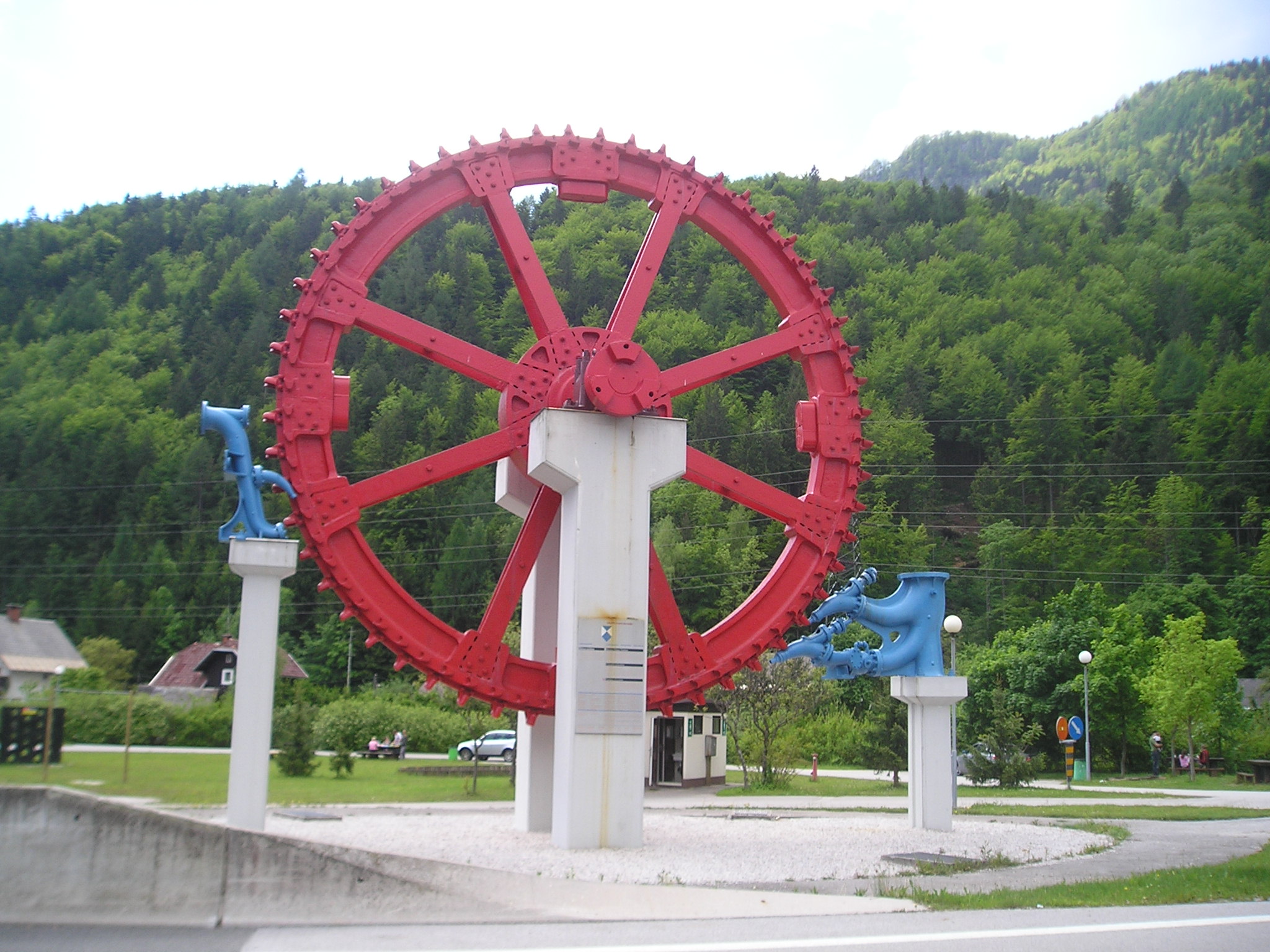
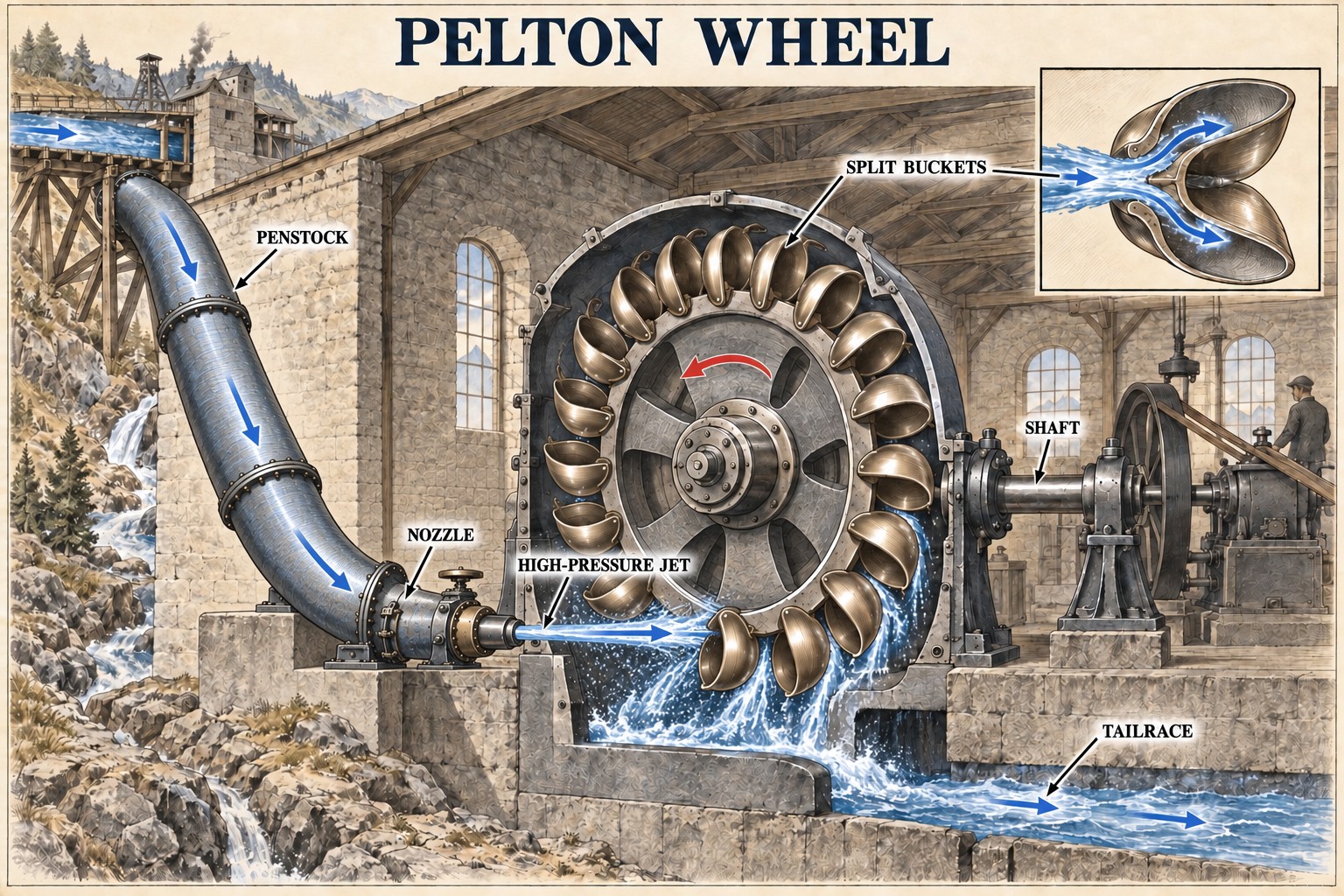
An impulse water turbine whose rim carries a ring of split, spoon-shaped buckets, struck by one or more high-pressure jets of water rather than turned by the water's weight or flow the way an ordinary waterwheel is.
Historical usage
Patented in 1880 by the American engineer Lester Allan Pelton, who developed it while working among the gold mines of California's Sierra Nevada; the first commercial iron wheel was installed at the Mayflower Mine, Nevada City, in 1878, and by 1900 over 11,000 were in use worldwide. Its efficiency and small size made it a practical choice at British metal mines with a strong head of water but only a modest flow, and it appears at several Welsh slate quarries and northern lead mines from the later 19th century onward, generating power for mills, compressors and (later) electric lighting.
How it worked
A jet of water, directed through a nozzle at high velocity, strikes the split buckets around the wheel's rim; each bucket's spoon shape reverses the direction of the water rather than merely blocking it, extracting nearly all of the jet's kinetic energy before the water falls away with very little speed left. This impulse principle is most efficient when the bucket rim travels at around half the speed of the water jet itself.
Why it was used
Where a mine had access to a strong natural fall of water but only a small stream -- common in mountainous mining country with high rainfall but no large river -- a Pelton wheel could extract far more usable power from that limited flow than either an ordinary waterwheel or a steam engine fed by expensively-carted coal.
Risks & limitations
Like any water-powered plant, output still depended on a reliable head and flow of water, and the nozzles were prone to wear and blockage from grit; but a Pelton wheel needed far less water than an overshot or breastshot waterwheel to deliver the same power, which was its whole advantage over older wheel designs.
Related terminology
Mines associated with this term
5 examples chosen from 11 linked records — the term page is not an index.
- Britannia Copper Mine — Gwynedd (well documented example)
Named in this record’s workings: “…Llyn Llydaw in 1898, powered by water piped down from Glaslyn to a Pelton wheel, with ore delivered to it from the workings above by aerial…” - Carrock Fell Mine — Cumbria (well documented example)
Named in this record’s history: “…milled for close to 100 tons of 16% concentrate. Power came from Pelton wheel generators, supplemented by gas engines in dry weather, and…” - Cwm Ebol Quarry — Gwynedd (well documented example)
Named twice in this record, first in the history: “…built to supply water pressure for the mill's waterwheel and later a Pelton wheel, remained a source of danger long after mining ended: in June 2012,…” - Hobbs Hill Tin Mine — Cornwall (well documented example)
Named in this record’s history: “…stamping and processing floor, a leat serving a turbine or Pelton wheel, a magazine, a count house, a smithy and two wheelpits belonging to…” - Nantiago Mine — Powys (well documented example)
Named in this record’s workings: “…the Nant Iago via a network of leats drove three waterwheels and two Pelton wheels, used for pumping, ore-drawing and processing. Surviving remains…”
Sources
- (secondary) Pelton Wheel — Engineering and Technology History Wiki (IEEE/ASME)
- (secondary) Pelton wheel — Wikipedia
Record created: 30 August 2026 · Last researched: 30 August 2026