 MineArchive
Hafod y Llan Slate Quarry
| Also known as | South Snowdon Slate Works, South Snowdon Slate Quarry, Cwm Llan Quarry |
|---|---|
| Location | Head of Cwm Llan, Hafod y Llan, Nant Gwynant, Beddgelert, Gwynedd — 53.0513, -4.0706 (exact) |
| Commodity | Slate |
| Type | Slate |
| Worked | 1840s–1889 |
| Maximum depth | Unknown. |
Overview
The South Snowdon Slate Works at the head of Cwm Llan, opened in the 1840s and given a mill, turbine and a great incline and tramway in the 1860s and 1870s; the most productive quarry in the Beddgelert district, it never repaid its cost and was abandoned in 1889.
History
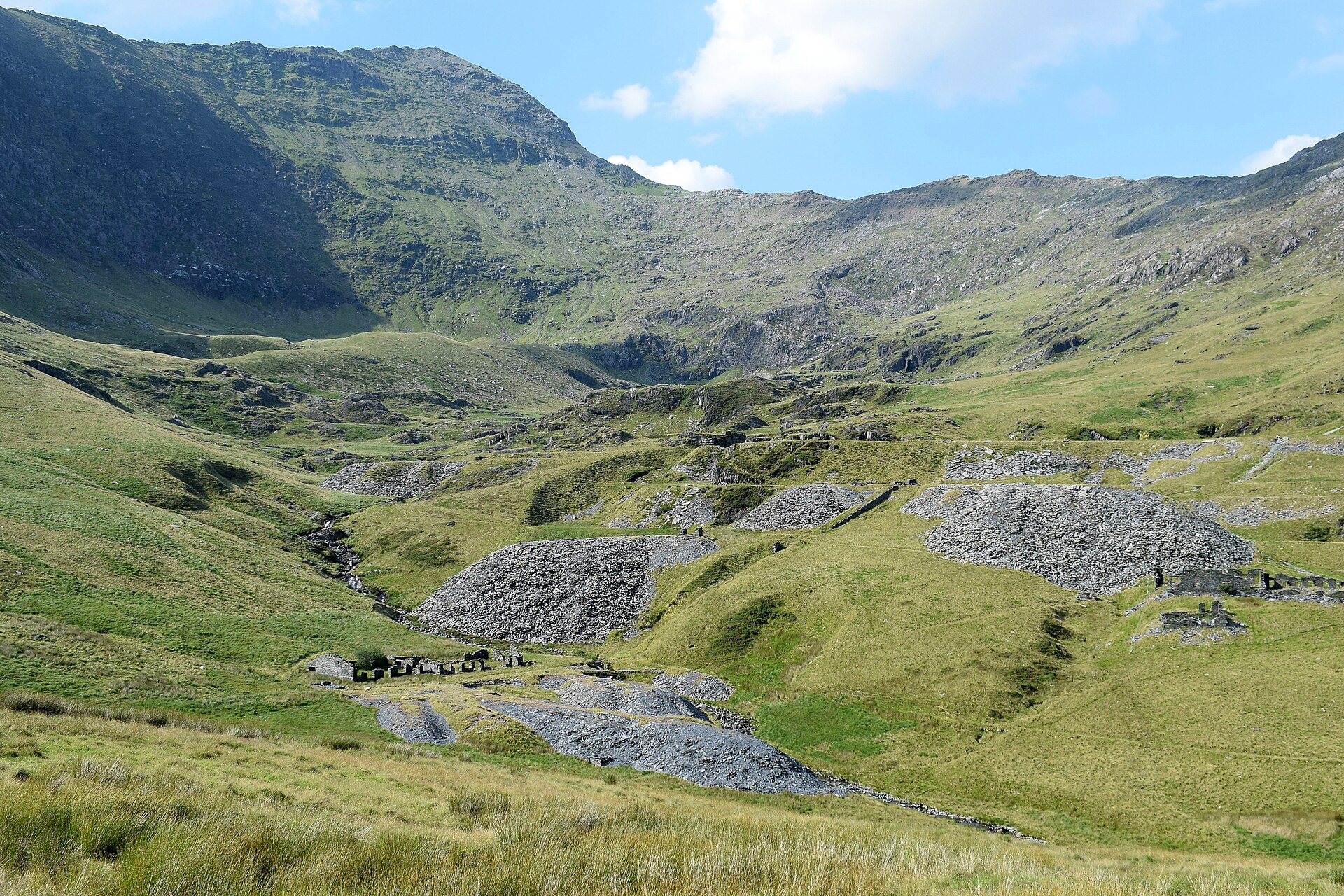
Hafod y Llan slate quarry, also called the South Snowdon Slate Works, is at the head of Cwm Llan, a side valley of the Afon Glaslyn on the southern slopes of Snowdon. It was an open working, believed to have started in the 1840s as a small quarry linked to the nearby metal mines, and possibly earlier; one account has it in production by 1821. It was developed by Allen Searell, a Devon man with mining and quarrying interests across North Wales, who was involved there in the 1840s. Slate first went down by a short tramway to the Cwm y Llan cart road that served the local copper mines.
The quarry grew in the late 1860s and 1870s. The water-powered mill was enlarged and converted to turbine drive in 1869, and a tramway with two steep inclines was built down to Pont Bethania in Nant Gwynant, from where slate was carted to the Croesor Tramway for Porthmadog. A railway along Nant Gwynant was hoped for but never built. The quarry became the most productive in the Beddgelert district but never justified its heavy investment; its manager, Pierce Davies, kept a diary of gales that unroofed the mill and burst the dams. It declined after the 1870s and was abandoned in 1889, and the tramway track was lifted in 1913. William Pritchard of Rhosgadfan reworked it on a small scale in the 1930s and 1940s, and in the 1960s slate from the barracks was cut for reuse. The quarry track up Cwm Llan became the Watkin Path, opened by Gladstone in 1892.
Geology
Unknown.
Workings
An open working on several levels, with adits from the levels into the pit, short tramways and an incline down to the mill.
Closure
Abandoned in 1889 after declining from the 1870s; the tramway track was lifted in 1913. Small-scale reworking followed in the 1930s-40s and the 1960s.
What remains
The workings, inclines, mill and barracks are ruined; the adits into the pit are flooded and most are collapsed. The manager's house is roofless.
Workings on several levels, the mill with launder pillars and the line of the turbine pipe, houses, barracks, a weighbridge, an arched tramway crossing, two reservoirs, and the exit tramway with its two steep inclines down to Nant Gwynant.
Redevelopment
National Trust land on the Hafod y Llan farm; the Watkin Path follows the old quarry track.
Related mines
- Braich yr Oen Mine — Linked by its own transport to the Hafod y Llan slate quarry.
- Cwmorthin Slate Mine — Allen Searell worked both quarries.
- Hafod y Llan Copper Mine — Copper mine and slate quarry of the same name in Cwm Llan, both worked by Allen Searell.
Nearby mines
- Braich yr Oen Mine — 0.5 miles (0.8 km) SE
- Hafod y Llan Copper Mine — 0.6 miles (1.0 km) SE
- Hafod y Porth Copper Mine — 1.1 miles (1.7 km) S
- Lliwedd Mine — 1.3 miles (2.1 km) E
- Clogwyn Coch Copper Mine — 2.1 miles (3.4 km) N
Straight-line distance, within 9 miles (15 km). Show on the map.
People
- Allen Searell (d. 1865) · manager — Developed the quarry
What's uncertain
Points where sources disagree or the record could not be settled; both accounts are kept. All open questions in the archive.
- Hafod y Llan quarry was in production by 1821. (uncertain) 4
Recorded claims
Individual factual claims, each attached to the source(s) that support it below. Where sources disagree, both are kept.
- Hafod y Llan slate quarry is believed to have started in the 1840s, possibly earlier in the nineteenth century. 1,2,3
- Hafod y Llan quarry was in production by 1821. (uncertain) 4
- The mill was extended and converted to turbine operation in 1869, and a tramway with inclines was built down to Pont Bethania in Nant Gwynant, from where slate was carted to the Croesor Tramway. 2,3
- The quarry was developed by Allen Searell, a Devon man with mining and quarrying interests in North Wales. 5,4,2
- Hafod y Llan was the most productive slate quarry in the Beddgelert district but never justified its heavy investment. 3,6
- The quarry closed during the 1880s, officially when it was abandoned in 1889. 4,2,6
- The tramway track was lifted in 1913, and the quarry was reworked on a small scale in the 1930s and 1940s. 4,6
- The quarry track from Nant Gwynant to Cwm Llan was extended to the summit as the Watkin Path, opened by Gladstone in 1892. 1
Sources
- (secondary) The history of Hafod y Llan — National Trust
- (secondary) Hafod y Llan Slate Quarry; South Snowdon Slate Works (NPRN 40536) — Coflein (RCAHMW)
- (secondary) Hafod y Llan (South Snowdon Quarry) (Buddlepit Mine Database) — Buddlepit Mine Database
- (secondary) Stunning Eryri valley with tunnels, pits and rope swings across unbelievably beautiful pools — Daily Post (North Wales Live)
- (secondary) Allen Searell — Festipedia (FR Heritage Group)
- (observational) South Snowdon Slate Works — Treasure Maps (Iain Robinson)
Record created: 19 October 2026 · Last researched: 19 October 2026