 MineArchive
Lliwedd Mine
| Also known as | Cwm Erch Copper Mine, Cwm Merch Mine, Llywydd Mine, Lliwedd Copper Mine |
|---|---|
| Location | Lliwedd Bach and Cwm Erch (Cwm Merch), Hafod y Llan, Nant Gwynant, Beddgelert, Gwynedd — 53.0570, -4.0400 (exact) |
| Commodity | Copper |
| Type | Metal |
| Worked | By 1806–1865 |
| Maximum depth | Unknown. |
Overview
A remote copper mine high on the southern flank of Y Lliwedd above Cwm Llan, working a single lode from the early nineteenth century; its mill ruins, scattered machinery and stopes are a scheduled monument, recorded also as Cwm Erch copper mine.
History
Lliwedd mine lies high on the southern flank of Y Lliwedd, where the slopes of Lliwedd Bach fall into Cwm Erch (Cwm Merch) above Cwm Llan, on the Hafod y Llan land south of Snowdon. It worked a single copper lode running north-west through Ordovician volcanic rocks, much of it mined out from the surface in deep, narrow stopes. The mine was returning copper ore by 1806, when it belonged to the Parry family of Craflwyn. About 1821 it was worked by the Lliwedd Mining Company, a group of shopkeepers from Ruthin. On Parry's death in 1829 the estate passed to Sir John Duckinfield; a deep level was driven in 1831, and in 1838, two years after Duckinfield's death, Joseph Peers of Ruthin became sole lessee. Between 1838 and 1843, 1,090 tons of ore were sold at Swansea.
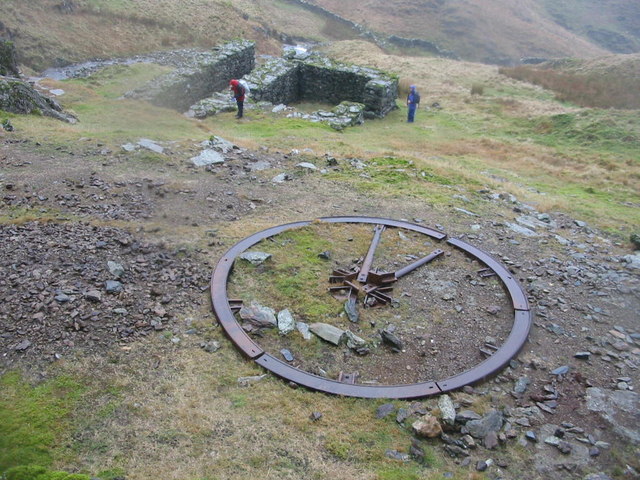
The workings in Cwm Erch were active from 1841 to 1865: a water wheel was put up in 1841, and in 1851 H. McKellar formed the Hafod y Llan Copper and Lead Mines Company to run them. Its crushing machinery was driven by a water wheel cast by the Hawarden Iron Works: one account gives it as 25 feet across, another as a 30-foot wheel, now collapsed, beside a pit for a 25-foot wheel that was apparently never finished. The mine had upper and lower mills, a dressing floor and a tramway, and crushed ore was carried down on the backs of the homeward-bound workmen and then by pack pony. In 1900 the site was examined again by the South African Gold Mining Syndicate. Its total recorded output is about 1,938 tons of ore.
Geology
A single copper lode striking north-west through Ordovician volcanic rocks; the site is a Geological Conservation Review site for Ordovician volcanism in North Wales.
Workings
Deep narrow stopes open to the surface along the lode, a main adit level on an upper terrace joined to the mill by a chute, a deep level driven in 1831, and higher entrances dropping to the lower level.
Closure
Work in Cwm Erch ended in 1865; the South African Gold Mining Syndicate re-examined the mine in 1900.
What remains
A scheduled monument. The mill site keeps much machinery, including the frame of the water wheel and stamping parts; in 2011 the lower main adit still had its rails but was collapsed about 100 feet in.
A lower ore-processing mill, a central mill site with the water wheel frame and other machinery, the main adit terrace and chute, worked lodes and slots with timber braces and staging, a roofless hafod, ponds and a graded track.
Redevelopment
National Trust land on the Hafod y Llan farm, within Eryri National Park.
Related mines
- Hafod y Llan Copper Mine — Copper mines on the Hafod y Llan land in Cwm Llan, under Y Lliwedd.
Nearby mines
- Hafod y Llan Copper Mine — 1.0 miles (1.6 km) SW
- Braich yr Oen Mine — 1.2 miles (2.0 km) SW
- Britannia Copper Mine — 1.2 miles (2.0 km) N
- Hafod y Llan Slate Quarry — 1.3 miles (2.1 km) W
- Hafod y Porth Copper Mine — 2.0 miles (3.2 km) SW
Straight-line distance, within 9 miles (15 km). Show on the map.
What's uncertain
Points where sources disagree or the record could not be settled; both accounts are kept. All open questions in the archive.
- The mine's 25-foot water wheel was cast by the Hawarden Iron Works Company. (disputed) 1
- A collapsed 30-foot water wheel cast at the Hawarden Ironworks drove the crushing machinery, and a pit for a 25-foot wheel appears to have been abandoned unfinished. (disputed) 7
Recorded claims
Individual factual claims, each attached to the source(s) that support it below. Where sources disagree, both are kept.
- Lliwedd mine was returning copper ore in 1806, when it was owned by the Parry family of Craflwyn. 1
- About 1821 the mine was worked by the Lliwedd Mining Company, formed of shopkeepers from Ruthin, and from 1838 Joseph Peers of Ruthin was sole lessee. 1
- Between 1838 and 1843, 1,090 tons of Lliwedd ore were sold at Swansea. 1
- Cwm Erch copper mine worked from 1841 to 1865; a water wheel was erected in 1841, and in 1851 H. McKellar formed the Hafod y Llan Copper and Lead Mines Company. 2,3,4
- The central ore-processing area of the Cwm Erch copper mine below Lliwedd Bach is a scheduled monument. 3,5
- In 1900 the mine was investigated by the South African Gold Mining Syndicate. 1
- In 2011 the lower main adit kept its rails but was collapsed about 100 feet from the entrance. 6
- The mine's 25-foot water wheel was cast by the Hawarden Iron Works Company. (disputed) 1
- A collapsed 30-foot water wheel cast at the Hawarden Ironworks drove the crushing machinery, and a pit for a 25-foot wheel appears to have been abandoned unfinished. (disputed) 7
- Crushed ore was carried down on the backs of the home-going workmen and then by pack pony. 7
Sources
- (secondary) Lliwedd (Buddlepit Mine Database) — Buddlepit Mine Database
- (secondary) Cwm Erch (Buddlepit Mine Database) — Buddlepit Mine Database
- (secondary) Cwm Erch Copper Mine (NPRN 33783) — Coflein (RCAHMW)
- (secondary) Cwm Erch Copper Mine (NPRN 33772) — Coflein (RCAHMW)
- (secondary) Cwm Erch Copper Mine, Lliwedd Bach, Hafod y Llan (MNA136321) — National Trust Heritage Records
- (observational) Lliwedd Mine (trip report, 2011) — United Cavers Exploration Team forum
- (secondary) Llanberis, Snowdon and Nant Gwynant (Section 21) — Jaggers Heritage
Record created: 19 October 2026 · Last researched: 19 October 2026