 MineArchive
Hartley Colliery (Hester Pit)
| Location | New Hartley, Northumberland — 55.0746, -1.4749 (approximate) |
|---|---|
| Commodity | Coal |
| Type | Coal |
| Worked | 1845-46–1862 |
| Operators | Carr Brothers (1845–1862) |
Overview
New Hartley Colliery, and its single shaft the Hester Pit, was a Northumberland coal mine whose catastrophic failure in January 1862 killed 204 men and boys and directly forced a change in British mining law requiring every colliery to have at least two independent means of escape.
History
The Hester Pit was sunk inland from the coast from 1845, reaching the Low Main seam on 29 May 1846, to replace an earlier Hartley pit that had flooded with seawater. It was operated by the Carr brothers and worked as a single-shaft mine: one 12-foot-diameter shaft, divided by a timber brattice into an upcast and downcast side, served simultaneously for winding coal and men, for pumping, and for ventilation. Chronic flooding from seawater percolating through the strata required a powerful pumping engine, and in 1855 a 300-horsepower beam engine was installed above the shaft, driving three-stage bucket pumps capable of raising 1,500 imperial gallons of water a minute. On 16 January 1862, during a shift changeover, the engine's cast-iron beam fractured and fell down the shaft, destroying the ventilation brattice, snapping two of the four chains supporting the cage, and bringing down around 30 yards of debris that completely blocked the shaft between the Yard and High Main seams — sealing in the roughly 204 men and boys who were underground at the time. Despite a rescue effort lasting several days, involving master sinker William Coulson and his team cutting through the blockage, all 204 were found dead, killed by suffocation as the sealed workings filled with gases including carbon monoxide. The Hester Pit was never reworked after the disaster; a new colliery was later established elsewhere in the area to continue coal mining in the district.
Geology
The colliery worked the Northumberland Coalfield's productive Coal Measures, reaching the Low Main seam via the Hester Pit shaft; the ground was afflicted by persistent inflows of seawater percolating through the strata from the nearby coast, which the mine's substantial pumping plant existed specifically to counter.
Geological setting: Sedimentary Beds and Seams (well documented example)
Workings
A single 12-foot shaft, divided internally by a timber brattice into upcast and downcast sides, provided the mine's only access, haulage, pumping and ventilation route — a design that proved fatally inadequate when the shaft itself was blocked. The 300-horsepower beam engine installed in 1855 drove three-stage bucket pumps to keep the workings clear of seawater.
Closure
The Hester Pit closed permanently after the January 1862 disaster and was never reopened; mining in the district continued instead at a new colliery established to the north.
What remains
Unknown.
Nearby mines
- Seaton Delaval Colliery — 2.0 miles (3.2 km) W
- East Holywell Colliery — 2.2 miles (3.6 km) SW, Tyne and Wear
- Gloria Colliery, Hartley — 2.4 miles (3.9 km) NW
- Seghill Colliery — 2.5 miles (4.0 km) W
- West Holywell Colliery — 2.6 miles (4.2 km) SW, Tyne and Wear
Straight-line distance, within 9 miles (15 km). Show on the map.
Disasters & major incidents
-
Hartley Colliery disaster, 1862
16 January 1862 · Winding / Shaft Accident · 204 fatalities
The cast-iron beam of New Hartley Colliery's pumping engine fractured and fell down the mine's single shaft during a shift changeover, blocking the only way in or out and sealing 204 men and boys underground, all of whom died of suffocation over the following days despite a sustained rescue effort. The disaster's central lesson — that a mine with only one shaft has no way out if that shaft fails — led directly to a change in the law within months.
Culture
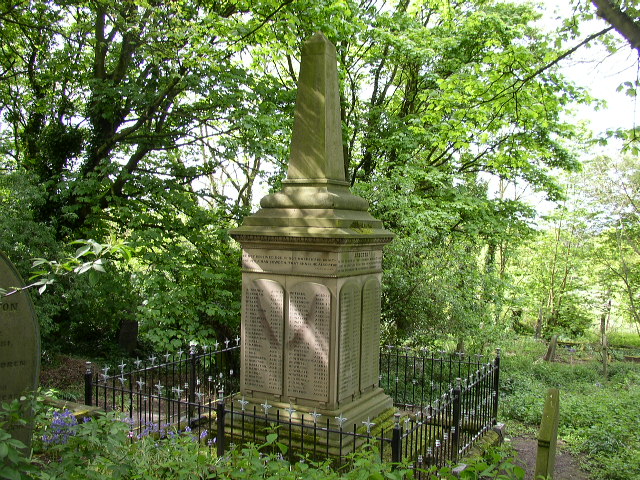
- Hartley Disaster Memorial, Earsdon (Art)
The memorial stands over the graves of most of the 204 men and boys who died in the Hester Pit of Hartley Colliery in January 1862. - The Hartley Calamity (Joseph Skipsey) (Literature)
Skipsey's ballad is about the men trapped at the Hester Pit of Hartley Colliery in January 1862.
Recorded claims
Individual factual claims, each attached to the source(s) that support it below. Where sources disagree, both are kept.
- A 300-horsepower beam engine installed in 1855 drove three-stage bucket pumps capable of raising 1,500 imperial gallons of water a minute. 1
- An estimated 60,000 people watched the funeral procession. The memorial at St Alban's Church, Earsdon — a sandstone pedestal with an egg-and-dart cornice supporting an obelisk — carries the names and ages of the dead, several as young as eleven. 2
- The engine beam that fractured and fell down the shaft was cast iron and weighed 42 tons. 2
Sources
- (secondary) Hartley Colliery disaster — Wikipedia
- (primary) Church of St. Alban, Hartley Colliery Disaster Memorial (HER 5247) — Tyne and Wear Historic Environment Record
- (primary) Hartley Mine Plans (BGS Mine Plans Catalogue, R362B) — British Geological Survey / The Coal Authority
- (secondary) New Hartley Colliery Shaft Accident - Hartley - 1862 — Northern Mine Research Society
Record created: 22 August 2026 · Last researched: 28 August 2026