 MineArchive
The Hartley Calamity (Joseph Skipsey)
| Category | Literature |
|---|---|
| Dates | 17 March 1832: Skipsey born at Percy Main. 8 July 1832: his father killed. 1859: first book of poems. 16 January 1862: the Hartley disaster. 1889: custodian of Shakespeare's Birthplace. 3 September 1903: Skipsey dies at Low Fell, Gateshead. |
'The Hartley Calamity' is the pitman poet Joseph Skipsey's ballad on the Hartley Colliery disaster of January 1862, when the shaft of the Hester Pit was blocked and 204 men and boys died below. It follows the trapped men from the morning shift to their last sleep, and the mothers' vigil by the pit heap.
The mining history in this record
On 16 January 1862 the massive beam of the pumping engine at Hartley Colliery's Hester Pit broke and blocked the shaft, sealing in the men and boys below; 204 of them, most of the male population of the village, died before rescuers could dig through. Joseph Skipsey, then a working miner, wrote 'The Hartley Calamity' in response.
Skipsey was born at Percy Main in 1832, four months before his father Cuthbert, an overman at Percy Main Colliery, was shot dead by a special constable during a strike. He went into the pit as a trapper at seven, taught himself to read and write in the long shifts, and published his first poems in 1859. His ballad follows the Hartley men from the dawn shift, with the putters and waggons going to and fro, through the shock, the rush to the shaft and the discovery that it is closed, to their struggle to clear it with mall and pick and, at last, a brother and an orphan boy falling asleep below while the families keep watch by the black pit heap above.
People
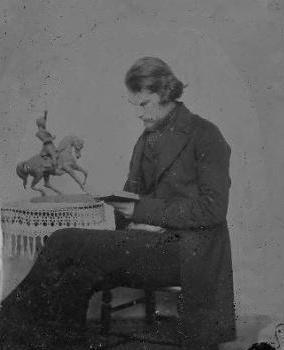
Joseph Skipsey, miner and poet, 'the Pitman Poet'.
Legacy today
It remains Skipsey's best-known poem and one of the best-known works on the Hartley disaster. Skipsey went on to be championed by Rossetti and Burne-Jones, was given a civil list pension in 1880, and in 1889 became custodian of Shakespeare's Birthplace before returning to the north-east.
Mining language in this record
Words and phrases in this record that are genuine mining terminology, occupations, methods or economic practice — not scenery or ordinary regional language that merely appears in a mining-adjacent work.
| Expression | Meaning | MineArchive connection |
|---|---|---|
| putters | The lads who pushed the coal tubs from the hewers to the haulage roads; the poem's 'putters go, the waggons to and fro'. (Northumberland and Durham) | Putter — Same concept. |
| hew | To cut coal at the face; the men are 'black as the coal they hew'. (Northumberland and Durham) | Hewer — The verb behind the Hewer term. |
| 'wall' and 'board' | The two kinds of working place in the pit, set in quotation marks in the poem: the bords driven into the coal and the walls between them. (Northumberland and Durham) | Room and Pillar — Similar: the north-east's bord-and-pillar working, catalogued as Room and Pillar. |
| stour | Dust, here the coal dust that the sweat glues to the hewers' skin. (Northern England and Scotland) | No mining term: ordinary dialect for dust. |
| mall | A heavy hammer or maul, used with the pick as the trapped men try to clear the shaft. (Northern England) | No mining term: a common tool word. |
Recorded claims
Individual factual claims, each tagged with how solidly it's grounded and attached to the source(s) that support it. Where sources disagree, both are kept.
- 'The Hartley Calamity' by Joseph Skipsey imagines the last hours of men trapped underground in the Hartley Colliery disaster of January 1862. (documented fact) 1,2
- It is among Skipsey's best-known works, written in response to the disaster at Hartley Pit. (documented fact) 2,3
- Skipsey, born at Percy Main in 1832, began work in the pit at seven as a trapper and taught himself to read and write. (documented fact) 3
- His father Cuthbert, an overman at Percy Main Colliery, was shot dead by a special constable in July 1832 during the unrest of a miners' strike. (documented fact) 2,3
- The poem follows the Hartley men from the morning shift to the shock, the closed shaft, their attempt to clear it, and the families' vigil by the pit heap, ending with two hundred dead. (documented fact) 1
- Skipsey's work was admired by Dante Gabriel Rossetti and Edward Burne-Jones, and in 1889 he became custodian of Shakespeare's Birthplace, leaving after about two years. (documented fact) 2,3
Mines
- Hartley Colliery (Hester Pit) — Northumberland
Skipsey's ballad is about the men trapped at the Hester Pit of Hartley Colliery in January 1862.
Disasters
- Hartley Colliery disaster, 1862 — 16 January 1862
Sources
- (primary) Poem: The Hartley Calamity, by Joseph Skipsey — Co-Curate (Newcastle University)
- (secondary) Joseph Skipsey — Wikipedia
- (secondary) Joseph Skipsey (Carols from the Coalfields) — Chris Harrison Music
Record created: 4 October 2026 · Last researched: 4 October 2026