 MineArchive
Haig Colliery explosion, 1922
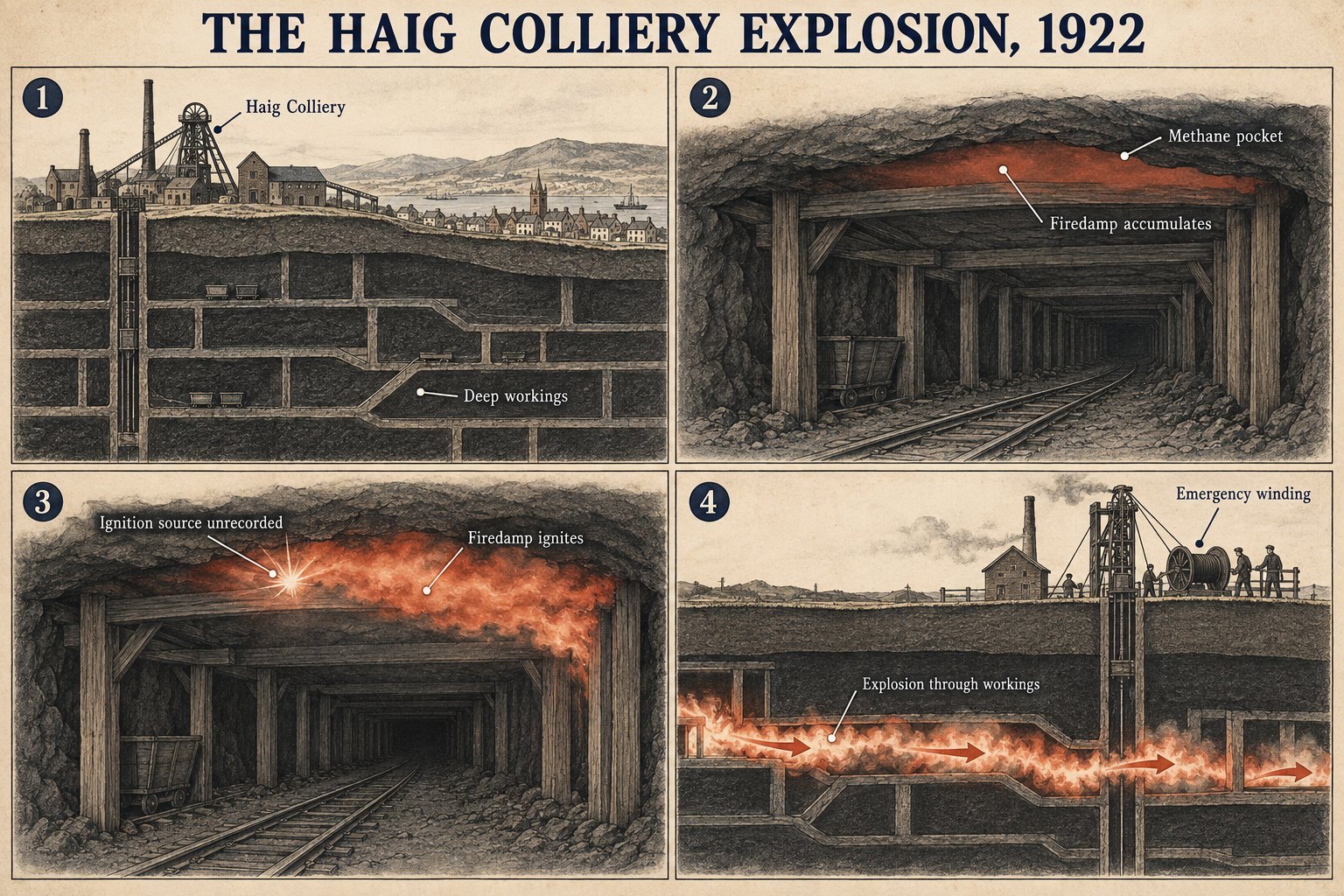
A firedamp explosion at Haig Colliery on 5 September 1922 killed 39 men, the worst of three major explosions to strike the mine over its working life.
| Date | 5 September 1922 |
|---|---|
| Mine | Haig Colliery |
| Region | Cumbria |
| Type | Explosion |
| Fatalities | 39 (39 killed, all in the North District of the Six Quarters Seam. The NMRS list names 38 of them.) |
| Context | During active mining |
Location
Plotted at Haig Colliery. Recorded location. The large pin is the mine; the small round markers are the nearest mines on record. Click one for its page. View on full map
Cause
A firedamp (methane) explosion underground.
Contributing factors
Gas had been reported on 28 days in the year before the explosion, yet no men had been withdrawn for it: a place with gas was laid idle and the men sent elsewhere. Stone-dusting had not been carried beyond the point where the roads were considered naturally wet. The district's deputies were working twelve-hour shifts, and one onsetter had to search about 80 men in 15 minutes for contraband.
What happened
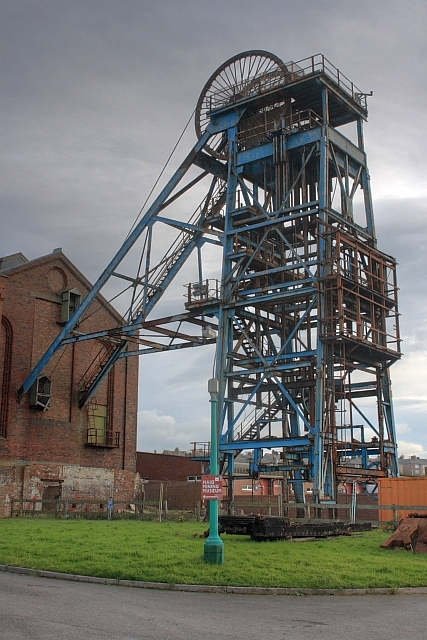
On 5 September 1922 a firedamp explosion tore through the workings at Haig Colliery in Whitehaven and killed 39 men. It remains the single worst disaster in the colliery's history, in a mine that would go on to suffer two further major explosions in 1928 and 1931. Haig was the Whitehaven Collieries Company's new pit, sunk between 1914 and 1918 to take over from the Wellington shafts; in July 1922 its drift had holed through to the Wellington workings, and it was still raising only about 250 tons a day. Eighty-two men and boys went down at 5 a.m. Thirty-nine of them were in the North District of the Six Quarters Seam, the only part of the pit the explosion reached, where the coal was holed by hand and brought down by blasting and gas had been reported in the last working places since 20 July. One of the district's deputies had been on holiday since 24 August, and the other two were covering his shift by working twelve hours. A few minutes before nine the banksman saw a cloud of dust come up the downcast shaft. The undermanager, Alexander Millar, and the rope splicer, Travaskis, were blown off their feet near the compressor house. Among the dead were the deputy in charge of the district, William Weightman, and the shotfirer, John Carson Brewster.
Rescue & recovery
Millar went into the North District, found a boy, Telford, dead at the junction, and was himself found unconscious 120 yards down the dip by the agent, R. Steel, the William Pit's manager, Mr Brodie, and the deputy Thompson, and carried out. A hewer, W. Carter, found under derailed tubs, died on the way to the infirmary. The fan, stopped when the blast displaced the planks over the upcast shaft, was restarted at about 10.30, but the return airway was full of afterdamp. Blown-out air crossings and stoppings had to be rebuilt before the Brigham rescue team and others could get down the engine plane, and Steel himself was overcome by afterdamp and carried out. No one was found alive. Twenty-five bodies were recovered by the early hours of 6 September; the last, buried under heavy falls, were brought out on Sunday 10 September.
Investigation & inquiry
The inquest and the inquiry were held together for six days from 9 October 1922 in the Congregational School Room, Scotch Street, Whitehaven. The Chief Inspector of Mines, Thomas Mottram, found the safety lamps and signalling apparatus incapable of igniting gas, ruled out a match and cigarette found in clothing, and concluded that the explosion began at the flame of a shot fired in the bottom coal at the face of Moore's heading. The jury recommended a spare deputy on each shift, no overtime for deputies, a stricter search, a definition of 'wet throughout' for stone-dusting, and that no explosive be used to get coal at Haig.
Changes to practice & legislation
The agent undertook that blasting would stop in the Six Quarters Seam, with holing and shearing machines in its place, and a committee of the Secretary for Mines was looking into a flameless explosive.
What's uncertain
Points where sources disagree or the record could not be settled; both accounts are kept. All open questions in the archive.
- Gas had been reported in the Six Quarters Seam the day before, and the deputy, William Weightman, went down with a shot-firer and approved the shot that ignited it. (uncertain) 1
Recorded claims
Individual factual claims, each attached to the source(s) that support it below. Where sources disagree, both are kept.
- A firedamp explosion at Haig Colliery, Whitehaven, on 5 September 1922 killed 39 men. 1,2
- The explosion was confined to the North District of the Six Quarters Seam, where 39 of the 82 men underground were working. 2
- The Chief Inspector, Thomas Mottram, concluded that the explosion began at the flame of a shot fired in the bottom coal at the face of Moore's heading. 2
- Gas had been reported in the Six Quarters Seam the day before, and the deputy, William Weightman, went down with a shot-firer and approved the shot that ignited it. (uncertain) 1
- With one deputy on holiday, the other two deputies of the North District were working twelve-hour shifts. 2
- No one in the district was found alive; the last bodies were recovered on 10 September. 1,2
- The jury recommended a spare deputy on each shift, no overtime for deputies, a stricter search, and no explosives for getting coal at Haig. 2
- Haig was a pit of the Whitehaven Collieries Company, Limited. 2
Related terminology
Mining terms this disaster is structurally linked to, with the nature of the relationship.
- Banksman (contextual relationship)
Named in this record’s narrative: “…his shift by working twelve hours. A few minutes before nine the banksman saw a cloud of dust come up the downcast shaft. The undermanager,…” - Contraband (contextual relationship)
Named in this record’s contributing factors: “…and one onsetter had to search about 80 men in 15 minutes for contraband.” - Deputy (contextual relationship)
Named 5 times in this record, first in the contributing factors: “…point where the roads were considered naturally wet. The district's deputies were working twelve-hour shifts, and one onsetter had to search…” - Shot-firing (contextual relationship)
Named 3 times in this record, first in the narrative: “…reached, where the coal was holed by hand and brought down by blasting and gas had been reported in the last working places since 20 July.…” - Stone Dusting (contextual relationship)
Named twice in this record, first in the contributing factors: “…for it: a place with gas was laid idle and the men sent elsewhere. Stone-dusting had not been carried beyond the point where the roads were…”
Sources
- (secondary) Haig Colliery — Wikipedia
- (secondary) Haig Colliery Explosion - Whitehaven - 1922 — Northern Mine Research Society
Record created: 21 August 2026 · Last researched: 31 October 2026