 MineArchive
Carn Brea Mine
| Also known as | Carn Brea and Tincroft Mine |
|---|---|
| Location | Carn Brea, near Redruth, Cornwall — 50.2214, -5.2775 (approximate) |
| Commodities | Copper, Arsenic, Tin, Tungsten |
| Type | Metal |
| Worked | 1832–1913-14 |
Overview
Formed in 1832 from four smaller setts at the northern foot of Carn Brea hill, this was one of the largest and most productive mines of the Camborne-Redruth district in its own right, before its 1896 amalgamation with the neighbouring Tincroft and Cook's Kitchen mines folded its later history into the combined Tincroft story.
History
Carn Brea Mine was formed in 1832 by the amalgamation of four smaller workings — Wheal Fanny, Tregajorran, Barncoose and Wheal Druid — becoming the largest single sett in the district. The mine was highly productive from the outset: in 1847 alone it sold 10,372 tons of copper ore for £73,445, representing 6.65% of the entire copper output of Devon and Cornwall that year. As with most of the district's mines, the balance between copper and tin shifted over the following decades — copper production declined from the 1850s while tin extraction grew as deeper ground became workable with improving technology. By 1860 the Tregajorran section had become the mine's deepest, while Barncoose led in tin output; rising costs forced the Barncoose section to be abandoned in 1873. By 1892 the mine was running 18 steam engines and 27 boilers to keep the workings pumped, wound and stamped.
Across its independent working life to 1896, Carn Brea raised some 237,493 tons of copper ore averaging 7.5% copper, 29,600 tons of tin, 4,140 tons of arsenic and 390 tons of mispickel (arsenical pyrite). In 1896 the mine amalgamated with its neighbours Tincroft and Cook's Kitchen; the enlarged concern employed 466 men underground and 607 on the surface that year, though rising costs and ageing plant meant profits continued to decline even at this greater scale. Output after amalgamation continued to include substantial arsenic and tungsten production — 3,142 tons of arsenic and 390 tons of tungsten in 1906, and 938 tons of tin, 277 tons of arsenic and 12 tons of tungsten as late as 1912. The Carn Brea section of the combined mine finally closed in 1913-14, while Tincroft itself continued working until 1921.
Geology
Copper and tin of the Camborne-Redruth district, with arsenic and a little tungsten alongside them; the copper ore raised over the mine's independent life averaged 7.5 per cent copper.
Workings
Four constituent setts worked as one from 1832; 18 steam engines and 27 boilers were in use by 1892 to pump, wind and stamp the combined workings. Surface stamps were built in 1837, growing to 84 head by 1850, with a further stamps installation added in 1871-72.
Closure
Rising costs forced the Barncoose section to be abandoned in 1873, and in 1896 the mine amalgamated with its neighbours Tincroft and Cook's Kitchen.
What remains
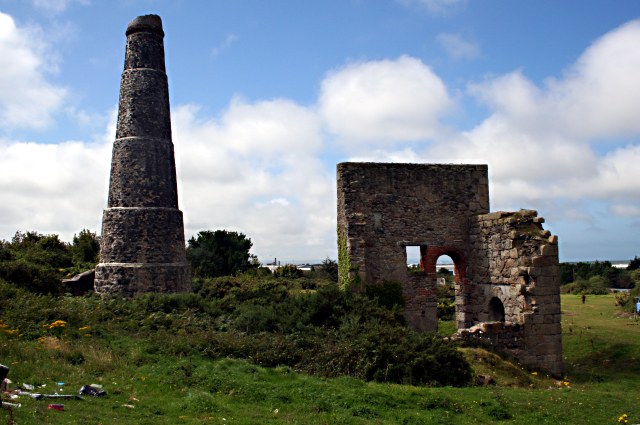
The lone surviving engine house, built for the 1837 stamps, stands on the northern edge of Carn Brea hill on private land but is clearly visible from a public footpath.
Related mines
- Cook's Kitchen Mine — Amalgamated with Carn Brea and the Tincroft sett in 1895-96 to form Carn Brea and Tincroft Mines Ltd.
- Tincroft Mine — Amalgamated in 1896 as Carn Brea and Tincroft Mines Ltd; together the two raised some 460,000 tons of copper ore.
- Wheal Union — Dines records some of Wheal Union's lodes as the eastward extensions of Carn Brea's, and the Mining Remediation Authority catalogue files twenty-two plans of the site under the combined name 'Carn Brea East and Wheal Union'.
Nearby mines
- South Crofty — 0.2 miles (0.3 km) NE
- Tincroft Mine — 0.2 miles (0.3 km) S
- Cook's Kitchen Mine — 0.3 miles (0.5 km) S
- Dolcoath Mine — 0.3 miles (0.5 km) SW
- Wheal Buller — 0.7 miles (1.1 km) E
Straight-line distance, within 9 miles (15 km). Show on the map.
Recorded claims
Individual factual claims, each attached to the source(s) that support it below. Where sources disagree, both are kept.
- Carn Brea Mine was formed in 1832 by amalgamating Wheal Fanny, Tregajorran, Barncoose and Wheal Druid, becoming the largest sett in the district. 1,2
- In 1847 the mine sold 10,372 tons of copper ore for £73,445, representing 6.65% of the copper output of Devon and Cornwall that year. 2
- Rising costs forced the Barncoose section to be abandoned in 1873; by 1892 the mine was running 18 steam engines and 27 boilers. 2
- Across its working life to 1896, Carn Brea raised approximately 237,493 tons of copper ore averaging 7.5% copper, 29,600 tons of tin, 4,140 tons of arsenic and 390 tons of mispickel. 2
- In 1896 Carn Brea amalgamated with Tincroft and Cook's Kitchen, employing 466 underground and 607 surface workers that year; later output included 3,142 tons of arsenic and 390 tons of tungsten in 1906, and 938 tons of tin, 277 tons of arsenic and 12 tons of tungsten in 1912. 2
- The Carn Brea section of the combined mine closed for good in 1913-14, while Tincroft itself continued working until 1921. 2
Sources
- (secondary) Carn Brea Mine, Cornwall — Cornwall Calling
- (secondary) Carn Brea Mine — Explore Cornwall
Record created: 26 August 2026 · Last researched: 26 August 2026