 MineArchive
Tincroft Mine
| Location | Pool, Carn Brea, Cornwall — 50.2190, -5.2780 (approximate) |
|---|---|
| Commodities | Copper, Tin |
| Type | Metal |
| Worked | By the 1680s–1921 (South Tincroft) |
| Operators | Carn Brea and Tincroft Mines (1896–1921) |
Overview
Tincroft, known since at least the 1680s and amalgamated with the neighbouring Carn Brea Mine in 1896, was one of the giants of the Camborne-Redruth district — together the two mines raised nearly half a million tons of copper and over 50,000 tons of tin before South Tincroft's final closure in 1921.
History
The Tincroft sett was known by the 1680s under the name Penhallick Vean & Tyn Croft, originally worked for copper. Tin production began in 1865 as advances in mining technology allowed deeper ground to be worked economically, even as copper output fell through the second half of the 19th century. In 1896 Tincroft amalgamated with the neighbouring Carn Brea Mine; across their combined working lives the two mines raised some 460,000 tons of copper and 53,000 tons of tin. A man engine was installed on Dunkin's Shaft in 1859, connected to a 26-inch rotative beam engine, to raise and lower miners far more safely than climbing ladders alone. In 1891 a compressor house was built at South Tincroft, housing a horizontal steam-driven compressor made by Harvey's of Hayle that powered underground rock drills. South Tincroft finally closed in 1921.
Geology
The mine worked copper and tin lodes within the Camborne-Redruth orefield, the same hydrothermal, granite-related Cornubian mineralisation worked at the neighbouring Dolcoath and Basset Mines.
Geological setting: Hydrothermal Deposits (well documented example), Veins and Lodes (well documented example)
Workings
Dunkin's Shaft was equipped with a man engine from 1859, connected to a 26-inch rotative beam engine; South Tincroft's 1891 compressor house housed a horizontal steam-driven compressor by Harvey's of Hayle, powering underground rock drills.
Closure
South Tincroft closed in 1921, ending large-scale working across the combined Carn Brea and Tincroft sett.
What remains
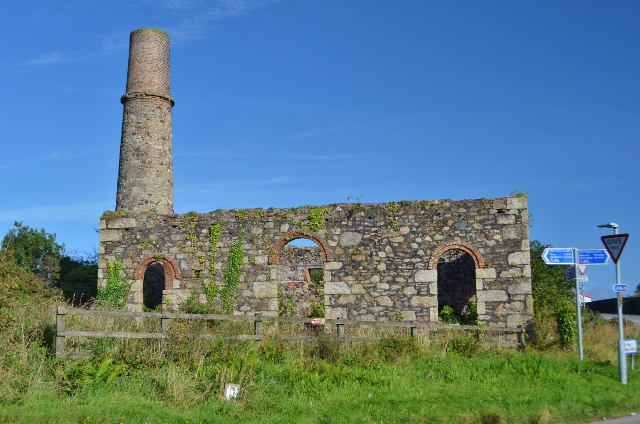
Largely built over; the man engine house, its chimney and the 1891 compressor house stand consolidated at South Tincroft.
Much of the mine site has been built over, but the man engine house and the 1891 compressor house survive at South Tincroft, consolidated and interpreted as part of the Mineral Tramways / Great Flat Lode heritage trail.
Related mines
- Carn Brea Mine — Amalgamated in 1896 as Carn Brea and Tincroft Mines Ltd; together the two raised some 460,000 tons of copper ore.
- Wheal Union — Dines records that some of Wheal Union's eight lodes are thought to be the eastward extensions of lodes in Tincroft, which is a large part of why the sett was tried three times.
Nearby mines
- Carn Brea Mine — 0.2 miles (0.3 km) N
- Cook's Kitchen Mine — 0.2 miles (0.3 km) SW
- Dolcoath Mine — 0.2 miles (0.3 km) SW
- South Crofty — 0.3 miles (0.5 km) NE
- Wheal Basset (Basset Mines) — 0.7 miles (1.1 km) SW
Straight-line distance, within 9 miles (15 km). Show on the map.
Recorded claims
Individual factual claims, each attached to the source(s) that support it below. Where sources disagree, both are kept.
- Across their combined working lives, Carn Brea and Tincroft raised some 460,000 tons of copper and 53,000 tons of tin. 1,2
- A man engine was installed on Dunkin's Shaft in 1859, connected to a 26-inch rotative beam engine; South Tincroft's 1891 compressor house housed a steam-driven compressor by Harvey's of Hayle. 1,2
- A steam engine was at work in 1794, making twelve strokes a minute and burning thirty bushels of fuel a day; at the 1896 amalgamation the combined Carn Brea and Tincroft workforce was 466 underground and 607 at surface. 2
- The Mining Remediation Authority's abandonment plans catalogue Tincroft Consols and Tincroft Old with Wheal Sisters, Trencrom, Wheal Kitty, Wheal Margaret and Wheal Mary on the tin ores at 1:500 (OM8157), and Tincroft with Wheal Providence (OM7276). 3,4
- The man engine house at South Tincroft was still standing in 2014, photographed with its chimney. 5
Photographs & further reading
A November 2016 visit with an unusually careful history — Tincroft known as 'Penhallick Vean & Tyn Croft' in the 1680s, tin from 1865, a man engine on Dunkin's shaft in 1859, the amalgamation with Carn Brea in 1896 and 460,000 tons of copper and 53,000 tons of tin between them — and photographs of the 1891 compressor house built for a Harvey's of Hayle engine to drive underground rock drills.
View sourceSources
- (secondary) Tincroft Mine, Pool, Carn Brea, Cornwall, England, UK — Mindat
- (secondary) Tincroft Mine, Cornwall — Cornwall Calling
- (primary) Tincroft Wheal Providence mine plan (BGS Mine Plans Catalogue) — British Geological Survey / The Coal Authority
- (primary) Wheal Sisters, Tincroft Consols, Tincroft Old and other workings: abandonment plans OM8157 (BGS mine plans catalogue) — British Geological Survey / Mining Remediation Authority
- (observational) Man Engine House, South Tincroft Mine (Geograph, Philip Halling, 2014) — Geograph Britain and Ireland
Record created: 23 August 2026 · Last researched: 24 September 2026