 MineArchive
Cook's Kitchen Mine
| Location | Pool, Carn Brea, Cornwall — 50.2170, -5.2800 (approximate) |
|---|---|
| Commodities | Copper, Arsenic, Tin |
| Type | Metal |
| Worked | By early 18th century–1913 |
| Maximum depth | 3,000 feet |
| Operators | Carn Brea and Tincroft Mines (1895–1913) |
Overview
Cook's Kitchen, one of Carn Brea's oldest workings, began as a small, rich copper mine in the early 18th century and grew, as it went deeper, into one of Cornwall's most profitable tin producers — reaching 3,000 feet below surface before its final closure in 1913.
History
Cook's Kitchen was already working for copper in the early 18th century, one of the earliest mines in the Carn Brea district, and had been operating for some 130 years by 1874. As the mine deepened its copper gave way to rich tin lodes, and between 1815 and 1897 it raised 8,859 tons of black tin alongside 40,920 tons of copper ore averaging 5.5% copper, plus 120 tons of arsenic and 222 tons of arsenical pyrite. It reached a depth of around 3,000 feet, among the deepest workings in Cornwall. The mine closed in 1848 but reopened the following year with tin now the main product. In 1872 the sett was divided into New Cook's Kitchen to the north and Old Cook's Kitchen to the south; in 1895 the whole was amalgamated with the neighbouring Tincroft sett, with Carn Brea Mine added the following year to form Carn Brea and Tincroft Mines Ltd. The combined venture finally closed in 1913.
Geology
The mine worked copper and tin lodes within the Camborne-Redruth orefield, the same hydrothermal, granite-related Cornubian mineralisation worked at the neighbouring Dolcoath, Tincroft and Basset Mines.
Geological setting: Hydrothermal Deposits (well documented example), Veins and Lodes (well documented example)
Workings
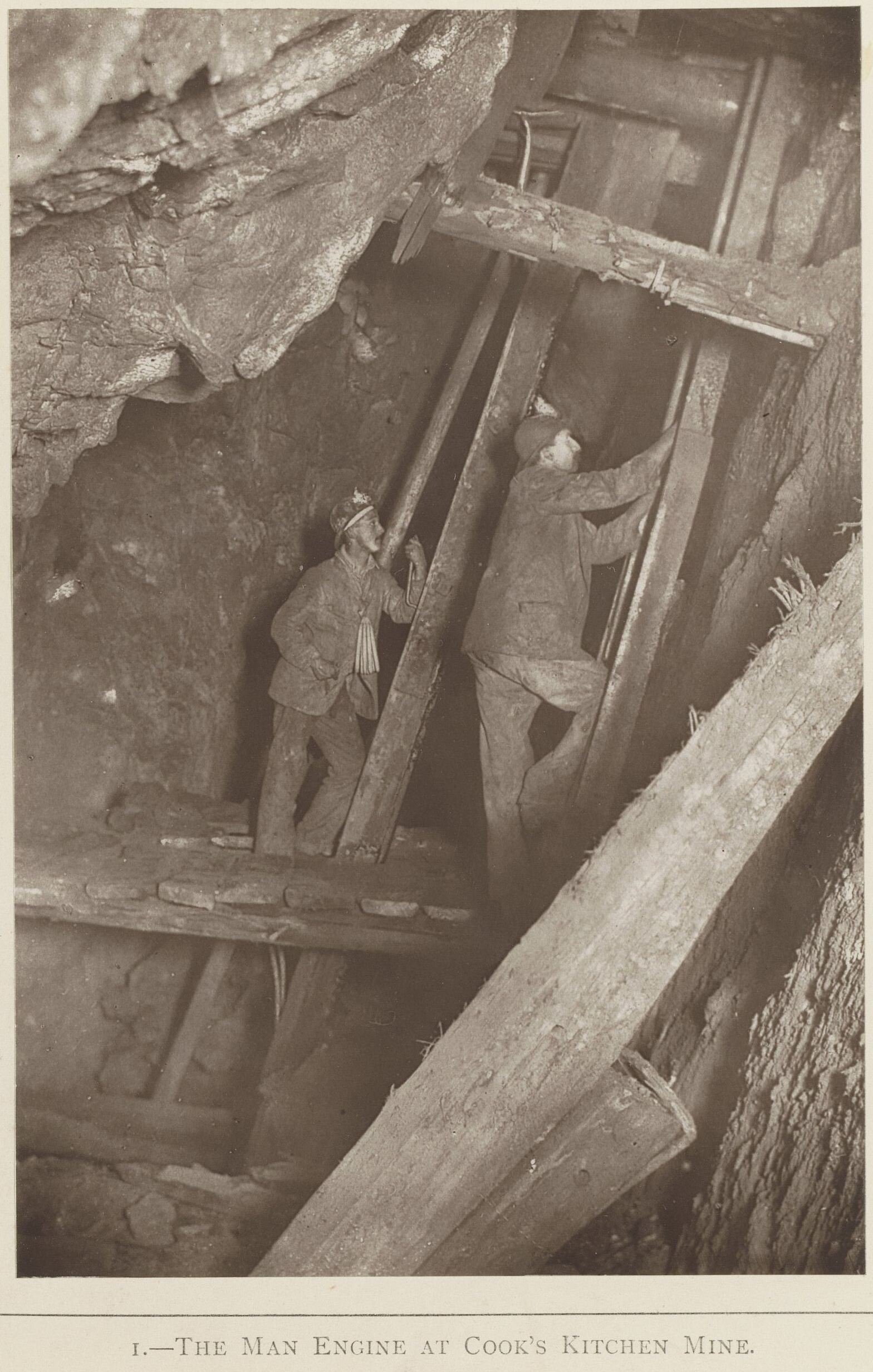
The mine reached a depth of around 3,000 feet, among the deepest in Cornwall; a man engine, installed to raise and lower miners more safely than climbing ladders, worked at Cook's Kitchen and was photographed in operation around 1893.
Closure
The combined Carn Brea and Tincroft Mines Ltd, which had absorbed Cook's Kitchen in 1895, closed for good in 1913.
What remains
Twin engine houses at Chapple's Shaft survive, along with further engine house remains at New Cook's Kitchen and Old and New Cook's Kitchen Shafts.
Related mines
- Carn Brea Mine — Amalgamated with Carn Brea and the Tincroft sett in 1895-96 to form Carn Brea and Tincroft Mines Ltd.
- South Crofty — South Crofty sank the New Cook's Kitchen shaft from 1907 on the northern half of the old Cook's Kitchen sett, and works it still.
Nearby mines
- Dolcoath Mine — 0.0 miles (0.0 km) NW
- Tincroft Mine — 0.2 miles (0.3 km) NE
- Carn Brea Mine — 0.3 miles (0.5 km) N
- South Crofty — 0.5 miles (0.7 km) NE
- Wheal Basset (Basset Mines) — 0.5 miles (0.9 km) SW
Straight-line distance, within 9 miles (15 km). Show on the map.
Recorded claims
Individual factual claims, each attached to the source(s) that support it below. Where sources disagree, both are kept.
- Between 1815 and 1897 the mine raised 8,859 tons of black tin, 40,920 tons of copper ore averaging 5.5% copper, 120 tons of arsenic and 222 tons of arsenical pyrite, reaching a depth of around 3,000 feet. 1,2
- In 1895 Cook's Kitchen was amalgamated with the neighbouring Tincroft sett, with Carn Brea Mine added in 1896 to form Carn Brea and Tincroft Mines Ltd, which closed in 1913. 1
- The Cook's Kitchen sett on the Dolcoath boundary was divided in 1872, the northern half becoming New Cook's Kitchen; sold to Tincroft in 1895, the New Cook's Kitchen sett was bought by the combined company in 1899 and its shaft sunk from 1907 under South Crofty Ltd. 1
- A transverse section through the New Cook's Kitchen shaft is held by the British Geological Survey (MP24201) and can be viewed online, with further South Crofty sections of the shaft beside it. 3
Photographs & further reading
The scanned section through the New Cook's Kitchen shaft, viewable online.
View sourceGrace's Guide's timeline of the mine from the 1740s to its absorption into Tincroft and Carn Brea.
View sourceSources
- (secondary) Cook's Kitchen Mine — Grace's Guide
- (secondary) Cook's Kitchen Mine, Pool, Carn Brea, Cornwall, England, UK — Mindat
- (primary) TRANSVERSE SECTION THROUGH NEW COOKS KITCHEN SHAFT (Mine plan MP24201, BGS mine plans catalogue) — British Geological Survey / Mining Remediation Authority
- (primary) New Cook's Kitchen mine plans (BGS Mine Plans Catalogue) — British Geological Survey / The Coal Authority
Record created: 23 August 2026 · Last researched: 24 September 2026