 MineArchive
Alva Silver Mine (Silver Glen)
| Location | Silver Glen, Alva, Ochil Hills, Clackmannanshire — 56.1583, -3.7852 (exact) |
|---|---|
| Commodities | Silver, Cobalt |
| Type | Metal |
| Worked | 1712–1716 |
| Operators | Sir John Erskine (1712–1716), Catherine, Lady Erskine (1715–1716) |
Overview
Silver Glen, cut into the Ochil Hills a kilometre east of Alva, produced the richest deposit of native silver ever found in the British Isles — a bonanza discovered by Sir John Erskine in 1712 and worked, in secret and under extraordinary circumstances, for barely four years before it was deliberately buried.
History
Sir John Erskine discovered his celebrated silver deposit in Silver Glen, behind Alva, in 1712 (some accounts give 1715); miners found the ground rich in metallic ores yielding crystallised native silver of a purity rarely seen elsewhere in Britain. The timing proved dramatic: the discovery came just as Erskine joined the Jacobite rising of 1715, leaving his wife, Catherine, Lady Erskine, to oversee the extraction of the silver in his absence. Around 40 tons of ore were raised and buried in barrels in the grounds of Alva House, while the richest material was smelted on site and the resulting ingots concealed under the floorboards of the house itself. Following the rising's failure the mine was deliberately filled in, but its existence and the concealed silver were later revealed to the government by one of the Erskines' own employees. Silver raised at Alva is said to have helped fund the Jacobite cause both in 1715 and again in the 1745 rising, and the deposit's associated cobalt ore was later worked intermittently and supplied to porcelain manufacturers, including William Littler of Prestonpans, as a blue colouring agent.
Geology
The deposit worked at Silver Glen is a hydrothermal vein system hosted in the volcanic rocks of the Ochil Hills, notable for yielding native silver in crystallised form rather than the silver-bearing lead ore typical of most British silver production.
Geological setting: Hydrothermal Deposits (well documented example), Veins and Lodes (well documented example)
Workings
The mine consists of a series of shafts and levels cut into the east side of the burn at the south end of Silver Glen; no detailed depth or extent figures are recorded for the workings.
Closure
The mine was deliberately filled in following the failure of the 1715 Jacobite rising, though its cobalt ore continued to be worked intermittently in later years.
What remains
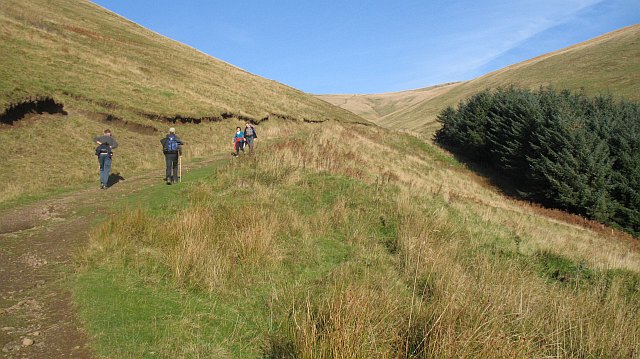
The glen itself, and the burn the workings run alongside, remain accessible as a hillwalking route above Alva; no significant mine structures survive above ground.
Nearby mines
- Devon Colliery — 1.1 miles (1.8 km) S
- Glenochil Colliery — 1.7 miles (2.7 km) SW
- Tillicoultry Colliery — 2.4 miles (3.9 km) E
- Alloa Colliery — 2.5 miles (4.0 km) SE
- Melloch Colliery — 2.6 miles (4.2 km) E
Straight-line distance, within 9 miles (15 km). Show on the map.
Recorded claims
Individual factual claims, each attached to the source(s) that support it below. Where sources disagree, both are kept.
- Around 40 tons of silver ore were raised and hidden in barrels at Alva House, with the richest material smelted on site and the ingots concealed under the house's own floorboards. 1,2
- The deposit is considered the richest bonanza of native silver ever found in Britain, and silver raised here is said to have helped fund the Jacobite risings of both 1715 and 1745. 1,3
- Sir John Erskine secured a pardon for his part in the 1715 rising on condition that he revealed all he knew of the mine and gave a tenth of its proceeds to the government, after samples of the ore had been assayed by Sir Isaac Newton; mining resumed a few years later. 1
- In 1759 a vein of erythrite, an ore of cobalt, was found and briefly revived the mine before it too was exhausted. 1
- Located at about 56.158 N, 3.785 W. 1
Photographs & further reading
An account of the 1715 discovery, the Erskines and the government's instructions to Justus Brandshagen, with the Hunterian's surviving Alva silver specimen.
View sourceSources
- (secondary) Silver Glen — Wikipedia
- (secondary) Alva Silver Mine, Silver Glen, Alva, Clackmannanshire, Scotland, UK — Mindat
- (secondary) Scotland's Silver Glen — LBMA Alchemist
Record created: 22 August 2026 · Last researched: 24 September 2026