 MineArchive
Devon Colliery
| Also known as | Fishcross, Devon 1 and 2, Sauchie |
|---|---|
| Location | Fishcross, near Sauchie, Clackmannanshire — 56.1426, -3.7759 (exact) |
| Commodity | Coal |
| Type | Coal |
| Worked | Early 19th century–1960 |
| Maximum depth | A 600 ft shaft was prepared for the 1873 reopening. |
| Operators | Alloa Coal Company, Erskine family, Earls of Mar |
Overview
A Clackmannanshire colliery opposite what is now Devon Village, on ground where coal was worked from the eighteenth century and for some three hundred years in all. The pit associated with the Erskine family of Alloa Tower and their mining engineer Robert Bald belongs to the early nineteenth century, and the colliery was later worked by the Alloa Coal Company. Water was its besetting problem, and in 1864 Neilson & Company of Glasgow built the Cornish beam-engine house that still stands - one of only two surviving historic beam engine houses in Scotland - to pump five tons a minute. On 26 March 1897 water burst through a dam in the Lower Five Feet seam and drowned six men. The colliery closed in 1960.
History
Coal was worked on the Devon ground from the eighteenth century, and mining went on here for around three hundred years. The pit opposite what is now Devon Village is a later thing than that: it is associated with the Erskine family of Alloa Tower, who owned the coal, and with Robert Bald, their mining engineer, and belongs to the early nineteenth century rather than the eighteenth - Bald was born in 1776 and could not have sunk it in the 1700s. It was later worked by the Alloa Coal Company.
Bald is the figure worth knowing here. The son of the Earl of Mar's colliery agent at Alloa, he became one of the earliest and most eminent mining engineers in Scotland and was later called the acknowledged father of the profession there. His A General View of the Coal Trade of Scotland, published in 1808, set out the conditions in which miners and their families worked and added an inquiry into the women who carried coal underground as bearers. He tried to stop the employment of women and children as bearers in 1822 and met opposition from the miners themselves, whose households depended on the earnings. When the Erskines' colliery lease expired in 1835 he offered either to resign or to take full responsibility, and took over the running of the Collyside, Woodlands and Devonside collieries on his own principles. The employment of women and children in mines was outlawed in 1842.
The mine stood idle from 1854 and was brought back by Andrew Roxburgh, then manager of the Alloa Coal Company, at well over the ten thousand pounds budgeted. The dates for that reopening do not agree: the one account of it gives the idle period as 1854 to 1879 and Roxburgh's decision as 1873, and both are recorded here rather than one being chosen - the likeliest reading is that the decision came in 1873 and winding resumed some years later. A 600-foot shaft was prepared and a pair of 24-inch winding engines installed, with a twelve-foot revolving drum for the wire ropes and twelve-foot pulleys. Ventilation was by a thirty-foot fan moving 200,000 cubic feet of air a minute - necessary for three square miles of workings - and a branch railway ran to the Alloa docks.
Water was the constant difficulty in the Clackmannanshire pits, and to fight it Neilson & Company of Glasgow built a beam-engine house in 1864 housing a Cornish pumping engine that lifted five tons a minute. It was still working into the twentieth century and was superseded by an electric pump in 1932. Water also caused the worst thing that happened here. At about a quarter to six on the morning of 26 March 1897, in the Lower Five Feet seam, water that had gathered behind a dam burst through - either the wooden door or the valve gave way - and six of the seven men working at the level were drowned (see Disasters, below).
Devon was one of four collieries in Clackmannanshire owned by the Alloa Coal Company in the nineteenth century. It closed in 1960 and was razed; only the beam engine house survives, restored and converted to office use in 1993.
Geology
The Clackmannanshire coalfield on the north side of the Forth, worked here in seams including the Lower Five Feet. Water is the defining fact of the ground: the pits of the district were notoriously wet, which is why a Cornish pumping engine of the kind more usually found in Cornish metal mines was built here in 1864, and why the colliery’s worst disaster was an inundation rather than an explosion.
Workings
A 600 ft shaft prepared for the 1873 reopening, wound by a pair of 24-inch engines with a twelve-foot drum and twelve-foot pulleys. Ventilation was by a thirty-foot fan moving 200,000 cubic feet a minute through some three square miles of workings. The 1864 beam-engine house held a Cornish pumping engine by Neilson & Company of Glasgow, pumping five tons of water a minute until an electric pump replaced it in 1932. A branch railway carried the coal to the Alloa docks for shipping.
Closure
The colliery closed in 1960 and the site was razed. Only the beam engine house was left standing.
What remains
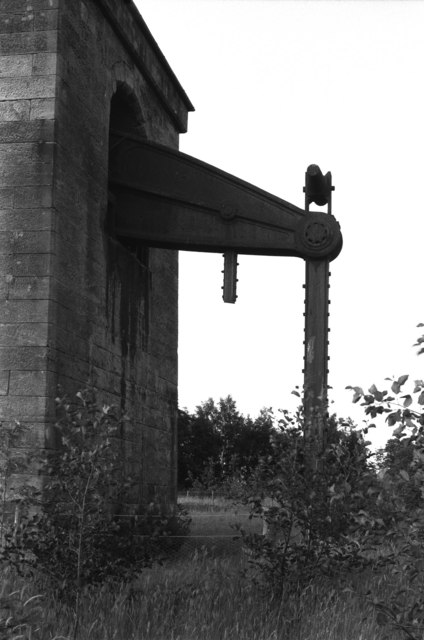
The beam engine house survives at Fishcross, near the SSPCA wildlife centre — one of only two historic beam engine houses left in Scotland, listed and restored in 1993 and converted to office space. The beam and pump rod are all that remain of the Cornish engine itself. Nothing else of the colliery is left.
The 1864 Cornish beam engine house, with the beam and pump rod of its engine; everything else was razed.
Redevelopment
The beam engine house was restored in 1993 and converted to office space.
Related mines
- Alloa Colliery — Both were Alloa Coal Company pits on the Earl of Mar's Clackmannanshire ground, worked by the partnership founded in 1835 and its limited successor.
- Craigrie Colliery — Both worked by the Alloa Coal Company.
- Dollar Mine — Alloa Coal Company pits; Devon Colliery washed Dollar's dross and supplied its electricity.
- Forthbank Colliery — Alloa Coal Company collieries; Forthbank's coal was washed at Devon.
- Isle of Canty Colliery — Alloa Coal Company mines; Isle of Canty's semi-anthracite was sent to the Devon and Meta pits at Sauchie for briquetting.
- Meta Colliery — Meta was also known as Devon 3 and drew its electricity, baths and canteen from Devon Colliery 450 m away.
- Sheriffyards Colliery — Clackmannanshire collieries of the Alloa Coal Company.
- Tillicoultry Colliery — Both Alloa Coal Company collieries; Tillicoultry's electricity came from Devon Colliery.
Nearby mines
- Meta Colliery — 0.2 miles (0.4 km) W
- Alva Silver Mine (Silver Glen) — 1.1 miles (1.8 km) N
- Alloa Colliery — 1.4 miles (2.2 km) SE
- Glenochil Colliery — 1.6 miles (2.6 km) W
- Sheriffyards Colliery — 2.0 miles (3.2 km) SE
Straight-line distance, within 9 miles (15 km). Show on the map.
Disasters & major incidents
-
Devon Colliery inundation
26 March 1897 · Flooding / Inundation · 6 fatalities
Water that had gathered behind a dam in the Lower Five Feet seam burst through at about a quarter to six in the morning. Seven men were working at the level; six were drowned. The only survivor was found half conscious by the men coming on at six. The bodies were not recovered until the water had been pumped away, more than three weeks later.
People
- Robert Bald (1776–1861) · manager — The Erskine family's mining engineer and manager at their Clackmannanshire collieries, and the man the Alloa Advertiser's account of Devon Colliery names alongside Erskine as its sinker.
What's uncertain
Points where sources disagree or the record could not be settled; both accounts are kept. All open questions in the archive.
- Coal was worked on the Devon site from the eighteenth century, for around three hundred years in all. The pit opposite what is now Devon Village, associated with the Erskine family and their mining engineer Robert Bald, belongs to the early nineteenth century, and the colliery was later worked by the Alloa Coal Company. (uncertain) 1
- The mine stood idle from 1854 and was brought back by Andrew Roxburgh, then manager of the Alloa Coal Company, at well over the ten thousand pounds budgeted. The single account of it gives the idle period as 1854 to 1879 and Roxburgh's decision as 1873, which cannot both describe the same reopening; the decision and the resumption of winding may be the two dates. The work involved a 600-foot shaft, a pair of 24-inch winding engines with a twelve-foot drum and twelve-foot pulleys, ventilation by a thirty-foot fan moving 200,000 cubic feet a minute for three square miles of workings, and a branch railway to the Alloa docks. (uncertain) 1
Recorded claims
Individual factual claims, each attached to the source(s) that support it below. Where sources disagree, both are kept.
- Coal was worked on the Devon site from the eighteenth century, for around three hundred years in all. The pit opposite what is now Devon Village, associated with the Erskine family and their mining engineer Robert Bald, belongs to the early nineteenth century, and the colliery was later worked by the Alloa Coal Company. (uncertain) 1
- Robert Bald was the Erskine family's mining engineer and manager, not a partner. He condemned the employment of women and girls underground, attempting to stop it in 1822, and when the lease expired in 1835 he took over the running of the Collyside, Woodlands and Devonside collieries himself rather than resign. His A General View of the Coal Trade of Scotland of 1808 had set out the conditions in which miners and their families worked, and the employment of women and children in mines was outlawed in 1842. 1
- The mine stood idle from 1854 and was brought back by Andrew Roxburgh, then manager of the Alloa Coal Company, at well over the ten thousand pounds budgeted. The single account of it gives the idle period as 1854 to 1879 and Roxburgh's decision as 1873, which cannot both describe the same reopening; the decision and the resumption of winding may be the two dates. The work involved a 600-foot shaft, a pair of 24-inch winding engines with a twelve-foot drum and twelve-foot pulleys, ventilation by a thirty-foot fan moving 200,000 cubic feet a minute for three square miles of workings, and a branch railway to the Alloa docks. (uncertain) 1
- The beam-engine house was built in 1864 by Neilson & Company of Glasgow because of the wet nature of the pit; its Cornish pumping engine lifted water at five tons a minute and was superseded by electric pumping in 1932. It is one of only two surviving historic beam engine houses in Scotland. 1,2
- The mine closed in 1960 and was razed to the ground; the beam engine house alone survived and was restored and converted to office space in 1993. 2
- Robert Bald (1776-1861), called by the late nineteenth century the acknowledged father of mining engineering in Scotland, was the son of the Earl of Mar's colliery agent at Alloa and spent much of his working life employed by the mine-owning Erskine family of Alloa Tower. 3,4
Photographs & further reading
The council’s account of the surviving engine house: why it was built, what its Cornish engine did, and how it came to be restored.
View sourceA local history column covering the colliery from its eighteenth-century sinking to the 1897 inundation, with the names of the six men drowned.
View sourceSources
- (secondary) A walk in the past: disaster at the Devon Colliery — Alloa Advertiser
- (secondary) Devon Colliery Beam Engine House — Clackmannanshire Council
- (secondary) Robert Bald — Wikipedia
- (secondary) Robert Bald — Clackmannanshire.scot — Clackmannanshire.scot
- (primary) Devon Colliery (Canmore 130814) — Historic Environment Scotland
Record created: 7 September 2026 · Last researched: 28 September 2026