 MineArchive
Sheriffyards Colliery
| Location | East end of Gartmorn Dam, near Coalsnaughton, Clackmannanshire — 56.1316, -3.7287 (approximate) |
|---|---|
| Commodity | Coal |
| Type | Coal |
| Worked | 1894–1921 |
| Maximum depth | Unknown. |
| Operators | Alloa Coal Company (1894–1921) |
Overview
An Alloa Coal Company colliery at the east end of Gartmorn Dam, sunk in 1894, employing 437 men by 1910 and abandoned in 1921; its brick ruins stand beside the loch's path network.
History
Sheriffyards Colliery stood at the east end of Gartmorn Dam, the reservoir above Alloa, and was worked by the Alloa Coal Company. The Alloa Waggonway, the horse-drawn line built from about 1768 to carry the Earl of Mar's coal to Alloa harbour, had among its several branches one to Sherriffyards Colliery at Gartmorn Dam.
The colliery of the Alloa Coal Company was being sunk in 1894, when 29 men were employed there, 17 of them underground. It grew quickly: 104 men worked there in 1896, 212 in 1900 and 437 in 1910, the highest of the recorded figures, falling to 270 in 1915 and 249 in 1920. It raised household, manufacturing and steam coal, from the Lower Five Feet and Splint seams by 1905 and from the Coalsnaughton and Main seams as well by 1920. James Bain, the company's general manager, listed Sheriffyards among its Clackmannanshire collieries in evidence on miners' housing. Among the men killed there were John Murray, a screenman struck by a train of empty wagons pushed by a locomotive in 1901, and William Mitchell, a drawer of 17 accidentally struck by his father's pick at the face in 1911.
A mineral railway crossing an arm of the loch connected the colliery to the Devon Valley line, and its coal went down to Alloa harbour for export. Abandonment plans of the Lower Five Feet and of the Coalsnaughton Main and Splint seams are dated 1921; other accounts put the closure in the early 1920s or about 1930.
Geology
The colliery worked the Lower Five Feet and Splint seams of the Clackmannanshire coalfield, and by 1920 the Coalsnaughton and Main seams as well.
Workings
Underground workings in up to four seams; 340 of the 437 men employed in 1910 worked below ground.
Closure
Abandonment plans of its seams are dated 1921; other accounts put the closure in the early 1920s or about 1930.
What remains
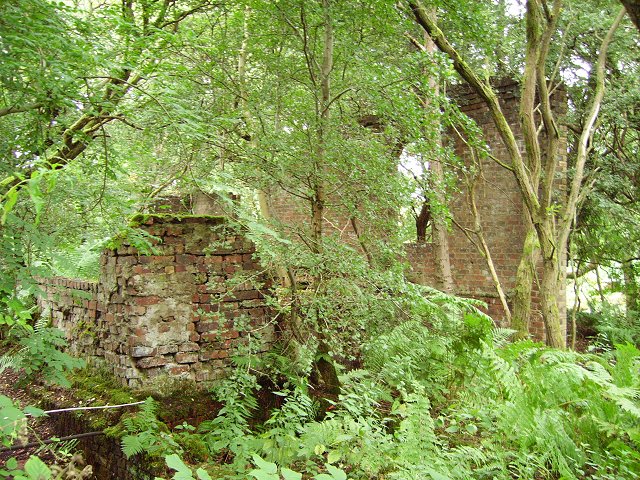
Brick ruins of the colliery stand among trees and undergrowth beside the path at the east end of Gartmorn Dam, now a country park and nature reserve.
Overgrown brick walls of colliery buildings, and the line of the mineral railway, which crosses an arm of the loch.
Redevelopment
The former colliery railway around Gartmorn Dam is part of the country park's path network.
Related mines
- Devon Colliery — Clackmannanshire collieries of the Alloa Coal Company.
- Meta Colliery — Clackmannanshire collieries of the Alloa Coal Company.
- Tillicoultry Colliery — Clackmannanshire collieries of the Alloa Coal Company.
Nearby mines
- Tillicoultry Colliery — 1.2 miles (1.9 km) N
- Alloa Colliery — 1.2 miles (2.0 km) W
- Melloch Colliery — 1.2 miles (2.0 km) N
- Castlebridge Colliery — 1.4 miles (2.3 km) SE
- Zetland Colliery — 1.4 miles (2.3 km) SW
Straight-line distance, within 9 miles (15 km). Show on the map.
What's uncertain
Points where sources disagree or the record could not be settled; both accounts are kept. All open questions in the archive.
- Sheriffyards Colliery closed in the early 1920s. (uncertain) 5
- Sheriffyards Colliery closed about 1930. (disputed) 8
Recorded claims
Individual factual claims, each attached to the source(s) that support it below. Where sources disagree, both are kept.
- Sheriffyards Colliery was sinking in 1894, with 29 men employed, 17 of them below ground. 1
- Sheriffyards employed 437 men in 1910, 340 of them below ground. 1
- By 1920 the colliery worked the Coalsnaughton, Lower Five Feet, Main and Splint seams. 1,2
- The Alloa Coal Company's general manager, James Bain, listed Sheriffyards among the company's Clackmannanshire collieries. 1,3
- The Alloa Waggonway had a branch to Sherriffyards Colliery at Gartmorn Dam. 4
- A former railway that served Sheriffyards Colliery crosses an arm of Gartmorn Dam and is now part of its path network. 5,6
- Abandonment plans of the Sheriffyards seams are dated 1921. 7,2
- Sheriffyards Colliery closed in the early 1920s. (uncertain) 5
- Sheriffyards Colliery closed about 1930. (disputed) 8
- Ruins of Sheriffyards Colliery stand among undergrowth beside Gartmorn Dam. 5,8,9
Sources
- (primary) Sheriffyards Colliery — Durham Mining Museum
- (primary) BGS / Mining Remediation Authority mine plan 21915935: Sheriffyards, Coalsnaughton Main & Splint, abandoned 1921 — British Geological Survey
- (secondary) Clackmannan Area Housing (evidence of James Bain, Alloa Coal Company) — Scottish Mining Website
- (secondary) Alloa Waggonway — Wikipedia
- (observational) Gartmorn Dam — Walking with Brian
- (observational) Disused railway, Gartmorn Dam (Geograph 244195) — Geograph Britain and Ireland
- (primary) BGS / Mining Remediation Authority mine plan 21915933: Sheriffyards, Lower Five Feet, abandoned 1921 — British Geological Survey
- (observational) Sheriffyards Colliery (Geograph 244191) — Geograph Britain and Ireland
- (observational) Old colliery, Gartmorn, Alloa, Scotland, Sept '08 — Derelict Places
Record created: 19 October 2026 · Last researched: 20 October 2026