 MineArchive
Castlebridge Colliery
| Location | Clackmannan, Clackmannanshire — 56.1150, -3.7058 (exact) |
|---|---|
| Commodity | Coal |
| Type | Coal |
| Worked | From 1978 (sinking)–2002 |
| Maximum depth | Shaft 426 m (6.1 m diameter, concrete-lined) |
| Operators | National Coal Board (1978–1987), Scottish Coal (Deep Mine) Ltd (1995–2002) |
Overview
The last productive part of the Longannet complex in Clackmannanshire, sunk from 1978 and in production from 1984, and for a time one of the most productive collieries in Europe. Longannet was not really five collieries but one mine five miles across, its workings joined by tunnel and feeding the power station on the Forth. When water broke through a dam into the sealed workings in March 2002 the whole complex was lost, and with it deep coal mining in Scotland.
History
The Longannet complex began production in 1969, built to supply the 2,400 MW Longannet power station on the north shore of the Forth east of Kincardine. It joined the Bogside, Castlehill and Solsgirth collieries and the Longannet mine into a single system about five miles long working the Upper Hirst coal, designed for 10,160 tons a day.
Castlebridge was the last part of it to be built. Its shaft, 6.1 m across and concrete-lined, was sunk from 1978 to 426 m, and production began in 1984. Bogside had closed in the 1980s and by the early 1990s the Castlehill and Solsgirth reserves were worked out, so output came increasingly from the Castlebridge side. On privatisation the complex passed to Mining Scotland and then to Scottish Coal (Deep Mine) Ltd. In the late 1990s new roadways were driven to reach a seam under the Forth downstream of the Kincardine Bridge.
Production from Castlebridge itself ceased in 2000, and the northern side of the complex was sealed and allowed to flood, dams holding the old workings back from the active Kincardine ground. In March 2002 millions of gallons broke through. The fifteen men underground at the time were working elsewhere and all got out safely, but the mine did not: repair was put at around £50 million. Scottish Coal (Deep Mine) Ltd went into receivership shortly afterwards, no new operator came forward, and the complex closed in April 2002 with the loss of more than 500 jobs.
Geology
The complex worked the Upper Hirst coal of the Clackmannan and Fife coalfield, a seam consistent enough over a wide area to justify joining five separate accesses into one underground system rather than sinking a pit to each district. In the late 1990s the workings were extended to a seam lying under the Firth of Forth itself, downstream of the Kincardine Bridge — the ground whose relationship with the sealed and flooded northern workings later proved fatal to the mine.
Geological setting: Sedimentary Beds and Seams (well documented example)
Workings
One concrete-lined shaft 6.1 m in diameter and 426 m deep, connected into a tunnel system running some five miles between the complex's several accesses. That connection was the complex's strength and in the end its weakness: when the northern side was sealed off and flooded after Castlebridge stopped producing in 2000, only constructed dams stood between that water and the working ground at Kincardine.
Closure
The mine was lost to water rather than to exhaustion or economics in the ordinary sense. The March 2002 inrush from the sealed northern workings flooded the underground system; the estimated £50 million cost of putting it right was not spent, Scottish Coal (Deep Mine) Ltd went into receivership, and the complex shut in April 2002. That was the end of deep coal mining in Scotland.
What remains
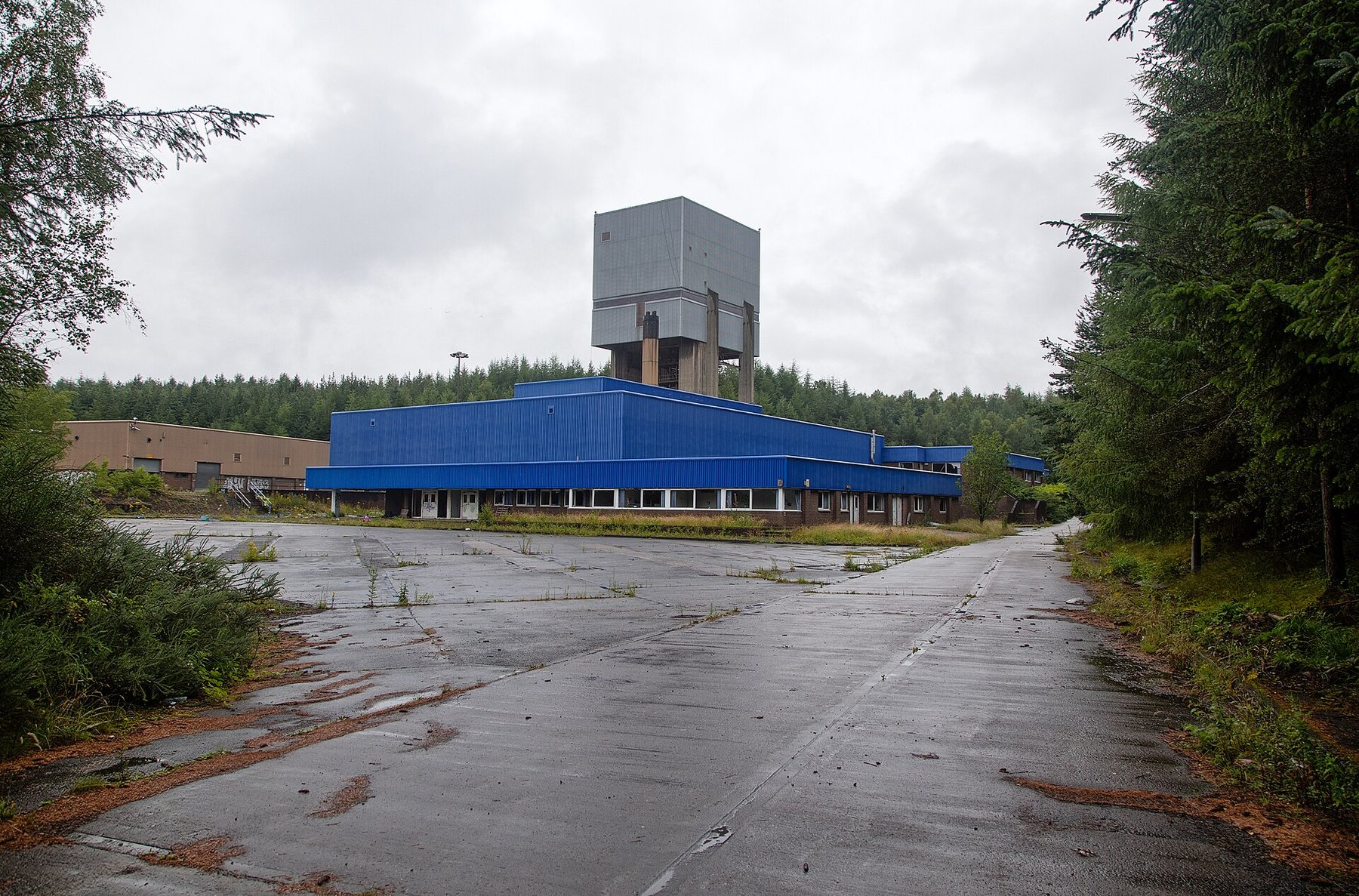
The colliery is gone as a working place. The winding tower survived long enough to be recorded photographically by the national monuments survey, and the surface buildings were still standing and being visited by explorers in August 2016. The site is approached across former colliery ground now given over to forestry and rough land.
The winding tower was recorded by the national monuments survey and the surface buildings were still standing in 2016; the ground around is forestry and rough land.
Related mines
- Castlehill Mine — Operated as a single unit with Castlebridge from September 1986.
- Solsgirth Colliery — Both were part of the Longannet complex, their workings joined into one five-mile tunnel system; Solsgirth's reserves were worked out by the early 1990s, after which output came increasingly from Castlebridge.
Nearby mines
- Tulligarth Colliery — 0.8 miles (1.3 km) W
- Brucefield Colliery — 1.1 miles (1.8 km) SW
- Sheriffyards Colliery — 1.4 miles (2.3 km) NW
- Zetland Colliery — 1.5 miles (2.5 km) W
- Alloa Colliery — 2.1 miles (3.4 km) W
Straight-line distance, within 9 miles (15 km). Show on the map.
Recorded claims
Individual factual claims, each attached to the source(s) that support it below. Where sources disagree, both are kept.
- Castlebridge's shaft was 6.1 m in diameter, concrete-lined and 426 m deep; sinking began in 1978 and production in 1984. 1,2
- The Longannet complex began production in 1969 and joined Bogside, Castlebridge, Castlehill, Solsgirth and the Longannet mine into a tunnel system about five miles long working the Upper Hirst coal, designed for 10,160 tons a day. 1,2
- Production from Castlebridge ceased in 2000 and the northern side of the complex was sealed and flooded behind dams; in March 2002 millions of gallons broke into the workings. The fifteen men below ground were in another part of the mine and all were evacuated safely. 1,2
- Repair was estimated at around £50 million and was not attempted. Scottish Coal (Deep Mine) Ltd went into receivership, no new operator took the complex on, and it closed in April 2002 with more than 500 jobs lost — the end of deep coal mining in Scotland. 1,2
Photographs & further reading
A detailed account of the whole Longannet system, its constituent collieries, the Upper Hirst workings and the 2002 flooding that ended it.
View sourceSources
- (secondary) Pit-L-12. Longannet Mine (Longannet Complex) — fifepits.co.uk
- (observational) Castlebridge Colliery surface buildings, August 2016 — 28DaysLater
- (primary) Castlebridge Colliery, National Record of the Historic Environment 148279 — Historic Environment Scotland
Record created: 9 September 2026 · Last researched: 9 September 2026