 MineArchive
Wheal Busy
| Also known as | Great Wheal Busy, Chacewater Mine |
|---|---|
| Location | Chacewater, Cornwall — 50.2575, -5.1739 (exact) |
| Commodities | Copper, Arsenic, Tin |
| Type | Metal |
| Worked | 16th century (earliest working)–1924 |
Overview
A copper mine at Chacewater that was a proving ground for Cornish steam: one of the county's first Newcomen engines in 1727, a Smeaton engine in 1775, and in 1777-78 the first Boulton and Watt engine in Cornwall. It ended its working life a century and a half later roasting arsenic, and the Brunton calciner that did it still stands to roof level.
History
Working on the site goes back to the 16th century, but the mine — then called Chacewater Mine, and renamed Wheal Busy after 1823 — became a serious copper producer from the 1720s. Its significance is as much about engines as ore. Joseph Hornblower put up one of the first Newcomen engines in Cornwall here in 1727 to fight the water. In 1775 a 72-inch engine designed by John Smeaton replaced it and disappointed; James Watt's firm supplied the county's first engine of its own type here in 1777-78, and the Great County Adit reached the mine in 1778, which did as much for the drainage as any engine. The mine produced over 100,000 tons of copper ore across its life, but struggled from the 1850s onwards through repeated reopenings: an 85-inch Harvey's pumping engine of 1856 ran about ten years before the 1866 copper collapse, and a 90-inch engine bought from Perran Foundry in 1873 for over £4,000 worked barely seven months before the mine shut again. The last phase was arsenic rather than copper. An Anglo-Belgian company built an arsenic recovery plant in 1907, a second-hand 85-inch engine of 1852 was brought over from a St Austell mine and re-erected in 1910, and Californian stamps were put up in 1924 for a final attempt at reworking the ground.
Geology
Wheal Busy sits in the copper ground north of the Carnon valley, on the same lode system that made Gwennap and Chacewater one of the most intensively worked districts in Cornwall. The ore was copper with tin at depth, and arsenic — present in the ore as arsenopyrite and long treated as a nuisance — became the commodity that kept the mine alive after the copper was uneconomic.
Geological setting: Veins and Lodes (well documented example)
Workings
Engine shaft carried the principal pumping engine, and its 1856 house survives with its telescopic stack. Drainage was the mine's defining problem and the reason for the succession of ever-larger engines; the Great County Adit, which drained a huge area of the Gwennap and Chacewater mines to the Carnon valley, reached Wheal Busy in 1778 and took the water that the engines could not. The 1907 arsenic plant worked on a different principle entirely: ore was roasted in a Brunton calciner to drive off arsenical vapour, which was condensed in a labyrinth of flues and swept out as a solid.
Closure
The mine produced over 100,000 tons of copper ore across its life but struggled from the 1850s onwards through repeated reorganisations.
What remains
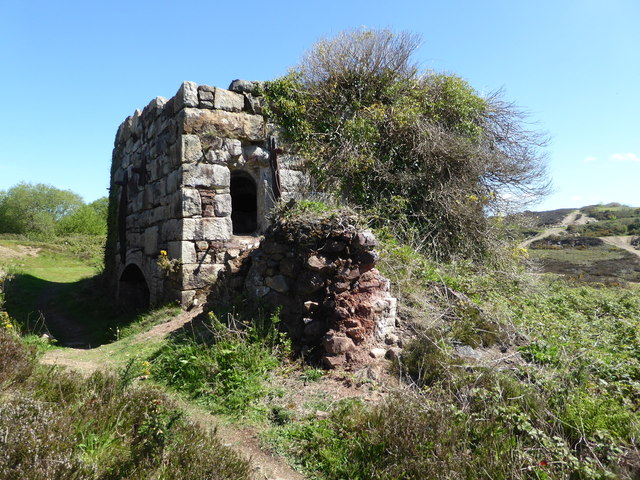
The Engine shaft pumping house of 1856 is the only engine house left standing on the site proper, with its stack and boiler house; it was consolidated in 2016 and remains fenced. The Brunton calciner stands to roof level — massive granite blocks bound with iron ties, a brick front still carrying its iron door fittings, and the revolving ore bed and other machinery surviving inside. A 2018 photograph shows the calciner sound and clear of vegetation. The smithy has lost much of its roof and has been described as in a sad state, though it has since received refurbishment funding. Shafts across the site were capped under Operation Minecap and the concrete caps are visible.
Engine shaft pumping engine house of 1856 with telescopic stack and boiler house; the Brunton calciner and its chimney from the 1907 arsenic plant; the smithy; capped shafts; and earthworks across the eastern part of the scheduled area. Scheduled Monument 1021392.
Related mines
- Great County Adit — The Great County Adit reached Wheal Busy in 1778, doing as much for its drainage as any engine.
- Hallenbeagle Mine — Hallenbeagle was reworked in the 1860s as part of Great Wheal Busy, and the two mines share a joint 1864 abandonment plan.
- Wheal Unity Wood — A final, failed arsenic venture at Wheal Busy in the mid-1920s brought Wheal Unity Wood's own operations to a close.
Nearby mines
- Killifreth Mine — 0.4 miles (0.6 km) SW
- Hallenbeagle Mine — 0.8 miles (1.2 km) W
- Poldice Mine — 1.0 miles (1.6 km) SE
- Wheal Gorland — 1.2 miles (1.9 km) S
- North Downs Mine — 1.4 miles (2.3 km) W
Straight-line distance, within 9 miles (15 km). Show on the map.
What's uncertain
Points where sources disagree or the record could not be settled; both accounts are kept. All open questions in the archive.
- Sources differ on the date and the machine. Grace's Guide has a Boulton and Watt pumping engine installed late in 1777, the first of its type in Cornwall; other accounts describe Watt rebuilding Smeaton's 72-inch engine of 1775 in 1778. Both agree Wheal Busy was where Watt's engine first worked in the county. (disputed) 1,2
- Figures differ by phase and are not directly comparable: 27,000 tons of arsenic is given for the mine's life, against 750 tons raised between the 1907 plant opening and closure. (disputed) 1,3
Recorded claims
Individual factual claims, each attached to the source(s) that support it below. Where sources disagree, both are kept.
- Sources differ on the date and the machine. Grace's Guide has a Boulton and Watt pumping engine installed late in 1777, the first of its type in Cornwall; other accounts describe Watt rebuilding Smeaton's 72-inch engine of 1775 in 1778. Both agree Wheal Busy was where Watt's engine first worked in the county. (disputed) 1,2
- Over 100,000 tons of copper ore across the mine's working life, the last significant year being 1866 at 1,630 tons. 1
- Figures differ by phase and are not directly comparable: 27,000 tons of arsenic is given for the mine's life, against 750 tons raised between the 1907 plant opening and closure. (disputed) 1,3
- In 1836 the mine employed 112 people: 34 men underground, 50 women at surface and 28 children. 1
- An 85-inch Harvey's pumping engine was installed in 1856 and worked about ten years; a 90-inch engine from Perran Foundry cost over £4,000 in 1873 and ran roughly seven months; an 85-inch engine built in 1852 was brought from a St Austell mine and re-erected in 1910. 1,2
- The BGS mine-plans catalogue holds three records covering Wheal Busy Great, grouped with Hallenbeagle, Wheal Fire, Wheal Hodge and Wheal Seymour. 4
Photographs & further reading
Site guide covering the surviving buildings, the 2016 engine-house consolidation and the capped shafts.
View sourceSources
- (secondary) Wheal Busy — Wikipedia
- (secondary) Wheal Busy — Grace's Guide
- (observational) Wheal Busy - Brunton calciner (14 May 2018) — Geograph Britain and Ireland
- (primary) Mine plans catalogue: Wheal Busy Great and Hallenbeagle, item 21867407 — British Geological Survey
Record created: 26 August 2026 · Last researched: 26 August 2026