 MineArchive
Killifreth Mine
| Location | Near Chacewater, Cornwall — 50.2541, -5.1803 (exact) |
|---|---|
| Commodities | Copper, Tin, Arsenic |
| Type | Metal |
| Worked | 1826–1927 |
| Maximum depth | 100 fathoms below the Great County Adit |
Overview
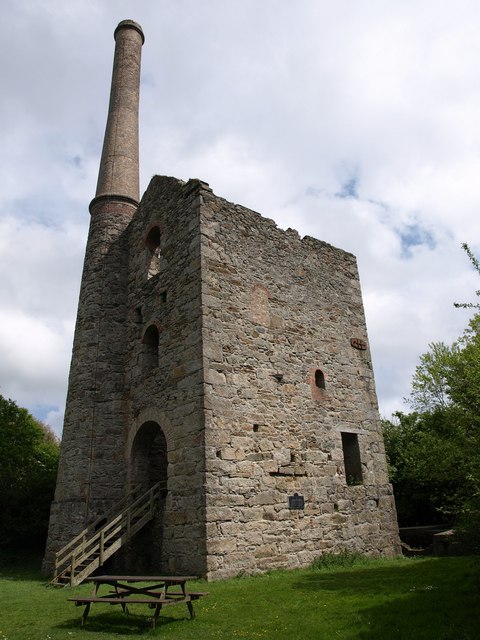
Killifreth Mine, near Chacewater, worked copper, tin and arsenic in turn over more than a century, and its Hawke's Shaft engine house carries the tallest surviving mine chimney in Cornwall.
History
Killifreth Mine lay near Chacewater in Cornwall. It worked shallow copper workings from 1826 to 1860, and was connected, before 1856, to the Great County Adit, a 31-mile drainage system serving over 60 mines, via a branch from Wheal Busy. In 1864 the mine was reworked for tin under a new company, deepening to 100 fathoms below the County Adit with improved results, though it never employed more than 281 men and its tonnages remained modest. Hawke's Shaft engine house was built in 1891 to house an 80-inch pumping engine, enlarged around 1900-1913 for an 85-inch engine, a horizontal whim, an air compressor and four boilers; its chimney is the tallest surviving in Cornwall. The mine closed in 1897 after falling tin prices coincided with the breakage of the main pumping engine's bob. It was used for a time afterwards by the Truro Mining School, then reopened around 1911-1914 by the company that also owned Wheal Busy to process arsenic. A final attempted reopening in 1927 failed when its equipment was found vandalised, and the remaining plant was dismantled for scrap during the Second World War.
Geology
Tin, copper and arsenic of the Gwennap district, the lodes cutting killas — the engine house at Hawke's Shaft is built of granite rubble and killas.
Workings
Worked shallow copper workings from 1826, then deepened for tin from 1864 to 100 fathoms below the Great County Adit; connected to that 31-mile drainage system via a branch from Wheal Busy before 1856. Hawke's Shaft engine house housed successive pumping engines (80-inch from 1891, 85-inch from c.1900-13) alongside a horizontal whim, air compressor and four boilers.
Closure
Closed in 1897 after falling tin prices coincided with the breakage of the main pumping engine's bob.
What remains
The ruined Hawke's Shaft engine house, with the tallest surviving mine chimney in Cornwall, and a separate ruined engine house and boiler house at Engine Shaft both survive; several structures across the site are Grade II listed.
Hawke's Shaft engine house (granite rubble and killas construction, three storeys, walls largely intact) and its chimney survive, along with the late-19th-century ruins of a second engine house and boiler house at Engine Shaft.
Nearby mines
- Wheal Busy — 0.4 miles (0.6 km) NE
- Hallenbeagle Mine — 0.6 miles (0.9 km) NW
- Wheal Gorland — 0.9 miles (1.4 km) S
- Poldice Mine — 1.0 miles (1.6 km) SE
- North Downs Mine — 1.1 miles (1.8 km) W
Straight-line distance, within 9 miles (15 km). Show on the map.
Recorded claims
Individual factual claims, each attached to the source(s) that support it below. Where sources disagree, both are kept.
- The mine worked shallow copper workings from 1826 to 1860, was reworked for tin from 1864 (deepening to 100 fathoms below the Great County Adit), and closed in 1897 when falling tin prices coincided with the breaking of the main pumping engine's bob. 1,2
- Hawke's Shaft engine house, built in 1891 for an 80-inch engine and enlarged around 1900-1913 for an 85-inch engine, carries the tallest surviving mine chimney in Cornwall. 1
- After the 1897 closure the site was used by the Truro Mining School, reopened around 1911-1914 by Wheal Busy's owning company to process arsenic, and a final 1927 reopening attempt failed when its plant was found vandalised; the remaining equipment was scrapped during the Second World War. 2
- Ten mine plan records survive in the BGS/Mining Remediation Authority catalogue under the name Killifreth Mine, correctly classified as a copper mine. 3
Photographs & further reading
A fuller operational history of the mine's copper, tin and arsenic phases, including its closure, reopenings and eventual scrapping.
View sourceSources
- (secondary) Killifreth Mine — Wikipedia
- (secondary) Killifreth Mine, Cornwall — Cornwall Calling
- (primary) Killifreth Mine (mine plan) — BGS / Mining Remediation Authority mine plans catalogue
Record created: 2 September 2026 · Last researched: 2 September 2026