 MineArchive
Wheal Gorland
| Location | Gwennap, Cornwall — 50.2417, -5.1839 (exact) |
|---|---|
| Commodities | Copper, Arsenic, Tin, Tungsten |
| Type | Metal |
| Worked | 1792–1864 |
Overview
A highly profitable Gwennap-district copper mine, worked 1792-1864 and briefly again 1906-1909, whose lasting fame rests less on its output than on its oxidised upper workings, the type locality for five secondary copper minerals — chenevixite, clinoclase, cornwallite, kernowite and liroconite.
History
Wheal Gorland lies just north-east of the village of St Day, in the parish of Gwennap — a district contemporaries called 'the richest square mile in the Old World'. The mine opened in 1792 and connected into the district's Great County Adit drainage system in its early years, though production through this period was uneven owing to sporadic ore distribution within the lodes. By 1833 the mine had made profits of over £300,000 and ranked third among Cornish mines by profitability, behind only Dolcoath and Consolidated Mines; a workforce recorded in 1836 numbered 86 — 53 men, 12 women and 21 children. Between 1815 and 1851 the mine raised roughly 40,750 tons of copper ore averaging 7.5% copper, alongside smaller quantities of black tin and arsenic; gold was also reported in the mine's gossan (oxidised surface) deposits. Control passed in 1852 to the St Day United mining group, which worked the site until abandoning it in 1864.
The mine reopened briefly from 1906 to 1909 under Edgar Allen and Company, who reworked old stopes and waste dumps in search of tin and tungsten ore rather than copper; before final closure the operation had sold 164 tons of tungsten ore and 18 tons of black tin.
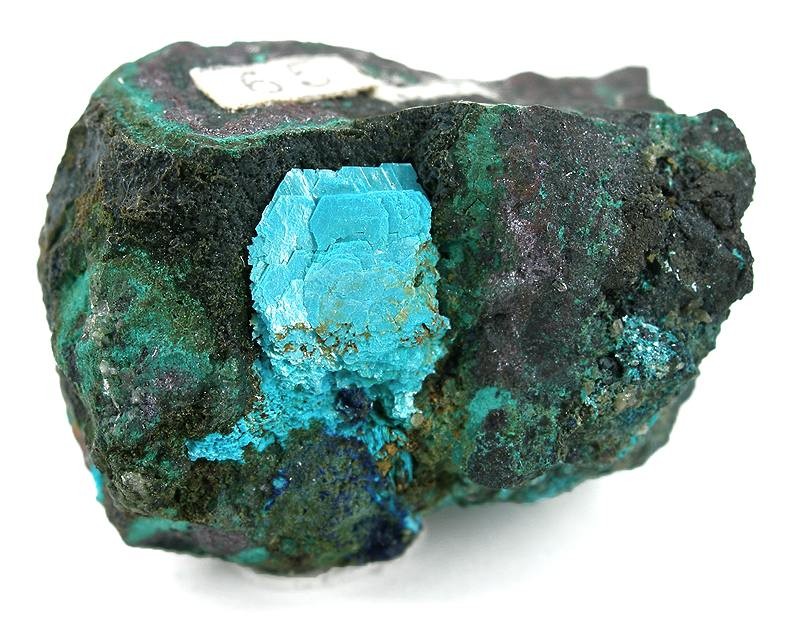
Wheal Gorland's greater significance, however, lies in mineralogy rather than metal output. The mine's oxidised, supergene-enriched upper zones produced an exceptional range of secondary copper minerals, and it remains the type locality — the place where a mineral was first scientifically described — for five species: chenevixite, clinoclase, cornwallite, kernowite and liroconite. Specimens from the mine, prized for their vivid colour (liroconite in particular for its sky-blue crystals), are held in major museum and private mineral collections worldwide.
Geology
Copper and tin lodes at Gwennap, with arsenic and tungsten in the same ground; the mine was connected into the district's Great County Adit drainage system in its early years.
Workings
Copper lodes connected to the district's Great County Adit drainage system, worked to sporadic but locally rich ore; the mine's oxidised upper zones — the source of its mineralogical fame — produced an unusually wide range of secondary copper minerals through supergene enrichment.
Closure
Before final closure the operation had sold 164 tons of tungsten ore and 18 tons of black tin.
What remains
The site has held Site of Special Scientific Interest status since 1988 in recognition of its mineral deposits, though a 2010 condition assessment recorded it as in 'unfavourable declining condition' owing to encroaching scrub vegetation threatening future access to the exposures.
Related mines
- Great County Adit — Connected into the district's Great County Adit drainage system in its early years.
Nearby mines
- Wheal Damsel — 0.7 miles (1.0 km) S
- Ting Tang Mine — 0.8 miles (1.3 km) S
- Killifreth Mine — 0.9 miles (1.4 km) N
- Poldice Mine — 0.9 miles (1.4 km) E
- Wheal Grambler — 0.9 miles (1.4 km) SW
Straight-line distance, within 9 miles (15 km). Show on the map.
Recorded claims
Individual factual claims, each attached to the source(s) that support it below. Where sources disagree, both are kept.
- By 1833 the mine had made profits of over £300,000 and ranked third among Cornish mines by profitability, behind Dolcoath and Consolidated Mines. 1
- Between 1815 and 1851 the mine raised roughly 40,750 tons of copper ore averaging 7.5% copper, alongside smaller quantities of black tin and arsenic. 1
- Control passed to the St Day United mining group in 1852, which worked the site until abandoning it in 1864. 1
- Edgar Allen and Company reopened the mine from 1906 to 1909, reworking old stopes and dumps for tin and tungsten, selling 164 tons of tungsten ore and 18 tons of black tin before final closure. 1
- Wheal Gorland is the type locality for five minerals: chenevixite, clinoclase, cornwallite, kernowite and liroconite. 1,2
- The site has held SSSI status since 1988, but a 2010 assessment found it in unfavourable declining condition owing to encroaching scrub. 1
- Located at about 50.242 N, 5.184 W. 1
Sources
- (secondary) Wheal Gorland — Wikipedia
- (secondary) Wheal Gorland, St Day, Cornwall — Minerals of Cornwall
Record created: 26 August 2026 · Last researched: 26 August 2026