 MineArchive
Wheal Grambler
| Also known as | East Wheal Sparnon, St Aubyn United Mines, Grambler and St Aubyn Mines |
|---|---|
| Location | St Day, Cornwall — 50.2364, -5.2022 (approximate) |
| Commodities | Copper, Fluorspar, Tin |
| Type | Metal |
| Worked | By 1792–1893 |
| Maximum depth | Unknown. An 1866 shaft accident (see Claims) describes a fall of 90 fathoms — roughly 165 m — indicating workings had reached at least that depth. |
Overview
A small copper mine on the eastern extension of the Sparnon lode near St Day, worked as East Wheal Sparnon/Wheal Grambler from 1792 and amalgamated with two neighbouring setts in 1834 to form St Aubyn United Mines, which continued raising copper, tin and fluorite until 1893. Its mid-1860s pumping engine house survives, Grade II listed, as the only such building left in the parish.
History
Wheal Grambler worked the eastern extension of the Sparnon lode and was originally known as East Wheal Sparnon. It was at work by 1792 and closed around 1798, then reopened for a further three years between 1805 and 1808. In 1834 it joined with two adjoining setts, Wheal St Aubyn and North Wheal Grambler, to form a single concern, St Aubyn United Mines — a merger substantial enough that Historic England's own listing for the site's surviving engine house records it as 'formerly listed as Engine House at St. Aubyn'. The combined mine remained a small venture: in 1861 it employed 40 men, 30 boys and 3 women, and profits were described as uncommon. Ten named shafts and four lodes were worked in total. Recorded output, by working name and period, was 8,450 tons of copper ore and 54 tons of black tin from Wheal Grambler proper (1843-56 and 1866-72); 2,670 tons of 8% copper ore from North Grambler (1859-67); and 1,390 tons of 6.5% copper ore, 43 tons of black tin and about 300 tons of fluorite from St Aubyn United (1871-93) — a combined total in line with the roughly 12,500 tons of copper ore reported for the group as a whole. The mine finally closed in 1893.
Geology
The eastern extension of the Sparnon lode near St Day, carrying copper and tin with fluorspar in the same ground.
Geological setting: Veins and Lodes (well documented example)
Workings
Ten named shafts and four lodes were worked, including the eastern extension of the Sparnon lode that gave Wheal Grambler its earlier name, East Wheal Sparnon.
Closure
The constituent setts — Wheal Grambler, Wheal St Aubyn and North Wheal Grambler — amalgamated in 1834 as St Aubyn United Mines, which worked on for a further sixty years before closing in 1893.
What remains
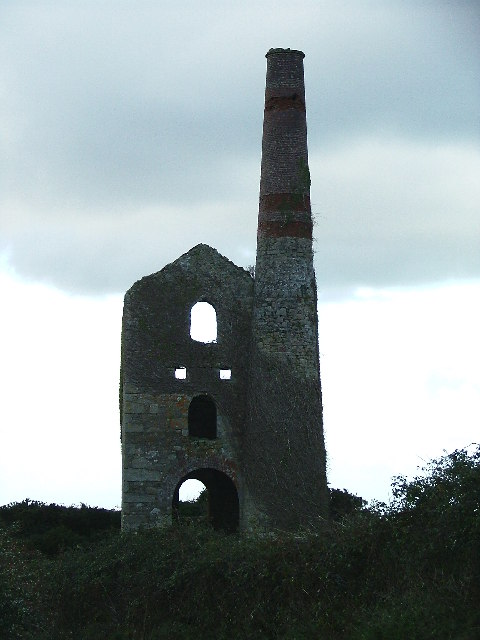
At the time of Historic England's 1988 survey, the surviving pump engine house was roofless and heavily ivy-clad, with a chimney slightly damaged at the base and some bricks missing near the top of its upper stage; the shaft immediately in front of the bob wall was protected by a rectangular enclosure and lightly covered with chicken wire. No more recent published condition report is recorded (checked 2026-08-29: AditNow's listing for the mine and Geograph's search were both inaccessible, and no dated 28 Days Later or Derelict Places report on this site turned up).
A single pump engine house at Higher Ninnis, near St Day — the only mine engine house surviving in the parish. Grade II listed (List Entry 1162418), it is built of granite and killas rubble with granite quoins, brick window arches and a brick upper stage to its tapered chimney, and held a 60-inch pumping engine, probably installed later in the 19th century.
Nearby mines
- Treskerby Mine — 0.9 miles (1.4 km) N
- Wheal Gorland — 0.9 miles (1.4 km) NE
- Pednandrea Mine — 1.0 miles (1.5 km) W
- Ting Tang Mine — 1.0 miles (1.6 km) SE
- Wheal Damsel — 1.0 miles (1.7 km) E
Straight-line distance, within 9 miles (15 km). Show on the map.
The engine house has no public access and stands on private land, though it remains clearly visible from the adjoining lane.
Recorded claims
Individual factual claims, each attached to the source(s) that support it below. Where sources disagree, both are kept.
- Wheal Grambler worked the eastern extension of the Sparnon lode and was originally known as East Wheal Sparnon; it was at work by 1792, closed around 1798, and reopened for a further three years between 1805 and 1808. 1
- In 1834 Wheal Grambler joined with the adjoining Wheal St Aubyn and North Wheal Grambler setts to form St Aubyn United Mines, which remained a small operation. 1
- In 1861 the united mine employed 40 men, 30 boys and 3 women, and profits were described as uncommon. 1
- Recorded output by working name: Wheal Grambler raised 8,450 tons of copper ore and 54 tons of black tin (1843-56 and 1866-72); North Grambler raised 2,670 tons of 8% copper ore (1859-67); St Aubyn United raised 1,390 tons of 6.5% copper ore, 43 tons of black tin and about 300 tons of fluorite (1871-93) — a combined total consistent with the roughly 12,500 tons of copper ore reported for the group as a whole. 1
- The united mine continued until 1893. 1
- The Mining Remediation Authority holds abandonment plans for 'GRAMBLER AND ST.AUBYN' (3 sheets, catalogue OMR40, tin and copper ores) and for 'GRAMBLER NORTH' (catalogue OMR89A, tin and copper ores); scans exist for both but are not yet published online. 2,3
- The surviving structure is a Grade II listed pump engine house (List Entry 1162418, listed 16 March 1987, amended 12 September 1989), built of granite and killas rubble with granite quoins, brick window arches and a brick upper stage to its chimney, and holding a 60-inch pumping engine; Historic England's architectural assessment dates it only broadly to 'probably later C19', consistent with other accounts placing it in use by 1865. 4
- Thomas Williams, of Tolcarne, was killed in February 1866 while repairing the shaft: standing in the whim kibble, he lost his footing as it swung and fell 90 fathoms. He was reported to be his widowed mother's sole support. A single fatality — this does not meet MineArchive's Disasters significance bar. 5
- The mine lies in the civil parish of St Day, historically within the union of Redruth and the mining district of Gwennap, about a mile from Redruth. 6
Sources
- (secondary) Grambler and St Aubyn — Explore Cornwall
- (primary) BGS/Mining Remediation Authority mine plans catalogue: GRAMBLER AND ST.AUBYN (OMR40) — British Geological Survey / Mining Remediation Authority
- (primary) BGS/Mining Remediation Authority mine plans catalogue: GRAMBLER NORTH (OMR89A) — British Geological Survey / Mining Remediation Authority
- (primary) Pump Engine House on Site of Gambler and St Aubyn Mine at SW 717 423, St. Day (List Entry 1162418) — Historic England
- (primary) Death of Thomas Williams — Royal Cornwall Gazette, 22 February 1866 — Royal Cornwall Gazette (transcribed, Cornwall Online Parish Clerks)
- (secondary) Grambler and St. Aubyn Mine — Grace's Guide to British Industrial History
Record created: 29 August 2026 · Last researched: 29 August 2026