 MineArchive
Hallenbeagle Mine
| Location | Chacewater, Cornwall — 50.2578, -5.1915 (approximate) |
|---|---|
| Commodities | Copper, Tin |
| Type | Metal |
| Worked | By 1835–c. 1867–1870 |
| Maximum depth | 107 fathoms (196m) at Engine Shaft, the deepest of the mine's six shafts |
Overview
A copper and tin mine beside the Redruth-Truro railway near Scorrier, worked hardest between 1835 and 1846 and briefly again in the 1860s alongside the neighbouring Great Wheal Busy sett. Its Grade II-listed 1864 pumping engine house at Read's Shaft is one of the best-known landmarks on this stretch of line, and now stands within a business park built on the old mine ground.
History
Hallenbeagle Mine was at work by 1835 and raised roughly 30,580 tons of copper ore, assaying around 6% copper, between 1835 and 1846. In the early 1860s it was reworked as part of Great Wheal Busy (the enlarged name the neighbouring Chacewater mine took from 1856, and already recorded on MineArchive as Wheal Busy) alongside several other adjoining setts — a joint operation that the Mining Remediation Authority's own 1864 abandonment plan lists under the combined title "Wheal Busy Great and Hallenbeagle, Wheal Fire, Wheal Hodge, Wheal Seymour". Hallenbeagle separated from that combination again in 1864, and a further 3,200 tons of copper were raised in 1864-67 before work wound down. According to Explore Cornwall, the mine was worked jointly once more just before the 1870s, this time with East Downs Mine, though only that one account reports it. In 1843 one of the shafts was reopened to search for tungsten after some had turned up in nearby dumps; the old workings had been backfilled with sawdust, which took considerable effort to clear, and once miners reached the 140ft level and had cleared 230ft of ground, no tungsten was found.
The mine worked six named shafts — Reed's (also spelled Read's, 36 fathoms), King's (74 fathoms), Engine (107 fathoms, the deepest), Stone's (56 fathoms), Eastern (36 fathoms) and Veffrey's — following five lodes: North, Wheal Rose Main, South, Reed's and Oat's. Reed's Shaft's engine house, built in 1864 by Harvey & Co to house its pumping engine, survives as the mine's principal standing structure and was listed Grade II by Historic England in 1985 — under the designation "Engine House at Read's Shaft, part of Great Wheal Busy", reflecting the two mines' shared operating history in this period. Sources disagree on the engine's exact size: Explore Cornwall records it as a 60-inch engine, while a Geograph caption for the same building notes sources differing between 60 and 70 inches. The engine was sold on to Perran Wheal Virgin in 1870. A smaller 22-inch whim engine also worked the site; Explore Cornwall places it at Reed's Shaft alongside the pumping engine, while Cornish Mine Images places it at a separate Doctor's Shaft — another point on which the sources do not agree. That engine was moved on to Dooneen Mine in Ireland by 1872.
Geology
Hallenbeagle sits in the same copper-and-tin lode ground around Chacewater and Scorrier that was worked intensively through the eighteenth and nineteenth centuries, immediately adjacent to Wheal Busy's own sett — the two mines' workings lie little more than a kilometre apart. The Mining Remediation Authority's own 1864 abandonment plan records the ore as tin and copper together, consistent with the mixed lode mineralisation typical of this part of the Cornish orefield.
Workings
Six shafts — Reed's, King's, Engine, Stone's, Eastern and Veffrey's — worked five lodes (North, Wheal Rose Main, South, Reed's and Oat's). Reed's Shaft carried the principal 60-inch (reported elsewhere as 70-inch) Harvey & Co pumping engine of 1864 and, per Explore Cornwall, a 22-inch whim engine; Cornish Mine Images instead places the whim engine at a separate Doctor's Shaft.
Closure
Production had ceased by 1867; the pumping engine was sold on in 1870.
What remains
As of an October 2019 site visit reported on Derelict Places, both engine houses still stood: Read's Shaft's pumping engine house substantially complete, and the smaller whim engine house reduced to consolidated remains. The site had by then been landscaped as part of an emerging business park, with the surrounding ground cleared and access roads laid in; Cornish Mine Images likewise describes the site as cleared and redeveloped for industrial and business use. Both engine houses remain freely visible beside the railway line and the A30.
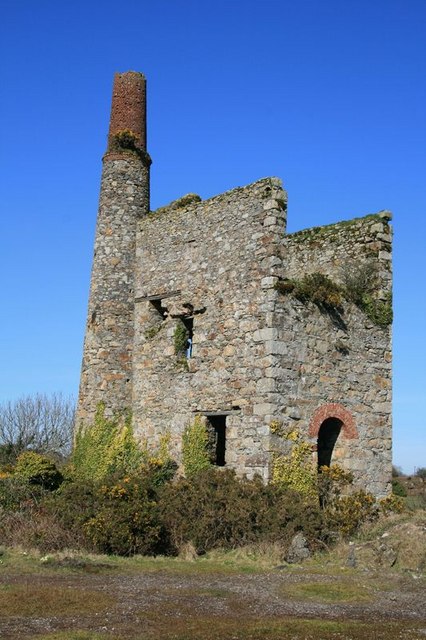
Read's Shaft pumping engine house of 1864 (Grade II listed, Historic England entry 1140975) with its round rubble chimney — killas rubble walling with granite quoins, brick arches or wooden lintels over openings, standing to three storeys' worth of wall height though no longer floored. The smaller, more ruinous whim engine house stands nearby. No other mine buildings are recorded as surviving above ground.
Related mines
- Wheal Busy — Hallenbeagle was reworked in the 1860s as part of Great Wheal Busy, and the two mines share a joint 1864 abandonment plan.
Nearby mines
- Killifreth Mine — 0.6 miles (0.9 km) SE
- North Downs Mine — 0.6 miles (1.0 km) W
- Wheal Busy — 0.8 miles (1.2 km) E
- Treskerby Mine — 0.8 miles (1.3 km) SW
- Wheal Gorland — 1.2 miles (1.9 km) S
Straight-line distance, within 9 miles (15 km). Show on the map.
What's uncertain
Points where sources disagree or the record could not be settled; both accounts are kept. All open questions in the archive.
- Just before the 1870s Hallenbeagle was reported worked jointly again, this time with East Downs Mine — reported by Explore Cornwall only. (uncertain) 1
- Sources disagree on the pumping engine's exact size: Explore Cornwall records it as a 60-inch engine, while a Geograph caption for the same building notes that sources differ between 60 and 70 inches. (disputed) 1,5
- A smaller 22-inch whim engine also worked the mine and was moved on to Dooneen Mine in Ireland by 1872. Explore Cornwall places this engine at Reed's Shaft alongside the pumping engine; Cornish Mine Images instead places it at a separate Doctor's Shaft. (disputed) 1,4
Recorded claims
Individual factual claims, each attached to the source(s) that support it below. Where sources disagree, both are kept.
- Hallenbeagle Mine was at work by 1835 and raised roughly 30,580 tons of copper ore, assaying around 6% copper, between 1835 and 1846; a further 3,200 tons of copper were recorded in 1864-67, though it is not stated whether this second figure is on the same ore-tonnage basis as the first. 1
- In the early 1860s Hallenbeagle was reworked as part of Great Wheal Busy alongside several neighbouring setts (Wheal Fire, Wheal Hodge, Wheal Seymour), separating again in 1864 — confirmed by the Mining Remediation Authority's own 1864 abandonment plan, filed under the combined title 'Wheal Busy Great and Hallenbeagle, Wheal Fire, Wheal Hodge, Wheal Seymour'. 2,1
- The Grade II listing for the Read's Shaft engine house, dated 21 November 1985, designates it 'Engine House at Read's Shaft, part of Great Wheal Busy' rather than under the Hallenbeagle name, and its own historical note records Great Wheal Busy working as 'Chacewater Mines' from 1823 and taking the name 'Great Wheal Busy' from 1856 — the same site already recorded on MineArchive as Wheal Busy. 3
- Just before the 1870s Hallenbeagle was reported worked jointly again, this time with East Downs Mine — reported by Explore Cornwall only. (uncertain) 1
- In 1843 one of the mine's shafts was reopened to search for tungsten after some had been found in nearby dumps. The old workings had been backfilled with sawdust, which proved difficult to clear; once miners reached the 140ft level and had cleared 230ft of ground, no tungsten was found. 1
- The mine worked six named shafts — Reed's (36 fathoms), King's (74 fathoms), Engine (107 fathoms, the deepest), Stone's (56 fathoms), Eastern (36 fathoms) and Veffrey's — following five lodes: North, Wheal Rose Main, South, Reed's and Oat's. 1
- Reed's Shaft's engine house was built in 1864 by Harvey & Co to house the mine's pumping engine, which was sold on to Perran Wheal Virgin mine in 1870. 1,4
- Sources disagree on the pumping engine's exact size: Explore Cornwall records it as a 60-inch engine, while a Geograph caption for the same building notes that sources differ between 60 and 70 inches. (disputed) 1,5
- A smaller 22-inch whim engine also worked the mine and was moved on to Dooneen Mine in Ireland by 1872. Explore Cornwall places this engine at Reed's Shaft alongside the pumping engine; Cornish Mine Images instead places it at a separate Doctor's Shaft. (disputed) 1,4
- The Read's Shaft engine house is a Grade II listed building (Historic England list entry 1140975, listed 21 November 1985): a beam engine house ruin of circa the late 19th century in killas rubble with granite quoins, with a round rubble chimney to its north-west corner, standing to three storeys' worth of wall height though no longer floored. 3
- As of an October 2019 site visit, both the pumping engine house and the smaller, more ruinous whim engine house remained standing, with the surrounding site landscaped as part of an emerging business/industrial park; both are freely visible beside the railway line and the A30. 6,4
Sources
- (secondary) Hallenbeagle Mine — Explore Cornwall
- (primary) Mine plans catalogue: Wheal Busy Great and Hallenbeagle, item 21867407 — British Geological Survey
- (primary) Engine House at Read's Shaft Part of Great Wheal Busy, Chacewater (Grade II, Historic England list entry 1140975) — Historic England (via British Listed Buildings)
- (secondary) Hallenbeagle Mine — Cornish Mine Images (Simon Jones)
- (observational) Reade's pumping engine house, Hallenbeagle — Geograph Britain and Ireland (John Gibson)
- (observational) Hallenbeagle Mine, Scorrier, Cornwall — Derelict Places
Record created: 29 August 2026 · Last researched: 29 August 2026