 MineArchive
Wheal Unity Wood
| Also known as | West Poldice, Tolgullow United Mines |
|---|---|
| Location | Gwennap, Cornwall — 50.2210, -5.1750 (approximate) |
| Commodities | Copper, Tin |
| Type | Metal |
| Worked | By 1815–1927 |
| Maximum depth | Unknown. The mine worked both copper and, unusually for this district, tin at depth. |
Overview
A Gwennap copper and tin mine that produced large tonnages of ore between 1815 and 1843, traded under several later names including West Poldice and Tolgullow United Mines, and closed for good in 1927 after a final failed arsenic venture -- notable for leasing its underground workings to the Truro School of Mines for student training in 1897.
History
Wheal Unity Wood was producing large tonnages of copper ore by 1815, and continued to do so until 1843, by which point output had reduced considerably, though the mine still employed 200 workers; unusually for this district, it also produced some tin ore at depth. During the second half of the 19th century the mine opened and closed frequently, and was operated under a number of different names, including West Poldice (1880-85) and Tolgullow United Mines (1886-1903) -- though Wheal Unity Wood remained the name most commonly used throughout. A companion development at the northern end of the woodland, Killifreth, expanded tin production in the 1890s and became, according to contemporary accounts, a model of a small-scale mine, fitted with safety features on its skips and modern ore-processing equipment; by 1896, however, falling tin prices had made it unprofitable. In 1897 the underground workings were leased to the Truro School of Mines for the training of students. A replacement engine was installed in 1912, but the outbreak of the First World War meant no actual mining took place. Post-war tin price collapses in 1920-21, followed by a brief arsenic venture at the neighbouring Wheal Busy in the mid-1920s, brought operations to a final close in 1927.
Geology
Copper and tin lodes at Gwennap, the tin worked unusually for the district at depth.
Workings
Worked via Magor's Shaft, pumped by a 70-inch non-rotative Cornish beam pumping engine installed in 1872, with a second engine house powering both winding gear to raise ore and stamps for ore pulverising; a companion working at Killifreth, to the north, added safety-fitted skips and modern processing equipment in the 1890s.
Closure
Closed permanently in 1927, after the 1920-21 tin price collapse and a final failed arsenic venture at the neighbouring Wheal Busy.
What remains
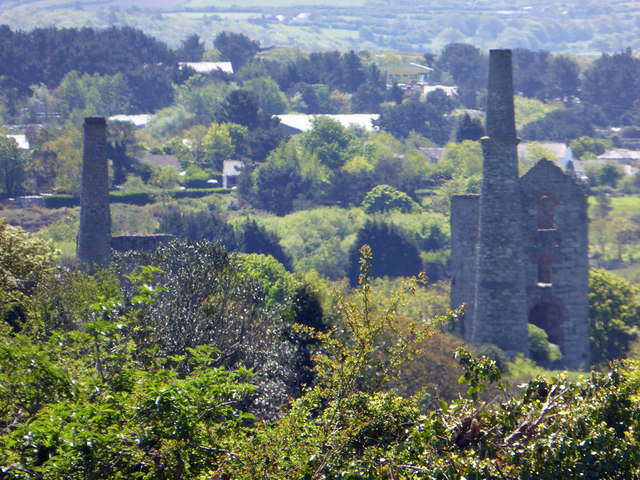
The site is now largely wooded, with the woodland itself named after the mine; the two surviving engine houses -- Magor's pumping engine house and the winding/stamps engine house -- stand in a field beside the woodland and along Todpool respectively.
Two engine houses (Magor's pumping engine house, 1872, and a winding/stamps engine house) survive, along with the regenerated woodland covering much of the former mine ground.
Related mines
- Wheal Busy — A final, failed arsenic venture at Wheal Busy in the mid-1920s brought Wheal Unity Wood's own operations to a close.
Nearby mines
- Poldory Mine — 0.4 miles (0.7 km) NE
- Wheal Cupboard — 0.5 miles (0.7 km) NE
- Ale and Cakes Mine — 0.5 miles (0.8 km) N
- Wheal Andrew — 0.6 miles (1.0 km) N
- Copper Hill Mine — 0.7 miles (1.1 km) NE
Straight-line distance, within 9 miles (15 km). Show on the map.
Recorded claims
Individual factual claims, each attached to the source(s) that support it below. Where sources disagree, both are kept.
- Between 1815 and 1843, Wheal Unity Wood produced large tonnages of copper ore; by 1843 output had reduced considerably, though the mine still employed 200 workers, and unusually for the district it also produced tin ore at depth. 1
- During the second half of the 19th century the mine traded under several names, including West Poldice (1880-85) and Tolgullow United Mines (1886-1903); in 1897 its underground workings were leased to the Truro School of Mines for the training of students. 1
- A replacement engine installed in 1912 saw no use once the First World War intervened; post-war tin price collapses in 1920-21 and a brief mid-1920s arsenic venture at neighbouring Wheal Busy preceded final closure in 1927. 1
- The former mine ground is now regenerated woodland bearing the mine's own name, with the two surviving engine houses reachable via permissive footpaths through Unity Wood and a further path to the engine houses at Todpool. 2
Photographs & further reading
A fuller account of the mine's production history, its later trading names and the 1897 Truro School of Mines training lease.
View sourceSources
- (secondary) Wheal Unity Wood Mine, Cornwall — Cornwall Calling
- (secondary) Unity Wood Mine — Explore Cornwall
Record created: 30 August 2026 · Last researched: 30 August 2026