 MineArchive
Cronton Colliery explosion
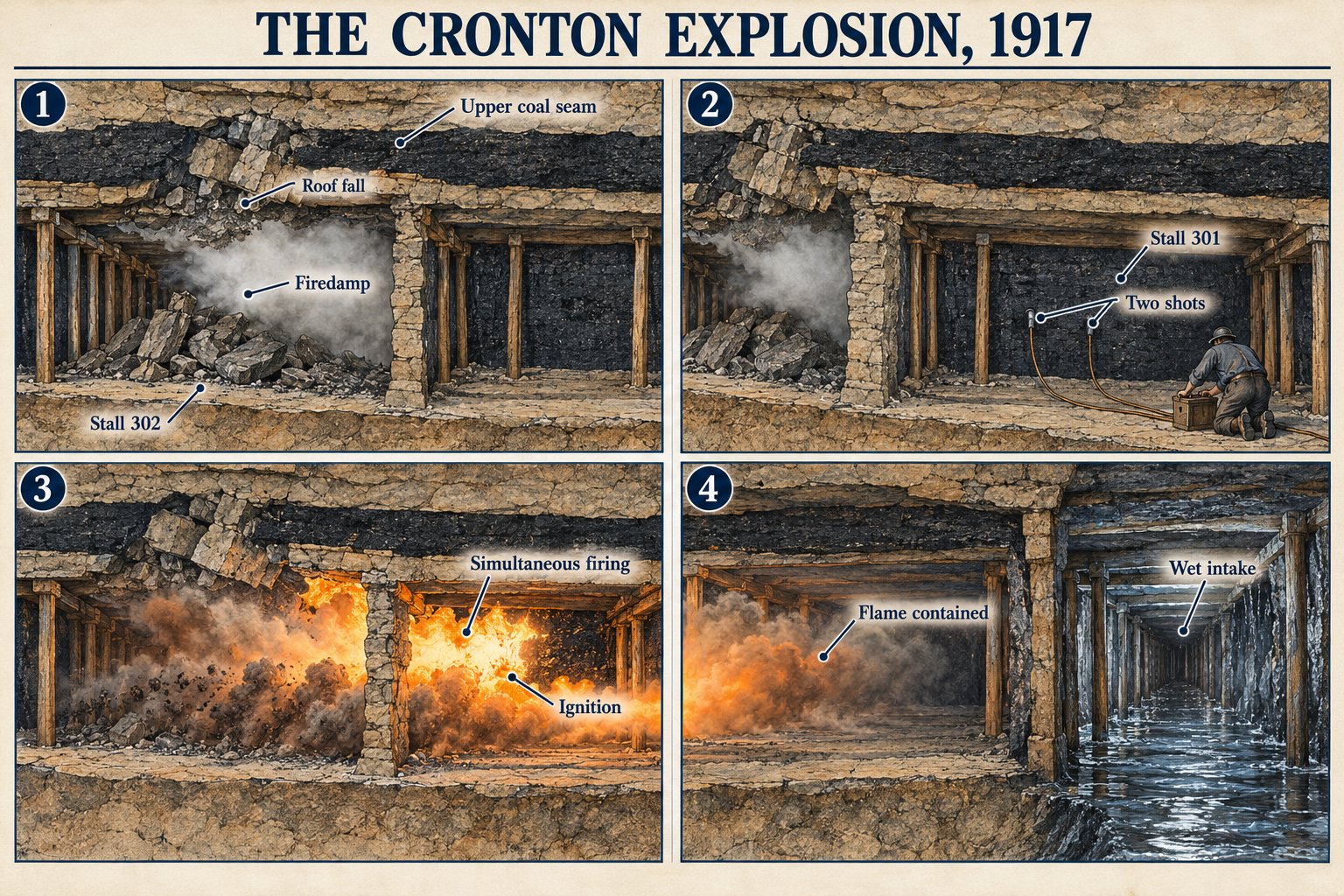
An explosion in the Pasture (Crombouke) seam during the morning shift killed eight men after two shots were fired simultaneously at adjoining stalls, likely igniting firedamp released by a roof fall.
| Date | 11 December 1917 |
|---|---|
| Mine | Cronton Colliery |
| Region | Merseyside |
| Type | Explosion |
| Fatalities | 8 |
| Injuries | James Cummings, an 18-year-old haulage hand, survived with injuries. |
| Context | During active mining |
Cause
Two Monobel No.1 explosive shots were fired simultaneously at stall 301 in the Pasture seam. The likely trigger was firedamp released by a roof fall at the adjoining stall 302, which had exposed an upper coal seam some nine feet thick located about 7.5 feet above the working area.
What happened
Shortly after 8 a.m. on 11 December 1917, an explosion tore through the Pasture (Crombouke) seam at Cronton Colliery. Eight men were killed: colliers Albert Ball (30), Walter Pye (42), James O'Neil (40) and John Harrison (36); jigger George Richard Jones (23); haulage hand John W. Travis (24); waydrawer Samuel Foulkes (63); and fireman Joseph Lawton (32). Haulage hand James Cummings, aged 18, survived with injuries. The blast followed the simultaneous firing of two explosive shots at stall 301, in breach of the Explosives in Coal Mines Order, with the likely ignition source being firedamp released by a roof fall at the adjoining stall 302 that had exposed a thick upper coal seam close above the working. Wet conditions in the intake airways are thought to have limited the spread of flame, containing structural damage to the immediate area.
Investigation & inquiry
The coroner's inquest concluded on 15 January 1918. It found that firing two shots simultaneously had breached the Explosives in Coal Mines Order, but the jury returned a verdict of death by misadventure and attributed no blame to anyone.
Related terminology
Mining terms this disaster is structurally linked to, with the nature of the relationship.
- Jigger (contextual relationship)
Named in this record’s narrative: “…(30), Walter Pye (42), James O'Neil (40) and John Harrison (36); jigger George Richard Jones (23); haulage hand John W. Travis (24);…” - Return Airway (contextual relationship)
Named in this record’s narrative: “…thick upper coal seam close above the working. Wet conditions in the intake airways are thought to have limited the spread of flame, containing…” - Roof Fall (contextual relationship)
Named 3 times in this record, first in the summary: “…at adjoining stalls, likely igniting firedamp released by a roof fall.” - Shot-firing (direct cause)
The explosion followed two shots fired simultaneously in breach of shot-firing regulations. - Stall (contextual relationship)
Named 5 times in this record, first in the summary: “…eight men after two shots were fired simultaneously at adjoining stalls, likely igniting firedamp released by a roof fall.”
Sources
- (secondary) Cronton Colliery (1913-1984) — Northern Mine Research Society
- (secondary) Cronton Colliery Explosion, Widnes, 1917 — Northern Mine Research Society
Record created: 26 August 2026 · Last researched: 26 August 2026