 MineArchive
Kieve
| Dialect | Cornish |
|---|---|
| Category | Ore Processing |
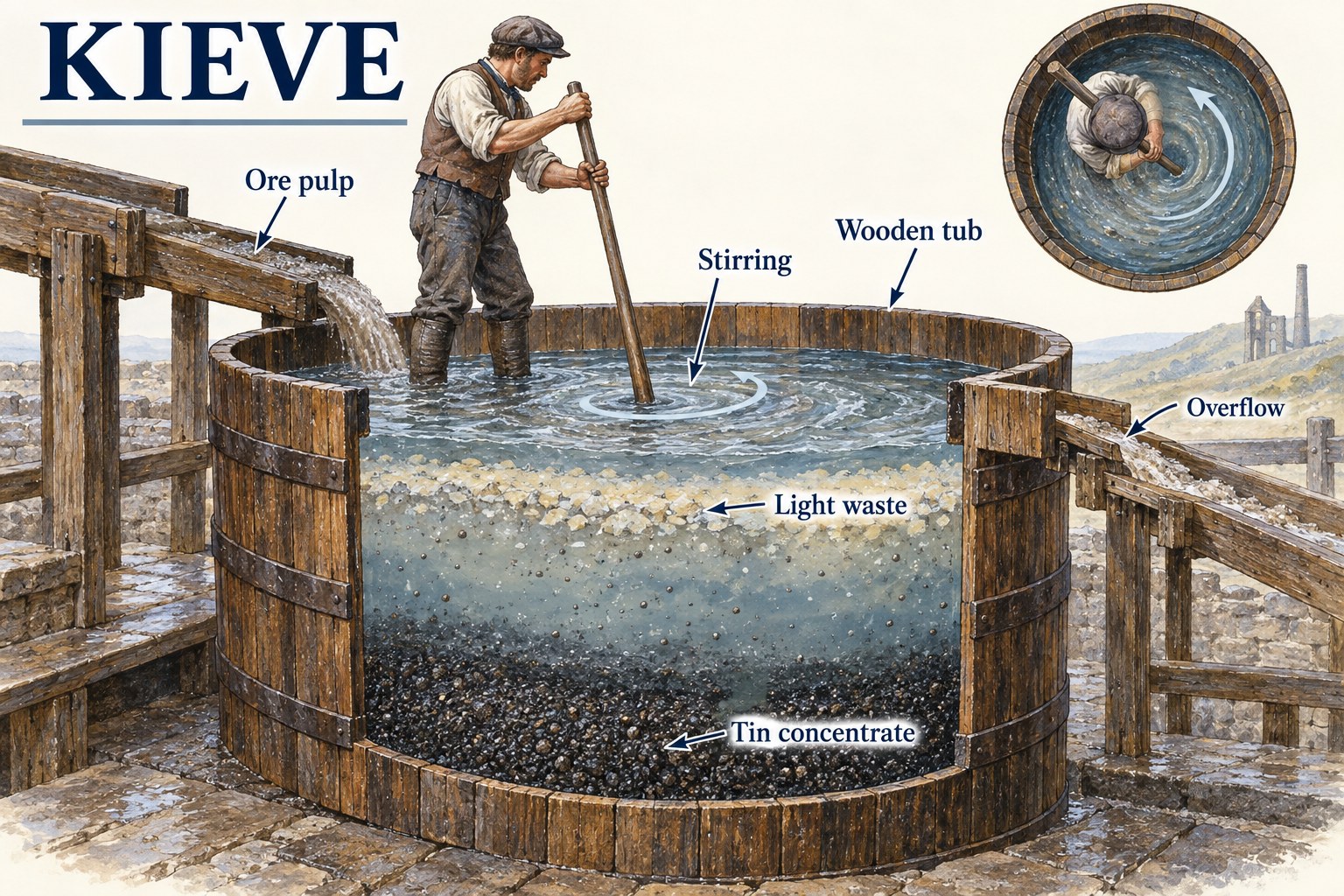
A large wooden tub, also spelled keeve, used in the final stage of dressing Cornish tin ore, in which crushed ore and water were stirred so that heavy metallic particles settled out from the lighter waste.
Historical usage
Kieves (sometimes called 'chimming kieves') were a standard piece of dressing-floor equipment across Cornish and Devon tin mines, used at the end of a longer processing chain that began at the stamps and ran through settling launders and buddles before finishing in the kieve.
How it worked
Part-processed ore pulp, already roughly separated by the buddle, was fed into the kieve with water and stirred vigorously; the denser tin ore particles sank to the bottom of the tub while lighter waste material rose and could be skimmed or washed away, leaving a concentrated ore ready for smelting.
Why it was used
The kieve gave dressing-floor workers a final, finer stage of gravity separation beyond what the buddle alone could achieve, squeezing more recoverable tin out of ore that had already been through the coarser stages of the process.
Risks & limitations
Like buddling, kieving was slow, labour-intensive manual work — repeated stirring and settling by hand — and, being a late stage in the process, could only recover what earlier, coarser stages had failed to separate out.
Regional variation
The word survives in Cornish place-names for natural rock basins that resemble a tub — St Nectan's Kieve, a waterfall plunge-pool near Tintagel, takes its name from the same Cornish word for a tub, quite apart from any mining connection.
Related terminology
Sources
- (secondary) Dressing the Ore — Cornish Mining World Heritage Site
- (secondary) Glossary — Cornish Mining World Heritage Site
- (secondary) Glossary of Tinners' Terms — Dartmoor Tinworking Research Group
Record created: 21 August 2026 · Last researched: 21 August 2026