 MineArchive
Gascoigne Wood Mine
| Also known as | Gascoigne Wood Drift |
|---|---|
| Location | Near Sherburn in Elmet, west of Selby, North Yorkshire — 53.7816, -1.2019 (approximate) |
| Commodity | Coal |
| Type | Coal |
| Worked | 1983–2004 |
| Maximum depth | Not a shaft mine — Gascoigne Wood was the drift by which the complex's coal reached the surface, the coal itself being won at the five satellite pits to the east. |
| Operators | National Coal Board (1983–1997), UK Coal (1997–2004) |
Overview
The single surface point of the Selby coalfield — the drift mine to which five satellite pits sent their coal along the longest underground conveyor network in Europe, and where all of it was raised, washed, graded and loaded onto trains. Selby peaked at 12 million tonnes a year, about 45 per cent of British deep-mined output. The concentration that made it efficient also made it fragile: the fixed cost of the one exit was part of what closed the complex in 2004.
History
National energy planning in the early 1970s favoured large modern units over investment in older collieries, and the Selby scheme was put forward as a high-productivity complex with a deliberately small surface footprint in the Vale of York — achieved by concentrating all surface plant at Gascoigne Wood and linking the satellite mines to it underground. The project was formally inaugurated by the Duchess of Kent in 1976, with initial estimates of £400 million, a workforce of 4,000, a forty-year life and 10 million tonnes a year. The East Coast Main Line was diverted — the Selby Diversion — to protect rail services from subsidence.
The workforce was planned from the outset to be transferred in from eleven collieries nearing exhaustion around Wakefield and Rothwell, beginning in 1978–79 with miners from Walton Colliery. The transfer programme was meant to finish by 1986; the Nostell men did not arrive until 1987 and the last, from Sharlston, came in 1993. Large car parks were built for the commuting that resulted.
Production began in 1983, at Wistow first. Five pits — Wistow, Riccall, Stillingfleet, North Selby and Whitemoor — fed coal by long conveyor drifts to Gascoigne Wood, where it was raised, prepared and dispatched by rail to the power stations. Output reached 10 million tonnes a year in 1992–93 and peaked at 12 million in 1993–94, about 45 per cent of United Kingdom deep-mined output for that year; the complex produced over 121 million tonnes in all.
The 1984–85 strike stopped production entirely for a year, with mass pickets and large police deployments at Gascoigne Wood, Riccall and Whitemoor, and clashes between pickets and police at Gascoigne Wood itself. The mines passed to RJB Mining, later UK Coal, in 1997 on privatisation. Withdrawal of subsidy, geological problems and low coal prices then made the complex unprofitable; after losing around £30 million a year for three years, UK Coal announced a phased closure in July 2002. Mining ceased in 2004, after a working life of twenty-one years.
Geology
Gascoigne Wood was the drift entry to the Selby coalfield, a deep concealed field beneath the Vale of York which the Selby scheme was designed to work as a single unit. The coal itself was won at the five satellite pits to the east and brought here; the reason for the drift's position was haulage and surface access rather than the geology directly beneath it. Geological problems in the later years were among the factors that made the complex unprofitable.
Geological setting: Concealed Coalfields (historical documentary reference), Sedimentary Beds and Seams (historical documentary reference)
Workings
Twin drifts rather than a winding shaft: all the coal from five pits came to the surface here, was graded, washed and stored, and went out by rail from the sidings. The underground haulage was engineered for continuous high throughput and was the longest mine conveyor network in Europe, more than 25 km of belting linking the faces to Gascoigne Wood — the conveyor drifts from Wistow and Riccall alone being about 10 km and 12 km long. The principal steel-cord belt was reported at 1,300 mm wide and 28 mm thick, running at about 8.4 m/s and rated at roughly 3,200 tonnes an hour, with about 10.1 MW of installed drive power and a computerised system to detect belt damage.
Closure
The fixed costs of the single exit point meant Gascoigne Wood became less profitable as production was cut back at the five feeding pits. After losing around £30 million a year for three years, UK Coal announced a phased closure of the complex in July 2002; mining ceased in 2004 after a working life of twenty-one years, against the forty originally planned.
What remains
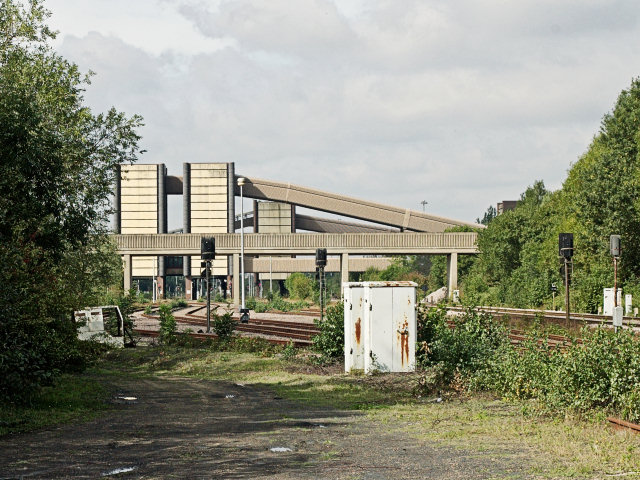
The mine has been demolished — clearance was already under way in September 2006, when the coal loading hoppers were photographed as structures that might soon disappear. The rail connection and sidings have been reused for freight, and the site has been redeveloped as a rail-linked distribution and logistics location.
Little of the mine itself; the rail sidings and connection survive in other use.
Redevelopment
The site and its rail connection have been redeveloped for freight and distribution use.
Related mines
- Kellingley Colliery — Both were UK Coal deep mines after privatisation in 1994.
- North Selby Mine — North Selby's coal went underground by conveyor to Gascoigne Wood.
- Riccall Mine — Riccall raised no coal of its own: everything it cut travelled by underground conveyor drift to Gascoigne Wood, the complex's single winding and preparation site.
- Stillingfleet Mine — All of Stillingfleet's coal went underground to Gascoigne Wood, to which it was connected through the south spine tunnel in March 1987.
- Walton Colliery — Both were Yorkshire coalfield workings in the Wakefield and Selby districts; Walton is named on the Gascoigne Wood record.
- Whitemoor Mine — Whitemoor's coal went underground to Gascoigne Wood, the Selby complex's single point of winding.
- Wistow Mine — The two were physically connected underground by a conveyor drift about 10 km long: Wistow won the coal and Gascoigne Wood raised it, Wistow having no coal winding of its own. Both were part of the Selby complex, designed so that five satellite pits fed a single surface point.
Nearby mines
- Wistow Mine — 3.6 miles (5.8 km) NE
- Kellingley Colliery — 5.3 miles (8.5 km) S
- Fryston Colliery — 5.4 miles (8.7 km) SW, West Yorkshire
- Peckfield Colliery — 5.5 miles (8.9 km) W, West Yorkshire
- Ledston Luck Colliery — 6.1 miles (9.8 km) W, West Yorkshire
Straight-line distance, within 9 miles (15 km). Show on the map.
Recorded claims
Individual factual claims, each attached to the source(s) that support it below. Where sources disagree, both are kept.
- The Selby scheme concentrated all surface plant at Gascoigne Wood and linked five satellite pits — Wistow, Riccall, Stillingfleet, North Selby and Whitemoor — to it underground, giving a deliberately small surface footprint in the Vale of York. 1
- The project was formally inaugurated by the Duchess of Kent in 1976, with initial estimates of £400 million, a workforce of 4,000, a life of about forty years and 10 million tonnes a year. 1
- The workforce was transferred in from eleven collieries nearing exhaustion around Wakefield and Rothwell, beginning with Walton Colliery men in 1978–79 and finishing with the Sharlston transfer in 1993, seven years later than planned. 1
- The underground haulage was the longest mine conveyor network in Europe, with more than 25 km of belting linking the faces to Gascoigne Wood; the principal steel-cord belt was reported as 1,300 mm wide and 28 mm thick, running at about 8.4 m/s and rated at roughly 3,200 tonnes an hour. 1
- Output reached 10 million tonnes a year in 1992–93 and peaked at 12 million in 1993–94, about 45 per cent of United Kingdom deep-mined output for that year; the complex produced over 121 million tonnes in total. 1
- No coal was produced in 1984–85 during the miners' strike; there were mass pickets and large police deployments at Gascoigne Wood, Riccall and Whitemoor, and clashes between pickets and police at Gascoigne Wood. 1
- The fixed costs of the single exit point made the mine less profitable as output was cut back at the feeding pits; after losses of around £30 million a year for three years, UK Coal announced a phased closure in July 2002 and mining ceased in 2004. 1
- The East Coast Main Line was diverted — the Selby Diversion — to protect rail services from the effects of the complex's working. 1
Photographs & further reading
A photographic account of what was left at Gascoigne Wood and its neighbour Wistow after closure.
View sourceThe whole complex of which this mine was the single surface point — its design, its conveyor network, its peak output and the economics that closed it.
View sourceSources
- (secondary) Selby Coalfield — Wikipedia
- (observational) Selby Coalfield — Gascoigne Wood and Wistow visit — 28DaysLater
Record created: 3 September 2026 · Last researched: 3 September 2026