 MineArchive
Shrinkage Stoping
| Category | Mine Workings & Access |
|---|
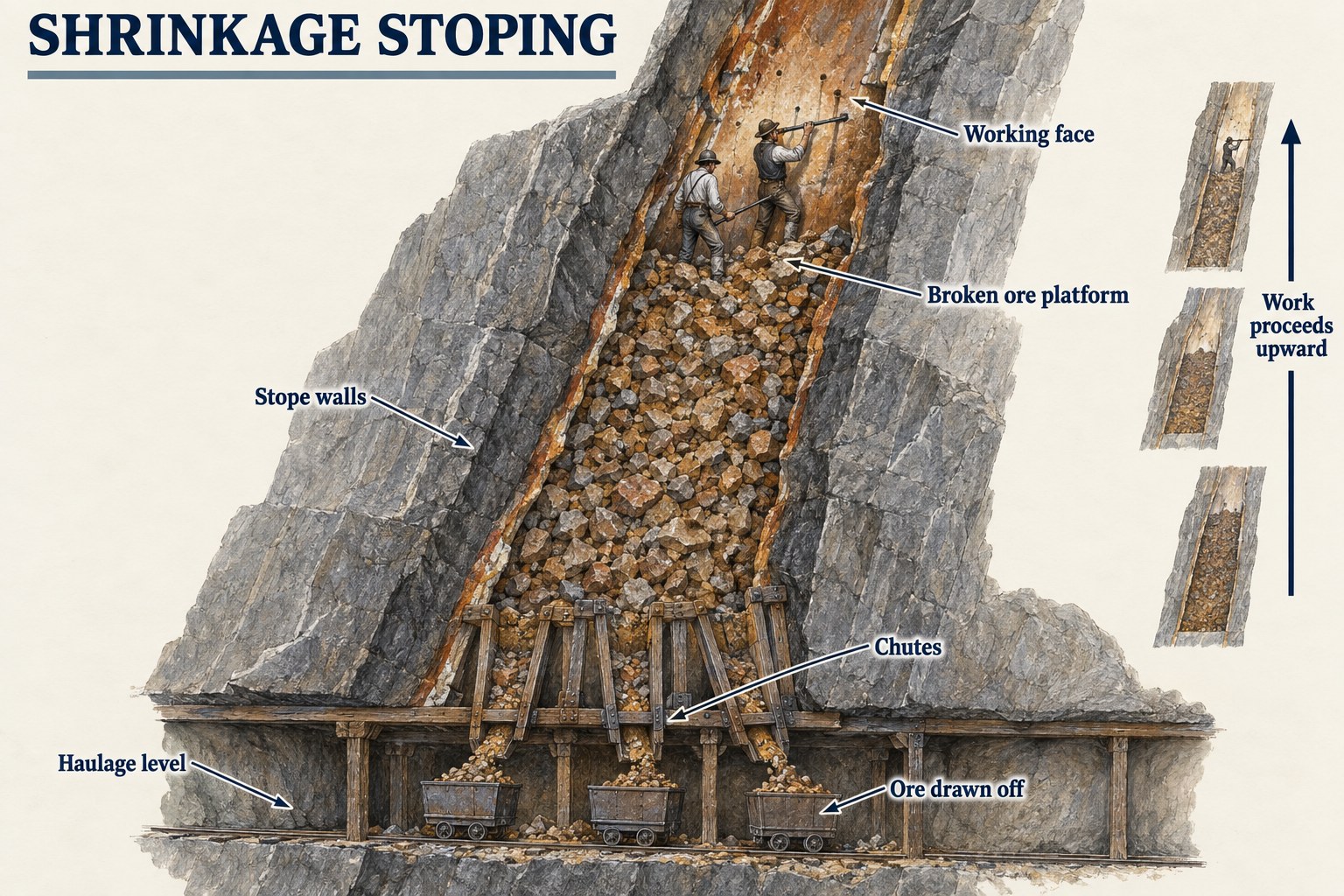
An underground stoping method for narrow, steeply dipping veins in which broken ore is deliberately left in the excavated void, or stope, as work proceeds, rather than being drawn off — the growing pile of broken rock serving both as a working platform for miners drilling the level above and as temporary support for the surrounding walls.
Historical usage
A long-established method wherever a strong, self-supporting, steeply dipping vein could be worked by hand drilling and blasting without heavy timbering. It is recorded at twentieth-century North Pennine fluorspar and lead mines — at Redburn Mine, Weardale, for example, mining proceeded 'by classical shrinkage stoping with sub levels at about 25-30m intervals'. The method has been largely superseded since the mid-twentieth century by mechanised alternatives such as vertical crater retreat (VCR), which removes miners from the stope itself and allows the whole process to be drilled and blasted from safe, already-mined levels above and below.
How it worked
Ore was drilled and blasted from the bottom of the stope upward in successive horizontal slices. Because blasted rock swells to occupy noticeably more volume than the solid ground it came from — commonly 30-50% more — only enough of the broken ore, typically around 30-40%, was drawn off through chutes at the base of the stope after each round to leave working headroom for the next; the rest was left in place, rising with the stope as a working platform and as lateral support for its walls. Once the stope had been worked up to its full height, the whole remaining pile of broken ore was finally drawn off and sent for processing.
Why it was used
It needed little artificial timbering or other support in strong, self-supporting ground; it let miners work from a broken-ore platform rather than requiring separate access staging; and, because ore was drawn off and sold throughout the life of the stope rather than only once it was fully mined out, it generated some revenue continuously through a long working campaign.
Risks & limitations
Miners had to work inside the stope immediately after each blast to prepare and clear the broken ore — a level of risk no longer considered acceptable by modern safety standards, and a major reason the method has fallen out of use. The volume swell of broken ore meant a substantial share of it had to stay underground, unsold, until the stope was finished, reducing overall recovery. The ore itself had to be strong enough not to compact solid when blasted, and stable enough not to oxidise or heat spontaneously during the months it might sit in the stope. The method also could not easily accommodate a vein that varied much in width or dip, unlike more selective modern alternatives.
Related terminology
Mines associated with this term
Included only where MineArchive's own research gives a reasonable evidential basis — not every mine where this might plausibly apply.
- Gwynfynydd Gold Mine — Gwynedd (well documented example)
Named in this record’s workings: “…ten men, raised about 5,000 tonnes of ore a year by overhand shrinkage stoping, and worked to an estimated grade of 15.2 grammes per tonne.” - Pendarves Mine — Cornwall (well documented example)
Named in this record’s workings: “…to 7 level at 305 metres. Most ore came from 5 level and above, by shrinkage stoping into 'Cousin Jack' chutes and later some draw-point stopes, with…” - Redburn Mine — County Durham (well documented example)
Named twice in this record, first in the history: “…levels was by electric locomotive. The mine was worked by classical shrinkage stoping with sub-levels at twenty-five to thirty metre intervals, and had…” - Settlingstones Mine — Northumberland (well documented example)
Named in this record’s workings: “…the emptied vein had to be packed: because the sill walls were hard, shrinkage stoping was used, the miners working upwards from a planked floor on…”
Sources
- (secondary) 10.3.2: Shrinkage Stoping (MNG 230: An Introduction to Mining Engineering) — Pennsylvania State University, John and Willie Leone Family Department of Energy and Mineral Engineering
- (secondary) Shrinkage stope mining — Wikipedia
Record created: 26 August 2026 · Last researched: 26 August 2026