 MineArchive
Settlingstones Mine
| Location | Fourstones, Tyne Valley, Northumberland — 54.9767, -2.2144 (approximate) |
|---|---|
| Commodity | Witherite |
| Type | Mineral |
| Worked | By 1670–1969 |
| Maximum depth | over 100 fathoms |
| Operators | Settlingstones Mines Ltd |
Overview
A lead mine turned single-mineral wonder: from 1873 to 1969, Settlingstones was Britain's principal source of witherite, a barium carbonate mineral used in everything from rat poison to steel hardening, and for most of that time the only one working anywhere in the world. Its one real rival was Fallowfield, a few miles east, which had opened the trade in 1845 and closed in 1911.
History
Lead was being mined at Settlingstones by about 1670, but the workings were abandoned before the end of that century, defeated by depth and water. Mining resumed around 1770, raising both lead and witherite, but it was only in 1873, when Settlingstones Mines Ltd was formed specifically to exploit it, that witherite became the mine's real purpose — the company having recognised there was more profit in the rare mineral than in the lead it had originally been sunk to reach. The Haydon field — the veins on the north bank of the Tyne between Haydon Bridge and Hexham, cut off from the rest of the Northern Pennine Orefield by seven miles of barren ground — had raised some 143,990 tons of lead concentrates between 1666 and 1938, but its real importance was as one of the world's main sources of witherite, of which it produced just over half a million tons. Settlingstones' own lead returns survive only for 1849–73, when 16,902 tons of concentrates were raised; the vein, followed south-west through a cross-course, changed there from galena and barytes to almost pure witherite. Between 1873 and closure in 1969 the mine produced around 630,000 tons of witherite product, making it easily the largest and most consistent witherite producer in the British Isles, and effectively the only substantial one in the world throughout that period. In 1965 it employed some seventy men, most from Haydon Bridge, a few in a terrace of mine cottages belonging to the Duke of Northumberland, who with the Commissioners of Greenwich Hospital held the mineral royalties; the dressing plant, built by Davison's ironworks of Hexham, was by then nearly a hundred years old and handled about 220 tons of crude mineral a week, sold in bulk to customers who collected it themselves for paints, dyes, inks, detergents, explosives, fireworks, ceramics, bricks, soap, beet sugar and optical glass. From 1965 the output came from old pillars of ore, and searches for new veins found nothing; the last shift was worked on Friday 28 March 1969. All plant was sold off on closure and the shafts capped, but this failed to prevent a collapse in 1971 near Ellen's Shaft, which destroyed the former mine offices — by then in use as kennels for the Haydon Hunt.
Geology
The witherite occurs in a single well-defined vein running roughly north-east to south-west through Carboniferous sandstones and shales, intruded by the dolerite Whin Sill, and has been proved along nearly a mile and a half of its length. The richest, most consistently witherite-bearing section of the vein averaged 10-12 feet wide — an unusually large and sustained concentration of a mineral that occurs almost nowhere else in workable quantity.
Workings
The Settlingstones vein runs north-east to south-west just south of the Roman Wall, nearly vertical and four to eleven feet wide, and for some 4,500 feet south-west of the Stanegate it carried witherite in place of galena and barytes wherever the Whin Sill formed its walls; the ore-shoots averaged 2.4 m wide with local widths of 9.1 m, and run-of-mine ore was commonly more than 77 per cent witherite. The mineral was won by stoping, but unlike lead the whole vein was taken, so the emptied vein had to be packed: because the sill walls were hard, shrinkage stoping was used, the miners working upwards from a planked floor on stemples, dropping surplus ore down timber hoppers to be drawn off through 'mills' at their feet and leaving the rest in the stope as a floor and a store, to be run out to the crushers as needed and the void filled with rubble at the end. Ore went in pony-drawn tubs along the levels to the foot of Frederick Shaft, the main winding shaft beside the Stanegate — a battery locomotive was being tried in 1965 — and on the surface by cable-hauled wagons along a mineral railway half a mile north-east to the dressing plant at Ellen's Shaft, the old centre of the mine, where it was crushed, washed and jigged to a product of pieces about three-eighths of an inch across. Earlier shafts included Winter's Shaft further up the hillside.
Closure
From 1965 the mine lived on old pillars of ore, and searches for new veins found nothing; the last shift was worked on 28 March 1969. The plant was sold off, the shafts were capped in 1969–70, and a collapse near Ellen's Shaft in 1971 destroyed the former mine offices.
What remains
No mineralisation is exposed at the surface today, and all underground workings are completely inaccessible — the shafts were capped on closure in 1969-70, and the site was further cleared and built over in places afterward.
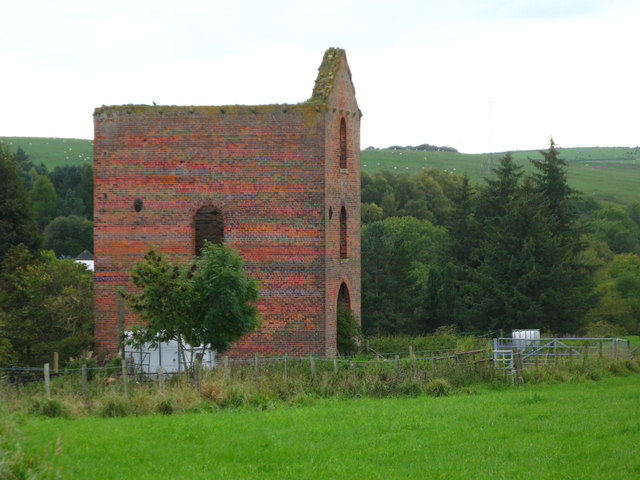
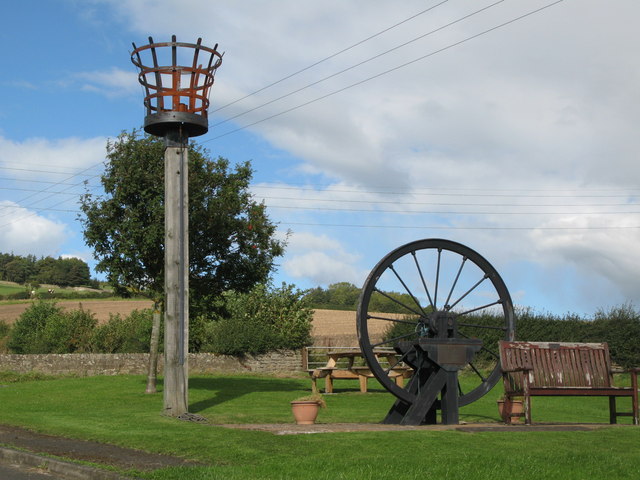
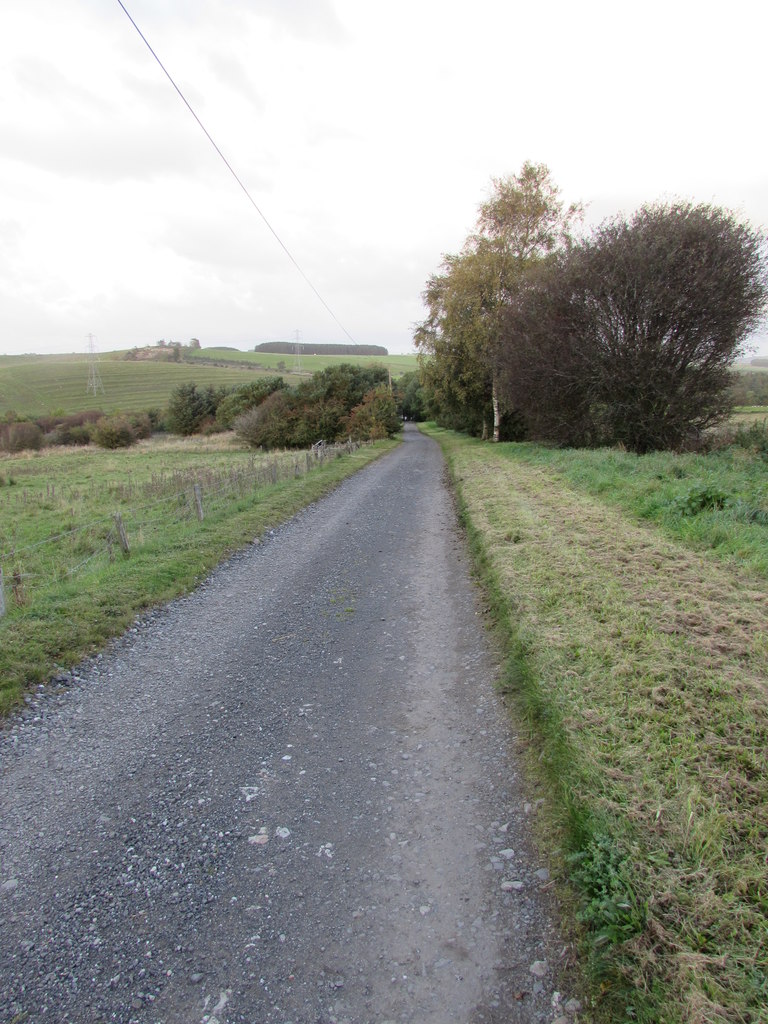
The pit wheel from Ellen's Shaft, saved by a few of the men at closure, was restored and set up in Fourstones in 2004 as a memorial to the mine and quarry workers of Newbrough and Fourstones. A former mine building was recorded in 2010, the line of the mineral tramway from the offices and plant to Frederick and Winter's shafts survives as a track, and the spoil dumps around the site still contain vein material of interest for study, though nothing can now be seen in situ.
Related mines
- Stonecroft and Greyside Mine — The two worked the same barium-bearing vein belt west of Hexham a mile apart, and the converted ancillary buildings and miners' cottages that survive from Stonecroft stand at Settlingstones.
Nearby mines
- Fourstones Colliery — 2.4 miles (3.9 km) NE
- Morallee Fell Mine — 2.4 miles (3.9 km) SW
- Stonecroft and Greyside Mine — 2.7 miles (4.4 km) N
- Langley Barony Mine — 2.9 miles (4.7 km) SW
- Stublick Colliery — 3.2 miles (5.2 km) SW
Straight-line distance, within 9 miles (15 km). Show on the map.
Recorded claims
Individual factual claims, each attached to the source(s) that support it below. Where sources disagree, both are kept.
- Between 1873 and closure in 1969 Settlingstones produced around 630,000 tons of witherite product, and was for long periods the world's sole commercial source. 1,2
- Lead returns survive only for 1849–1873, when 16,902 tons of lead concentrates were raised. 1
- Lead had been mined at Settlingstones since 1670 according to Brook; the GCR account says probably the 17th century. 1,2
- The last shift was worked on Friday 28 March 1969, the mine having drawn its output from old pillars since 1965 while searches for new veins failed. 2
- The witherite ore-shoots averaged 2.4 m in width, locally 9.1 m, and run-of-mine ore was commonly above 77 per cent witherite. 1
- In 1965 the mine employed some seventy men, most of them from Haydon Bridge. 2,3
Photographs & further reading
F. Brook's four-page account from visits in 1965, describing the shrinkage stoping, the haulage and the dressing plant, written as the mine closed.
View sourceThe Geological Conservation Review description of the vein, its witherite ore-shoots and minerals, with the published literature on the deposit.
View sourceSources
- (secondary) Settlingstones Mine, Northumberland — GeoGuide (Scottish Geology Trust)
- (secondary) Settlingstones – The World's Last Witherite Mine (F. Brook, NCMRS Memoirs 1971) — Northern Mine Research Society
- (secondary) Billy (102) was proud of mining heritage — Hexham Courant
- (primary) Abandoned mine plan catalogue entry: SETTLINGSTONES MINE — British Geological Survey
- (primary) Settlingstones (Witherite) — Durham Mining Museum
- (secondary) Settlingstones Mine, Newbrough, Northumberland — Mindat
Record created: 21 August 2026 · Last researched: 22 September 2026